Cell Biology
Unraveling the mystery of packaged genetic material
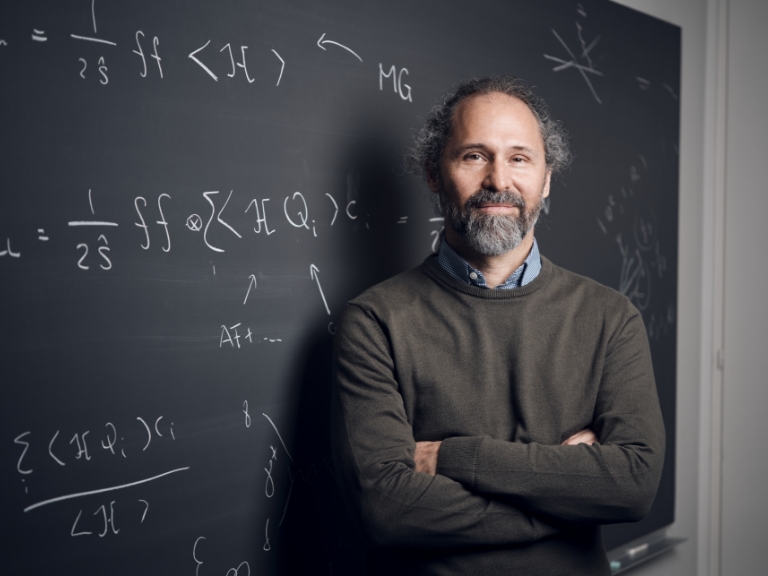
Cell biologist Peter Meister has been studying how our genome is organized within the cell nucleus for more than 20 years. A special roundworm is helping him unravel this mystery.

Peter Meister would like to live in Bern, but his wife and children have deep roots in the Basel region. That’s why the professor commutes by train from Baselland to the University of Bern four times a week. Still, he doesn’t consider himself a Basel native, but rather an “Alsatian.” That’s because he grew up in Saint-Louis, France, a village right next to the border with Basel. In his youth, he often roamed the marshlands near the Rhine with his binoculars, watching birds. When it came time to choose a field of study, he wavered between ecology and cell biology. Ultimately, he opted for the laboratory work that fascinated him, and thus chose cell and molecular biology.
After completing his studies, he worked as a doctoral candidate in Paris and as a postdoctoral fellow at the Friedrich Miescher Institute for Biomedical Research in Basel. From there, he moved to the University of Bern in 2011 – thanks to an assistant professorship funded by the Swiss National Science Foundation, he was able to choose his next place of work. “I chose Bern because the Department of Biology has an excellent reputation. And because I was given the opportunity to establish a new research area,” says Meister. He thus founded the “Cell Fate and Nuclear Organization Laboratory.” Today, he heads it as an associate professor, leading a research team of ten people.
Structure matters
Cell Fate and Nuclear Organization: What’s it all about? “Cell fate” refers to how a cell specializes during its development – for example, into a skin cell or a nerve cell. And nuclear organization concerns the cell nucleus, which contains, among other things, our genetic material. Meister’s research focuses primarily on this question: How is it possible for a DNA strand about two meters long to fit inside the cell nucleus when its diameter is only one-tenth the width of a hair? “It’s like having to stuff a rope stretching from Zurich to Geneva into a basketball,” Meister explains.
“Two meters of DNA in a cell nucleus: That's like trying to fit a rope stretching from Zurich to Geneva inside a basketball.”
Peter Meister
What seems unimaginable with a basketball works in every cell – provided the two-meter-long DNA is folded into loops, wound up, and thus compressed. This happens not only when new cells are formed, but constantly. “Our genetic material is very dynamic. The DNA is continuously being restructured,” says Meister. This is because the three-dimensional arrangement determines which gene segments lie next to one another. And this helps determine which genes are currently turned on or off – and thus which proteins are produced and what function a cell has – that is, whether it is, for example, a muscle cell, skin cell, or nerve cell. “The human genome has been fully sequenced for four years now – we know, so to speak, exactly how the rope is put together. But just as important is how the rope is wound. And not all questions have been answered yet,” says Meister.

The nematode as a model
Around the world, about a dozen research groups are working to clarify how the constant reorganization within the cell nucleus takes place. Peter Meister and his team are investigating these processes using a biological model organism – the nematode Caenorhabditis elegans, or C. elegans for short. In its natural environment, the worm – which is about one millimeter long – is found primarily in the soil, where it feeds on bacteria and helps break down organic matter. In biological research, the worm, with its nearly 1,000 cells, was the first animal to have its genome and nervous system fully sequenced. This analysis provided insights into how cells differentiate during development, when they divide, and how they undergo programmed cell death.
The worm is well-suited as a model organism for biology for various reasons, as Meister explains: “On the one hand, many fundamental biological processes in the worm follow the same principles as in humans. On the other hand, its genetic material can be specifically modified in the laboratory with relative ease. Another advantage is that the worm is transparent, allowing us to look directly into the cell nucleus under a microscope. And unlike with cell cultures, the worm allows us to observe not just a single cell type, but an entire organism composed of various cell types. This enables us to draw more realistic conclusions about how genetic changes affect the organism.”
Institute of Cell Biology
The Institute of Cell Biology at the University of Bern conducts cutting-edge research in molecular and cell biology to investigate a variety of topics that include host-pathogen interactions, systems biology, epigenetics, organelle biogenesis and developmental processes.
More information: https://www.izb.unibe.ch/index_eng.html
In Meister’s lab at the University of Bern, millions of these worms live in Petri dishes, where they feed on bacteria just as they do in the wild. Thanks to the worm, Meister and his team have been able to make important contributions to their field of research over the past years. For example, they were able to show that in the nematode, the Condensin I protein complex is primarily responsible for genome folding in the cell nucleus. This contrasts with mammals, where the Cohesin protein complex primarily performs this task. Based on this finding, it is now possible to conduct comparative studies to determine the principles governing genome folding.

Behavior matters too
This research is made possible primarily by new technological advancements. While microscopes are still used, high-tech devices for genome analysis play an even more significant role. In recent years, Meister has succeeded in establishing an outstanding infrastructure for his research by securing grants from various funding agencies. At the same time, he and his team are making a significant contribution to the development of new methods for elucidating 3D genomics – and making these methods available to researchers worldwide.
One of the distinctive features of his team is that it not only examines the structure of the nematode’s cell nucleus but also considers the entire organism. Together with researchers from the University of Fribourg, Meister is investigating how changes in genome folding affect the worms’ behavior, as he illustrates with a video. The video shows two Petri dishes. In the left dish, the worms move normally, purposefully searching for bacteria. In the right dish, due to a targeted genetic modification, the worms lack a protein complex that plays a role in genome folding. The result: The worms move slowly and sometimes just spin in circles – a behavioral abnormality. As it turns out, the worms’ nerve cells in particular have been affected by the altered genome folding and no longer function properly.
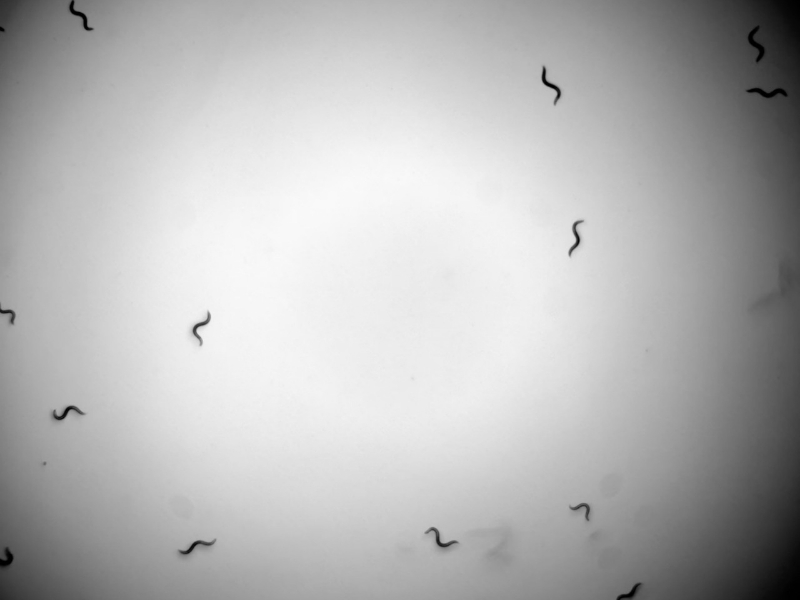
Nematodes without genetic modification move normally. © Peter Meister
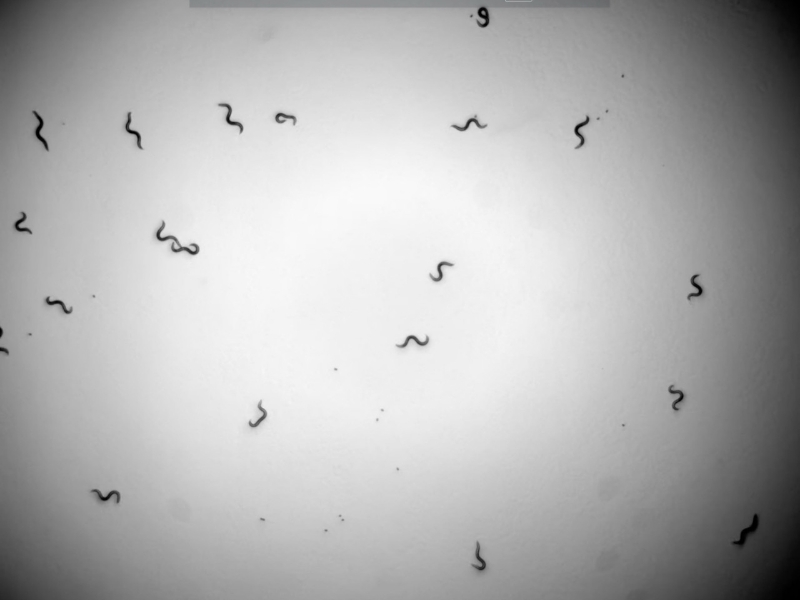
Genetically modified roundworm move more slowly and exhibit behavioral abnormalities. © Peter Meister
Something similar occurs in the rare human disease named Cornelia de Lange syndrome. This is caused by a mutation in the Cohesin protein complex. The consequences include malformations in numerous organs and impaired cognitive development. The extent to which the structure and folding of the genome also play a role in other diseases remains an open question. Meister, however, is cautious about the imminent medical application of his research: “We’re conducting open-ended basic research. The applications will emerge on their own once we know enough about genome folding.” The long-term goal, however, is to learn enough to predict, based on genome folding, which genes are activated in a specific DNA structure. This could be used, for example, to develop gene therapies or to produce artificial DNA in synthetic biology.
The future of education
While Meister is surrounded by worms in his day-to-day work, he still enjoys picking up his binoculars in his free time to watch birds. After a day’s work in Bern, he sometimes treats himself to a swim in the Aare. Water is his element, after all. The 49-year-old is also a scuba diving instructor and enjoys exploring the diverse fish life in the Red Sea during his vacations.
As a lecturer at the University of Bern, he received an award for excellence in teaching in 2023, specifically, for a two-day workshop that his lab holds annually in Kandersteg. The event isn’t just about research; there’s also time to discuss questions regarding the professional future of young researchers. Teaching is a central part of his work, says Meister. He doesn’t shy away from acknowledging that this raises big questions: “What added value will we, as university lecturers, offer in the future compared to artificial intelligence? Will we even be needed anymore?” He says it’s important to find answers to these questions. One thing is clear: there is still much to explore in the nematode’s cell nucleus. “We’re not that far from understanding the mechanisms of genome folding in detail. But clarifying what effects this has on living organisms will take a while longer,” says Meister. So he still has a few train rides ahead of him between Basel and Bern.
About the person
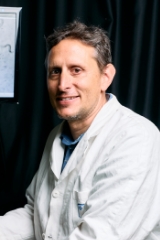
Peter Meister
is an associate professor of developmental biology and genetics at the Institute of Cell Biology at the University of Bern.
Subscribe to the uniAKTUELL newsletter

Discover stories about the research at the University of Bern and the people behind it.