Carl-Zeiss-Humboldt Research Award
Dancing with the elementary particles
Thomas Becher deals with "short distances and high energies": What happens when protons collide with each other at almost the speed of light? In search of answers, the physicist has moved from Bern to the USA – and back again.

Room number 121 at the Institute of Theoretical Physics has a large glass front facing south: it's a sunny day and the Alps are shining brightly. "After years in the flat plains of the Midwest in the USA, I enjoy the mountains even more than I used to," says Thomas Becher to the magnificent view from his office.
We sit down at the conference table. The conversation initially revolves around a movie that Becher has linked on his website. It is a video recording of a production for the "Nacht der Forschung" at the Unversity of Bern in 2017. The piece by dancer, choreographer and dance teacher Maja Brönnimann, in which "dance and physics interact at eye level", is called "Tanz der Elementarteilchen".
Experimental dance jumps
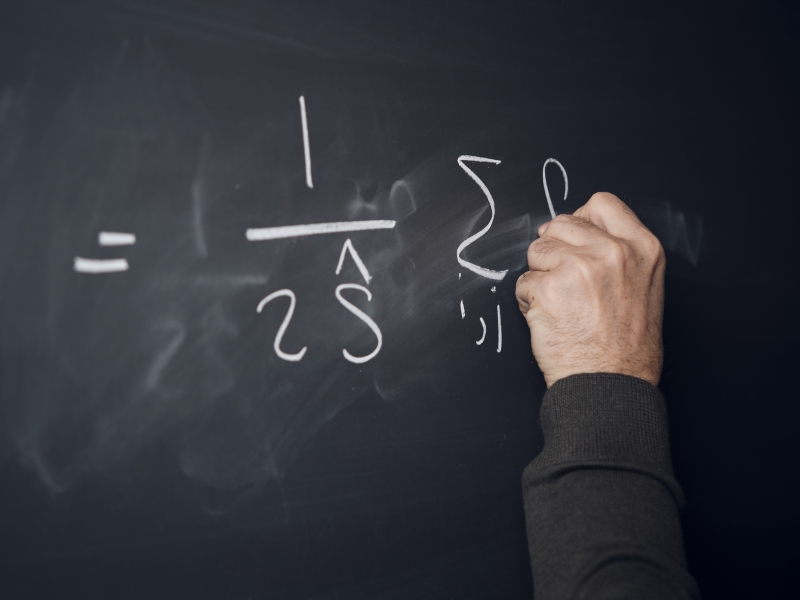
In the performance, particles such as electrons, photons, neutrinos and the Higgs boson are embodied by dancers. While they twirl around Thomas Becher to quirky music, the physicist speaks to the audience, picks up a piece of chalk and uses it to write formulas on the blackboard. When he wants to "add the other 30 diagrams and square the amplitude" to "calculate the probabilities", the dancers push him and the blackboard out. Hilarity spreads through the audience. It is probably also fed by the fact that they are unable to follow Becher's train of thought down to the last detail.
During the conversation in Becher's office, it doesn't take long for Becher to jump up from the meeting table as smoothly as a cat and start drawing on the blackboard: a circle with dots and spirals in it. The circle represents a proton, the dots and spirals stand for its components: Quarks and gluons. "The conservation of energy also applies to quantum mechanics," he reassures me. But then it immediately becomes abstract again: "Due to its charge, a proton has at least three quarks inside, but also gluons and quark-antiquark pairs," says Becher. "The quarks inside are a hundred times lighter than the proton. Almost all of its mass comes from the energy of the elementary particles, which is mainly contained in the interactions with the other elementary particles."
Preferring symbols to numbers
Becher is as wide awake as he is patient. He finds catchy images ("right after the Big Bang, the universe resembled a soup of quarks and gluons") to describe a world that defies common imagination and can probably only be grasped to some extent mathematically.
«I almost flunked out of high school and hated math. It only got better when symbols replaced the numbers.»
Thomas Becher
Becher came to physics because he had a "good physics teacher" at high school, whose "experimental demonstrations with lightning and wooden cows that fall over dead" left a lasting impression. Was Becher a good pupil? "No, I almost flunked out of high school," he says. "I hated math at the beginning." Taking the square root of two in writing was terrible, he says, and careless mistakes crept in all the time. "It only got better when symbols replaced the numbers," says Becher.
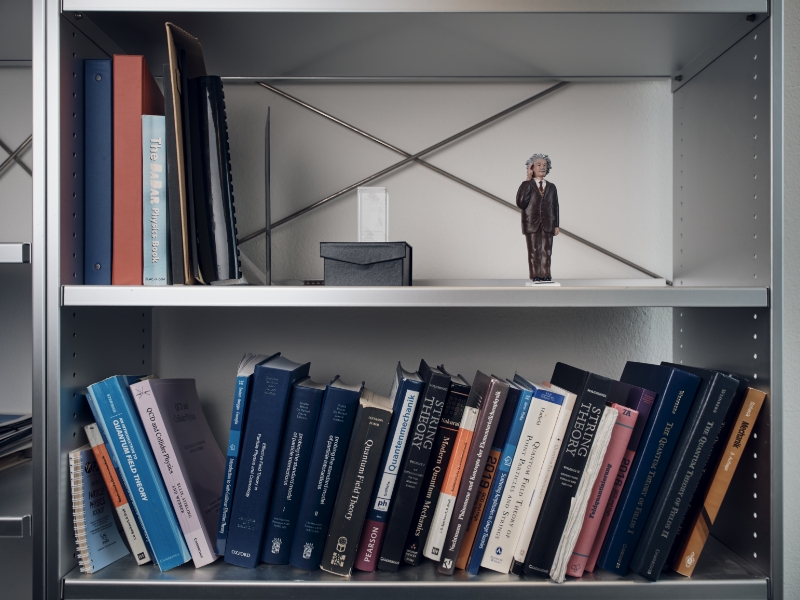
After completing his studies, he wrote his doctoral thesis on effective field theory at the University of Bern. His doctoral supervisor, Heinrich Leutwyler, is a leading researcher in this field and has done important pioneering work. Um, as a layperson, it is hard to understand what field theory exactly is, even after googling it.
But apart from that, why is the theory called "effective"? Becher pauses for a moment. A theory is effective, he says, when it detaches itself from the exact representation of reality – and is satisfied with an approximation in order to make physical processes calculable. "Newton's description of the falling apple is an effective theory: it neglects the effects of quantum mechanics, for example," says Becher.
Ever more powerful accelerators
After completing his doctorate, he successfully applied for a scholarship from the Swiss National Science Foundation. On Leutwyler's advice, he went to the USA, initially to Cornell University in New York State for a year and a half to study B mesons. These are particles made up of two quarks that decay within a picosecond – a trillionth of a second.
Becher then moved on from Cornell for a second postdoc at Stanford University in California, where a new "B factory" for the production of B mesons had started operation at SLAC, the Stanford Linear Accelerator Center. After another three years, the elementary particle physicist moved to Fermilab in Chicago, where the Tevatron is located: "The CERN of the USA," says Becher, "the pre-machine of the Large Hadron Collider in Geneva."
He was given his first permanent position at Fermilab. He would probably have stayed there if a colleague had not pointed out the vacant professorship at the University of Bern, says Becher. He sent in his application and was chosen, so in 2009 he came to Bern with his wife – who was delighted to be back – and their son, who was born in the USA.
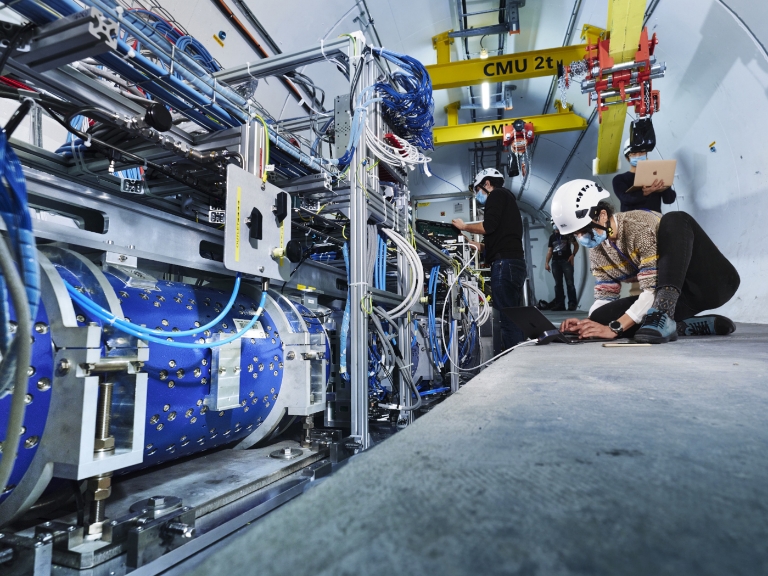
Here he built up a "fantastic research group with excellent people". Together, they bend over the data from the Large Hadron Collider: at CERN, protons are accelerated in a 27-kilometre-long circular tunnel under Geneva with ten times more energy than at the Tevatron - to "99 and 6 times the number 9 after the decimal point percent of the speed of light", says Becher.
Then they slam into each other "like two billiard balls". "The same experiment has been carried out at the LHC for years," says Becher. "With the billiard balls, the result would always be the same, but with the protons, the result is different every time. This is because decay is an ultra-relativistic and quantum mechanical phenomenon." As theoretical physicists, Becher and his team try to calculate the probabilities for the different decay scenarios.
This is easier said than done, because the components of the protons not only drift away at different speeds in all directions after the collision, but also continue to decay on their way and sometimes recombine. The measurement data is therefore only an indirect indication of what actually happens at the moment of collision.
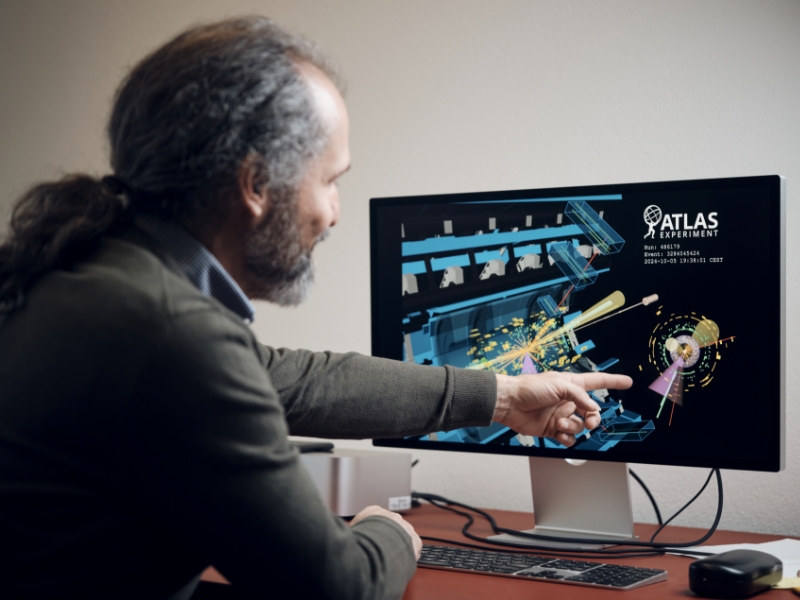
But why does Becher want to know this so precisely? "Out of curiosity," he answers. There is no application of his research in sight, but that could still change: "Today, particle accelerators play an important role in cancer medicine and materials research that we physicists had not foreseen."
Becher is delighted to receive the Carl-Zeiss-Humboldt Research Award from the Alexander von Humboldt Foundation at the end of December 2025: "I've never won a ski race or anything else, this is my first award," he says. The award, which is endowed with 100,000 euros, is also linked to a research stay in Germany.
There he wants to continue working on the "physics of short distances and high energy" - and (as the Alexander von Humboldt Foundation states in its press release) perhaps even gain insights that point towardsnew physics beyond the standard model of elementary particles.
About the person
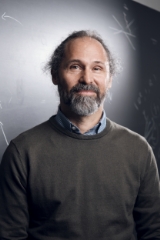
Thomas Becher is a professor at the Institute for Theoretical Physics and the Albert Einstein Center for Fundamental Physics (AEC) at the University of Bern.
The Carl-Zeiss-Humboldt Research Award
Once a year, the Alexander von Humboldt Foundation in Germany presents the Carl-Zeiss-Humboldt Research Award, sponsored by the Carl Zeiss Stiftung, to an internationally recognized scientific personality from abroad. The award recognizes the prizewinner's scientific life's work to date, while at the same time highlighting their special potential. The prize is endowed with 100,000 euros. The prizewinners are also invited to carry out research projects of their own choice in Germany in cooperation with specialist colleagues. The period of approximately six months to a whole year can be divided up. The prize is awarded to researchers in the fields of mathematics, computer science, natural sciences and technology (STEM) if the aim is to collaborate with colleagues in Baden-Württemberg, Rhineland-Palatinate or Thuringia.
Lecture: Physik am Freitag
Thomas Becher will present his research in a public lecture on April 24, 2026 as part of the Physik am Freitag series.
Subscribe to the uniAKTUELL newsletter
Discover stories about the research at the University of Bern and the people behind it.