Profile of a climate scientist
The Cloud Chaser
Franziska Aemisegger, a climate scientist from Bern, spent hours flying in a propeller plane beneath the clouds over the North Atlantic. In this profile, she explains what she hopes to discover and why she owes her research career to a famous French author.
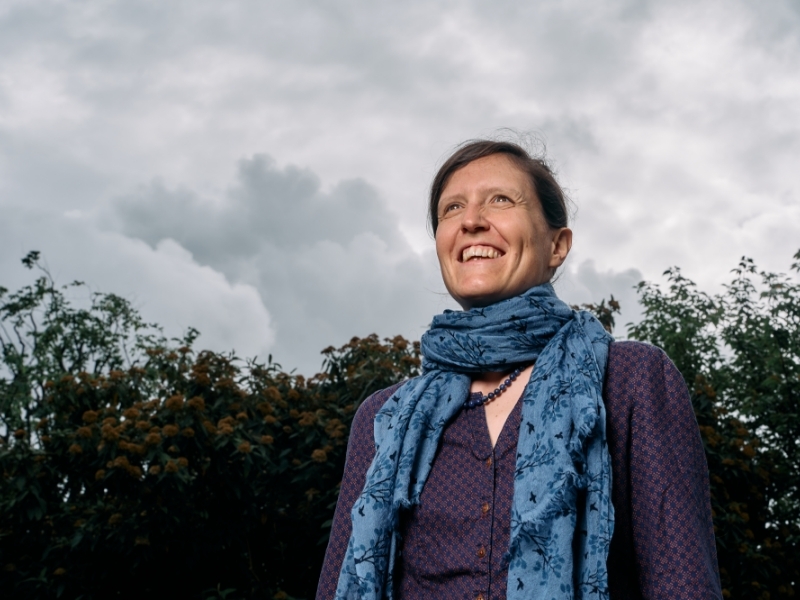
Are you afraid of flying? Then Franziska Aemisegger’s job wouldn’t be for you: The Bern-based climate researcher spends much of February as a flight operator in a small twin-engine Cessna belonging to the Technical University of Braunschweig, Germany. As part of the international “NAWDIC” measurement campaign (see info box), she takes to the skies almost daily.
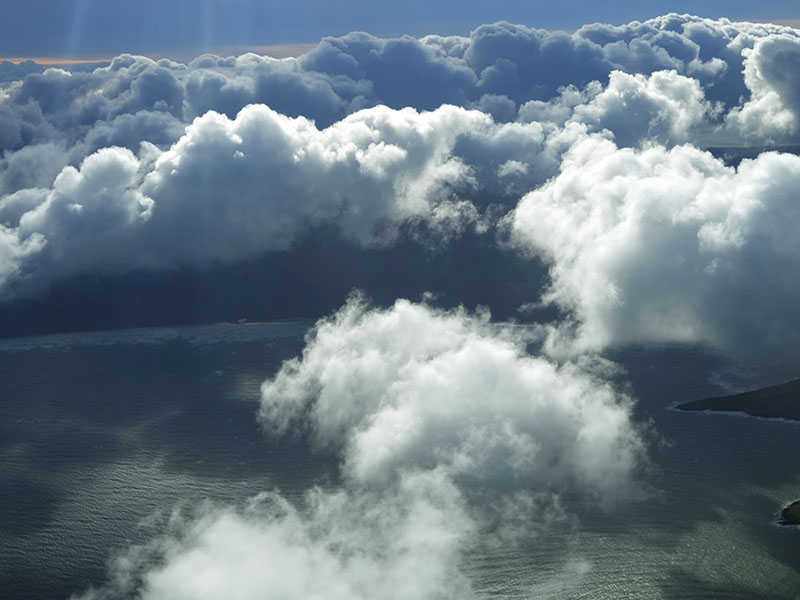
Each of the 18 flights lasts about three hours. During the measurement flights, the plane circles as close as possible to the underside of the clouds. “That’s where the clouds are fed with moist air, which drives precipitation formation,” explains Aemisegger. “This area beneath the clouds is invisible to weather satellites. However, the processes taking place there are very important for weather models and forecasts.” The researcher hopes NAWDIC will improve understanding of how winter storms form over the North Atlantic. When and where clouds release rain plays a key role in this.
A laser spectrometer as a seatmate
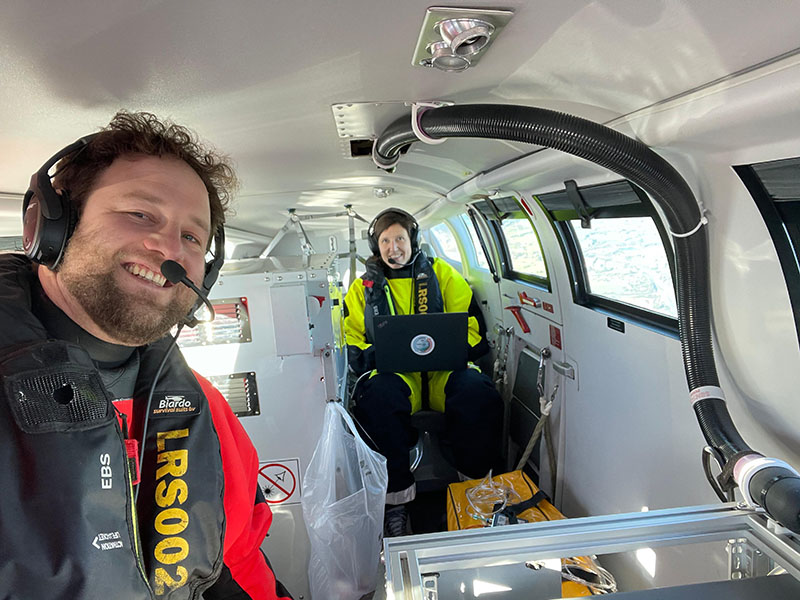
Aemisegger shares the already limited space in Cessna’s passenger cabin with her team, a laser spectrometer, and colleagues from the Karlsruhe Institute of Technology and their equipment. The laser spectrometer—a custom-built device designed specifically for in-flight measurements—draws atmospheric moisture through a tube and measures the concentrations of the water isotopes it contains.
The researcher is particularly interested in the isotope deuterium, a “heavy” form of hydrogen: Unlike “ordinary” hydrogen, the nucleus of deuterium contains a neutron in addition to a proton. Heavy water molecules condense more readily and are therefore removed from the air more quickly during precipitation. According to Aemisegger, the deuterium content is thus an indicator of how much precipitation clouds can produce.
NAWDIC
The flights with the laser spectrometer were part of the international measurement campaign NAWDIC (North Atlantic Waveguide, Dry Intrusion, and Downstream Impact Campaign). The goal of the project is to develop a better understanding of how winter storms form over the North Atlantic. Based on this, more accurate weather forecasts are to be developed in the future, and changes in storm intensity and frequency in the wake of global warming are to be recorded. NAWDIC took place from early January to late March under the leadership of the Karlsruhe Institute of Technology (KIT) in Brittany in northern France and Ireland. The project involved 51 institutions from 13 different countries. Switzerland was represented by three institutions: ETH Zurich, MeteoSwiss, and the University of Bern.
Exhausted – but happy
Aemisegger has since returned safely to the University of Bern, along with her team and five master’s students who accompanied her to Brittany. “I was pretty exhausted” after the campaign, the researcher says in retrospect. Despite the hardships, her eyes light up as she recounts the experience. “I spent three years preparing for NAWDIC. Witnessing live how the laser spectrometer recorded these long-awaited measurements was indescribable!”
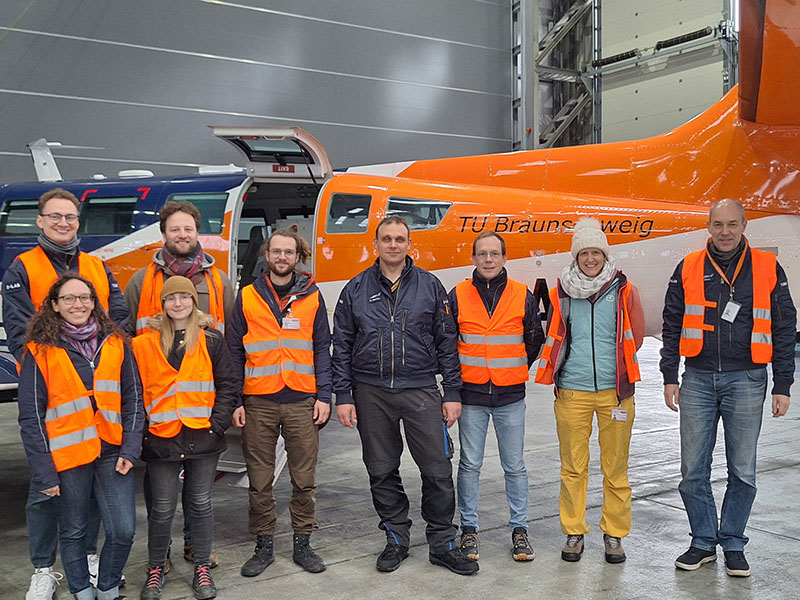
Aemisegger and her team have now begun analyzing the data together with researchers from ETH Zurich. To do this, the researchers are drawing not only on the laser spectrometer’s measurements but also on rain samples that the master’s students collected using measuring containers. These measurements will be combined with satellite data and high-resolution weather models.
As exhausting as the NAWDIC campaign was, the real work has only just begun, as Aemisegger emphasizes. Analyzing all the data is likely to take several years. This does nothing to dampen Aemisegger’s enthusiasm. She sees the core of her task in systematically replacing uncertainties with clarity: “As a scientist, I am in a privileged position. I help create a new understanding of processes taking place in the atmosphere. I’m generating knowledge.”
The diplomat
Franziska Aemisegger was born in Zurich in 1985 and was the eldest of three children. When she was four years old, the family moved to Lausanne. There were no integration courses for children back then. In kindergarten and later at school, only she spoke Swiss German. Aemisegger realized early on that she had to learn French quickly if she didn’t want to lose touch with the other children. The books by Antoine Saint-Exupéry, which Aemisegger devoured as a child, proved invaluable. “The Little Prince” brought the French author worldwide fame in the 1930s. But his lifelong passion was aviation. His attempts to set distance records often ended in crash landings—and provided material for new novels and short stories.
About the person
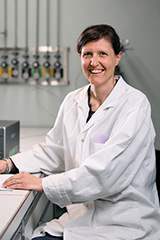
Franziska Aemisegger is a climate researcher who studies the dynamics of the atmospheric water cycle. Her scientific work is driven by a fascination with the processes a water molecule undergoes—from evaporation in the ocean, through its transport by weather systems, to cloud formation and infiltration into the ground as part of a raindrop. Aemisegger earned her Ph.D. in 2013 at the Institute for Atmospheric and Climate Science at ETH Zurich, where she conducted research until 2023. In 2024, she founded the Cloud Dynamics research group at the University of Bern. The group is based at the Department of Geography and the Oeschger Centre for Climate Research (OCCR).
“Saint-Exupéry was driven by a deep thirst for discovery that led him to seek out the unknown,” says Aemisegger. This urge, coupled with the author’s humanistic outlook, inspired and impressed her even as a child. “Without him, I might never have gone into research,” she says. “In his books, he describes how, although he felt small up in the clouds, he felt safe because of his camaraderie with other pilots. I could relate to that feeling very well during my flights for NAWDIC.”
Her background proved to be a major advantage for the researcher during the measurement campaign: Her status as a bilingual “neutral Swiss” meant she often served as a mediator between the various teams from Germany and France. Science as a bridge-builder—that is Aemisegger’s ideal. Science, she believes, brings together people from different disciplines, countries, and cultures: “Without interdisciplinary and international cooperation, a project as large as NAWDIC would not have worked.” Especially in today’s conflict-ridden times, it is important to her to highlight this unifying element.
Oeschger Centre for Climate Research
The Oeschger Centre for Climate Change Research (OCCR) is one of the strategic centres of the University of Bern. It brings together researchers from 14 institutes and four faculties. The OCCR conducts interdisciplinary research at the cutting edge of climate science. The Oeschger Centre was founded in 2007 and bears the name of Hans Oeschger (1927-1998), a pioneer of modern climate research.
Subscribe to the uniAKTUELL newsletter

Discover stories about the research at the University of Bern and the people behind it.