On identity and exclusion
Language as an instrument of power
Language is never neutral; it is always political. It shapes national identity, fosters a sense of belonging and establishes boundaries. In this article, sociolinguist Erez Levon uses examples from Israel and Switzerland to explain these dynamics.
A few years ago, I was a member of an appointment committee at the University of Bern. During the final stage of the selection process, candidates held discussions with students to exchange ideas about teaching. The application process is usually conducted in standard German. However, one candidate conducted his interview with the students in Swiss German, presumably to create a more informal atmosphere. And indeed, some of the students did interpret it that way. In their report to the committee, approximately half of the students praised this candidate, explicitly highlighting his use of dialect. The other half, however, felt that it was an disingenuous attempt to create an artificial sense of closeness.
This brief anecdote encapsulates the essence of my research interests: language is never neutral. It is always linked to deeply political questions: which language (or style of language) is considered appropriate in a given situation? How did the rules of “correct” language use come about? What are the consequences for those who defy these social expectations?
Building a nation through language
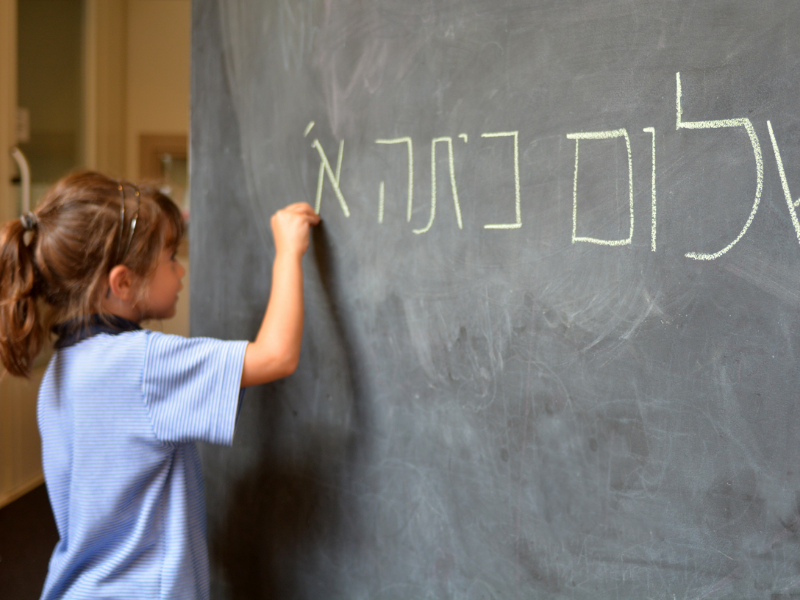
Much of my research has centred around language policy in Israel and the role of Hebrew in establishing the Israeli state. At the end of the 19th century, Jewish intellectuals from Central and Eastern Europe were searching for answers to the “Jewish question”, i.e. the persecution and marginalisation of Jews in Europe. These early Zionists viewed Jews as a diaspora of “people of the air” (“Luftmenschen” in the original German) whose persecution was partly the result of their separation from an imagined, mythical homeland. They therefore called for the creation of a “new Judaism“ characterised by “youth, independence, and physical strength”. This created an ideological divide between Jews in Palestine (later Israel) and those in the European diaspora.
For the early Zionist leaders, this opposition was evident in Hebrew losing its status as the main language to Yiddish, Ladino and other European languages. Reviving and promoting the status of Hebrew therefore became a central goal of Zionist activism. Although Hebrew had continued to exist in European Jewish communities as a liturgical language and for communication across national borders, everyday communication was done in other languages. However, Zionist scholars succeeded in elevating Hebrew from a marginal, secondary language to a modern language spoken by millions.
“Language was one of the central means by which a collective sense of identity was created.”
- Erez Levon
This transformation was successful because Hebrew was an important symbol of Zionism's cultural and territorial ambitions, marking a decisive break from the “weakness“ of Jewish life in Europe and the creation of a newly gained strength of the Jewish people in Palestine. To emphasise this change, an older variant of Biblical Hebrew was chosen for popular use, which differed significantly in grammar and pronunciation from the Rabbinic Hebrew that had been used for centuries in European Jewish liturgy. This pushed 2,000 years of European Jewish history into the background, instead promoting a narrative of continuity between Biblical times and the modern State of Israel. Language was thus one of the central means by which a collective sense of Israeli nationalism was created.
Swiss German as a distinction from the German of the German Empire
The case of Hebrew in Israel is a clear example of how a language can be used to build a nation. Another interesting case is Swiss German. Although Swiss German dialects have existed since the early days of the Swiss Confederation, they were considered less prestigious right up until the late 19th century and were avoided in formal contexts, in which “Reichsdeutsch”. i.e. the German spoken in the German Empire, was used instead.
“The elevation of the status of Swiss German played an important role in the development of Swiss nationalism.”
- Erez Levon
It was only after the First World War, and particularly with the rise of National Socialism in Germany in the 1930s, that Swiss intellectuals began to advocate for the elevation of the status of Swiss German and to distinguish it clearly from German spoken in Germany. Emil Baer and his Swiss German Language Movement called for Reichsdeutsch German to be replaced with an independent standard Swiss German. Although this goal was not achieved, Baer nevertheless laid the foundation for today's dialect landscape. Similar to the role of Hebrew in the development of modern Israeli nationalism, the promotion of Swiss German also played an important role in the development of modern Swiss nationalism.
Ethnic discrimination based on language
However, such nationalism is never stable. It must constantly be reaffirmed and reconstructed. This is another area in which language plays an important role. Let us come back to the example of Israel: the establishment of the state in the middle of the 20th century was driven almost exclusively by Jews of Eastern European origin, known in Israel as Ashkenazim. These Ashkenazi pioneers wanted to create a “new Jew“ who was different from European Jews, as well as to distinguish themselves clearly from Palestinians and people from other neighbouring Arab countries. In this sense, “Israeli“ was never intended to be purely Middle Eastern; connections to Europe and the rest of the world were deliberately strengthened to set them apart from their neighbours.
About the person
Prof. Dr. Erez Levon
is a professor of sociolinguistics and Director of the Centre for the Study of Language and Society (CSLS) at the University of Bern. His research focuses on the social significance of language. In particular, he is interested in how language variation signals group affiliation, and in the relationship between language and social inequality.
The distinction became more difficult with the independence of the European colonies in North Africa and the Middle East in the 1950s, as the majority of members of the Jewish communities from these countries emigrated to Israel. By 1961, 44 per cent of the Israeli population belonged to this group, known as the Mizrahim. By the early 1970s, the Mizrahi population had overtaken the Ashkenazi population in size. Despite this demographic shift, the political, cultural and economic elite remained Ashkenazi. Israeli-American cultural scholar Ella Shohat speaks of systematic discrimination against Mizrahi Jews by a Zionism that distributed its resources unequally, favouring “European” Jews and disadvantaging “Oriental” Jews.
“Linguistic discrimination has served as a cover for ethnic exclusion.”
- Erez Levon
This discrimination also manifested itself in language. Arabic, the mother tongue of most Mizrahim, was not only suppressed within Jewish-Israeli society, but Mizrahi variants of Hebrew were also heavily stigmatised and considered an indication of a lack of intelligence or education. Linguistic discrimination thus served as a cover for ethnic exclusion, allowing Ashkenazi society to define what constituted “true Israeli-ness”.
Regaining identity
This historical overview helps us to understand the current situation of Hebrew in Israel. Speaking Israeli Hebrew is still an important aspect of Israeli identity. Mizrahi variants (and communities) continue to experience discrimination and marginalisation. However, recent research has shown that younger Mizrahim born and raised in Israel are beginning to reclaim and express their Mizrahi heritage through language.
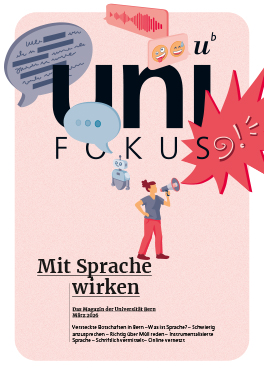
Magazine uniFOKUS
Language
This article first appeared in uniFOKUS, the University of Bern print magazine. Four times a year, uniFOKUS focuses on one specialist area from different points of view. Current focus topic: Language.
For example, Israeli sociolinguist Roey Gafter has shown that some young Mizrahim deliberately emphasise the differences in pronunciation between the standard (Ashkenazi) variant and their own audibly clearly distinguishable variant of Mizrahi Hebrew when speaking in formal contexts. According to Gafter, they do this to embody a “Mizrahi self” in their interactions, demonstrating that Mizrahim are a powerful force in Israeli society.
While language is a powerful tool for creating community, it can also be used to exclude others. While it can reinforce patterns of social inequality, it can also be used to combat them. For this reason, sociolinguistics offers a valuable perspective on both language and society. This is the special focus of research and teaching at the University of Bern's Center for the Study of Language and Society.
Subscribe to the uniAKTUELL newsletter

Discover stories about the research at the University of Bern and the people behind it.