The influence of WhatsApp and other messaging apps
“Communication is more flexible in the digital world”
Digital technologies have opened up new possibilities that also influence how we use language. Sociolinguist Florian Busch explains how smartphones are changing our everyday communication and giving rise to new forms of language.
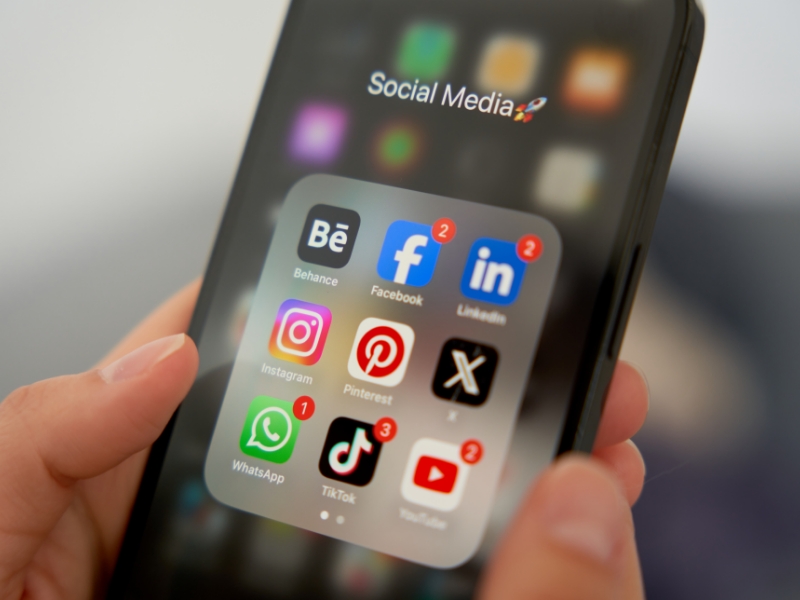
Smartphones have become indispensable in our everyday lives. How have these devices changed the way we communicate with one another?
Florian Busch: For us in language research, the most interesting aspect is the flexibilization that comes with smartphones. On the one hand, there is the spatial flexibilization: we are now integrated into much larger communicative networks than in the past. In addition to family and friends, there are also people we may have been in contact with ten years ago, whom we now carry around with us in our pockets, figuratively speaking. We can write to them while we are waiting for the bus or sitting on the toilet.
Why is this interesting from a linguistic perspective?
Because this spatial flexibilization always goes hand in hand with a specific manner of using language. I speak differently to my mother than I do to my colleagues at work. And I might even write in a different language to someone I met 15 years ago during a semester abroad. In this way, the mobile device brings linguistic diversity into everyday life.
We are currently also looking at the timing of smartphone communication in everyday life. In this study, participants record their smartphone screens, including all communication events, for 14 days. We are investigating the temporal rhythms in which different language styles and languages come into use in everyday life, and are also distinguishing between dialect and standard German. Smartphones are typically used during short breaks, for example on a train journey or during a coffee break, usually within a “checking cycle”.
«This messenger service is the heart of the smartphone.»
- Florian Busch
What exactly is a “checking cycle”?
You do a quick round of checking various apps to see what’s new. And at some point, you end up on WhatsApp. This messenger service is, so to speak, the heart of the smartphone. This is astonishing because it contradicts the notion that everything in the digital world is so fast-moving. WhatsApp, by contrast to this notion, has been number one in popularity and usage statistics for around 15 years.
How do we use language on WhatsApp?
On WhatsApp, we contact a wide variety of people in rapid succession, switching between styles and languages in an instant. This sometimes happens within just one minute. Even if two different chats are taking place in German, the language style used changes depending on the addressee. Of course, the style also depends on what we are doing by chatting: are we arguing, planning dinner, flirting? This code-switching, that is, switching between languages and language styles, is particularly interesting for us linguists.
Another topic of great interest are details such as the use of punctuation: do we dispense with full stops and commas altogether, or do we use only selected punctuation? What does it mean when commas and full stops suddenly appear in a WhatsApp chat that is otherwise characterised by a very informal style and hardly any punctuation? Using linguistic methods, we can explain how we use such stylistic nuances to organise and manage our social lives through language.
What role does dialect play in German‑speaking Switzerland?
Our data shows that in Switzerland, written dialect is now the norm in digital media such as WhatsApp, even in institutional contexts, such as, for example, messages to the class teacher. Unlike in Germany, using dialect in written language is therefore no longer automatically suitable for signalling informality in German‑speaking Switzerland.
However, as there is no standardised orthography for writing in dialect, we have the opportunity to develop creative solutions. This allows us, even within written dialect, to indicate whether we are communicating in a rather informal or a more formal context.
About the person

Florian Busch
is Assistant Professor of Discourse and Interactional Linguistics at the Institute of Germanic Languages and Literatures at the University of Bern. In the current Swiss National Science Foundation (SNSF) project “Texting in Time”, he is researching the processes of everyday smartphone communication in German-speaking Switzerland and Germany.
Like what, for example?
One way is to follow the spelling patterns of standard German, for example in more formal messages to your manager or a teacher. Another way, which we observed in WhatsApp data, is interestingly the opposite: people try to write dialect in formal messages almost phonetically. Formality is then indicated by a particular precision.
We also see that these stylistic shifts across several chats take place almost simultaneously. The information being sent may be the same, but the dialect used, and thus the social relationships displayed, differs between the chats.
Of course, the alternation between dialect and standard German remains important for defining communicative situations. We know this from face‑to‑face communication: when a student arrives for an oral exam, for example, you might first ask in dialect how she is doing and whether she has had a good journey getting there. As soon as the exam begins, though, you switch to High German to signal that it is now time to get serious.
Are new forms of language emerging as a result of digital communication?
Since the invention of writing, there has been a clear distinction between spoken and written language. The latter has traditionally been used to record information for the posterity, while spoken language is more fleeting and situational. In verbal conversation, we “pass the ball” back and forth, whereas in written communication it is up to me alone to pack as much information as possible into the text.
Digital communication is proverbially reshuffling the cards here. Writing is suddenly used to do what we have long done in spoken interaction, namely to create meaning together. We refer to this as “typed conversation”. However, the communicative resources are different: in spoken conversation, we use facial expressions, gestures and our voice to contextualise what we are saying. In typed conversation, this physical context is missing.
“The typed conversation lacks physical context.”
- Florian Busch
That's what emojis are for.
Yes, emojis show what we mean with what we write. Or we use an emoji to express how we feel about a statement the other person has sent us. Emojis have taken on a similar function in written language to facial expressions and gestures in spoken language. However, younger generations are using them less and less; the yellow symbols are now more characteristic of the boomer generation. There are also more subtle means of contextualisation, such as an exclamation mark at the end of a message, capital letters or the speed with which we reply. This is meta‑information that we attach to the message, sometimes unconsciously, and that is then interpreted.
It seems to me that young people are generally writing less and are sending voice messages instead.
Digital technologies have enormously increased the importance of written language in informal everyday life. Even private matters, such as romantic relationships or the organisation of family matters, are now increasingly handled in writing. Linguists also speak of a new everyday written language that differs from the written language we use for articles, academic texts or novels.
Recently, however, the question has arisen as to whether orality is once again becoming more important as a result of changes in the media. Voice messages are an indicator for us that friends are increasingly using spoken means to maintain their relationships, just as phone calls were central 20 years ago. The difference is that this spoken communication is now different in form: voice messages tend to be monologic texts and do not allow for an immediate response.
Magazine uniFOKUS

Language
This article first appeared in uniFOKUS, the University of Bern print magazine. Four times a year, uniFOKUS focuses on one specialist area from different points of view. Current focus topic: Language.
Let’s move on to the current megatrend, artificial intelligence (AI): what influence does AI have on language?
Because we now write almost everything digitally, texts are increasingly becoming hybrid products. We type, but the software is also writing in the background. This begins with autocorrection, word suggestions and automatic completions, and extends to long passages generated by artificial intelligence.
As AI gives greater weight to certain linguistic structures, these constructions gradually find their way into our everyday communication. And this is, in turn, increasingly being reflected upon by language users. For example, we now know that ChatGPT uses a lot of dashes. The dash is suddenly no longer an innocent punctuation mark, but becomes an indicator of ChatGPT‑generated texts. As a result, people who previously liked using dashes in their own style are now starting to wonder whether they should avoid them so as not to arouse suspicion that a text might have been generated by AI.
You spoke about the production of language. How is AI changing the reception of language?
Many people still have only a limited understanding of how AI generates language. School pupils and university students, for example, are often relatively trusting of ChatGPT’s answers because they do not understand how they are constructed: not by understanding text, but a statistical process that calculates the probability of which words follow one another. And this process is quite prone to producing false content.
However, recognising AI‑generated false information as such requires language and media skills. Educational institutions must actively teach how to critically assess and classify digital communication. Otherwise, we risk a growing divide between the digitally literate and the digitally illiterate.
“Social relationships tend to be strengthened by digital technologies.”
- Florian Busch
Will digital technologies sooner or later lead to an impoverishment of our language?
On the contrary: the use of language is becoming more flexible as a result of digital communication. There is not just one dialect and one standard language in everyday digital life. Instead, we are constantly coming into contact with different varieties of our language. This contact enriches our communicative toolbox.
A sudden proliferation of written language in informal social situations and a consequent rise in innovative written styles does not mean that standard writing, with its fixed spelling and punctuation rules, will suffer. In England, studies have shown that increased written digital communication with friends correlates with better spelling performance at school. This can be explained by the more routine engagement with writing. People who play around with the writing system learn how sounds and letters relate to one another. And anyone who consciously wants to deviate from orthographic norms, for example, to create an individual group style, must first actually know those norms. Such dynamics can actually strengthen linguistic awareness.
We talk on the phone less than we used to; we write emails or chat. Are we forgetting how to talk to each other?
We won’t forget how to talk to each other in person. Spoken interaction still plays too big a role in everyday life. However, the online and offline worlds can hardly be separated from one another anymore. We plan personal conversations, such as this interview, online. Digital media shape everyday social life everywhere and at all times.
However, this does not mean that we become lonely and only send and receive short messages. If anything, digital technologies tend to strengthen social relationships, as we can stay in touch with family and friends over long distances and at flexible times. Digital language use therefore brings considerable individual and social benefits.
Subscribe to the uniAKTUELL newsletter

Discover stories about the research at the University of Bern and the people behind it.