
In Focus
Is Luxury Superfluous or Necessary?
How has our understanding of luxury changed over the course of history, and how do we view it today? Can the desire for luxury be reconciled with efforts toward more sustainability?
“There are still good things,” proclaims the slogan of the German retailer Manufactum. But these “good things” are also expensive — and therefore exclusive. A pair of trainers can easily cost more than 400 Swiss francs. “More than 200 production steps are required to ensure the durability and comfort of the shoes: a padded collar, reinforced toe and heel areas, and a cushioned insole,” the product description explains. Perhaps it is not even a disadvantage that hardly anyone knows exactly what a “padded collar” is. Exclusivity in language, too, inspires trust.
What was once standard craftsmanship has now become a clear sign of luxury; after all, handmade products are something one must be able to afford. That applies to classic luxury brands in general — or does it? The matter has long since become more complicated. Trainers from the trendy label Balenciaga can easily exceed 1,000 francs in price, yet few would expect much craftsmanship there. And just like that, we are plunged into the confusion surrounding luxury: why do some people see an oddly shaped plastic shoe as the ultimate luxury item, while others value a lovingly handcrafted, somewhat old-fashioned leather shoe?
Luxury Is Not Necessarily Luxury
Sociologist Benita Combet puts it this way: “Luxury is a constructed category” — not something objectively measurable. Luxury is less an inherent quality than a social attribution. Or, as she says: “It is always about comparison.” What counts as luxury therefore depends on time and place. “A person in Congo would consider something different as luxury than we would here; antiquity had a different understanding of luxury than we do today.”
And one does not even have to go back as far as antiquity. Over roughly the last hundred years, perceptions have continuously shifted, with more and more luxuries becoming everyday necessities. A cultural history of luxury published in 1994 still described a “luxury home” as having features such as “double glazing, central heating and remote-controlled garage doors”. Central heating as luxury?
«Luxury is about setting yourself apart; it is about power.»
Benita Combet
For historian Christof Dejung, luxury is in many ways an explicitly modern phenomenon. Luxurious lifestyles certainly existed in antiquity and the Middle Ages, but in his view, they represented the “everyday practices of an elite”. Ordinary people would never even have imagined consuming luxury goods. For Dejung, luxury is closely tied to the rise of consumer society, which in turn inevitably became a “luxury society”. The question of luxury is therefore “one of the key questions of economic history: what exactly happened between the sixteenth and nineteenth centuries?”
About the Person

Benita Combet
is Assistant Professor (tenure track) of Sociology at the University of Bern. As part of a Swiss National Science Foundation Starting Grant project, she researches inequalities in promotion processes and other issues related to social inequality.
What does luxury mean to you?
“A relaxed weekend hiking trip with friends.”
The End of Self-Sufficiency
Dejung describes the process roughly like this: inspired by aristocrats and wealthy bourgeois families, more and more people began to desire extravagant lifestyles and the luxury goods associated with them. This longing, almost as a side effect, triggered structural change. To afford expensive textiles and colonial goods, people had to work more; self-sufficiency came to an end. In return, markets emerged that could provide ever larger quantities of such products.
Textiles illustrate another structural transformation. Cotton fabrics imported from South Asia remained symbols of exclusivity well into the eighteenth century. “The only way to compete with Indian hand spinners was mechanical production, which paved the way for the mass production of European textiles,” Dejung explains, highlighting this surprising aspect of industrialisation.
Combet points to similarly revealing side notes of social history: washing machines, too, were once an explicit luxury. When that changed, it was “extremely relevant” for women.
Being Different
But these are side notes. For Combet, luxury goods are above all social means of communication. “Luxury is about setting yourself apart; it is about power.” Philosopher Marcel Twele offers a definition that captures this aspect:
“Luxury is the possession of a good, or something regarded as good (by the person living in luxury), that clearly exceeds the satisfaction of basic needs and simultaneously marks inequality of goods between people or groups.”
In other words: luxury is not truly necessary; it communicates — sometimes discreetly, sometimes ostentatiously — that one can afford it. Adjusting the “showiness dial” is always part of the game.
Combet names the brand Louis Vuitton as an example: once the very epitome of luxury, the brand is now chosen “only by the ‘nouveau riche’”. Yet that does not mean luxury has become diluted. Rather, a kind of communicative arms race is taking place, moving toward ever more exclusive signals of what constitutes luxury. The latest must-have may then be the “ultra-exclusive Birkin bag”, understated in appearance but instantly recognizable within the right circles, while “people like us cannot even recognise it for the symbol that it is”. In this context, people sometimes speak of “loud” versus “quiet” luxury.
The fascinating question becomes: would a jumper made from extraordinarily exclusive yarn — luxurious to the touch but visually unremarkable — still count as a luxury item? Or can luxury never be entirely silent?
«Luxury is not inherently — that is, conceptually — bad.»
Marcel Twele
As luxury became “louder,” it increasingly attracted regulation — whether through moral appeals from religious figures or institutions or in the form of legal restrictions. Sumptuary laws are now considered one of the great ironies of economic history because they often became just as baroque as the fashions they were meant to suppress.
Historian Lorraine Daston discusses these “sumptuary regulations” extensively in her book Rules: A Short History of What We Live By. She describes the bizarre developments in this field in medieval and early modern Europe. The story almost resembles a “Tom and Jerry” relationship: prohibitions on extravagant fashions often drove the luxury industry toward ever newer and more exclusive variations, while lawmakers hopelessly lagged behind.
Magazine uniFOKUS
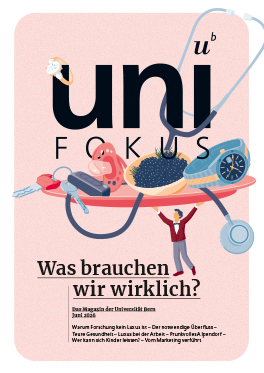
What do we really need?
This article first appeared in uniFOKUS, the University of Bern print magazine. Four times a year, uniFOKUS focuses on one specialist area from different points of view. Current focus topic: Luxury
Obscene or Innocent?
Marc Twele, however, insists on conceptual precision. Excess, he argues, is not identical with luxury. He views luxury itself as “unproblematic”, as possessing no intrinsically negative value. What often makes luxury problematic are its side effects, which are not directly tied to the luxury objects themselves.
For Combet, who approaches the luxury debate more politically, such distinctions matter less. The fact that people like Jeff Bezos can spend 500 million dollars on a yacht carries an unmistakably obscene dimension. “That money could vaccinate several hundred thousand girls against HPV and thereby protect them from cervical cancer,” she says. Is it morally defensible to squander such wealth on exclusivity enjoyed by only a tiny circle of friends?
About the person

Marcel Twele
is a postdoctoral researcher at the Institute of Philosophy at the University of Bern. His research interests include the philosophy of work, distributive justice, egalitarianism and economic philosophy.
What does luxury mean to you?
“Ultimate luxury means lacking nothing. And by that I do not merely mean lacking none of the essentials, but lacking absolutely nothing.”
Twele also concedes that his view that “luxury is not in itself, meaning the term itself, bad” is only relevant as a theoretical, academic question of the concept’s manifestation. No such “innocence” is possible or ever existed in the day-to-day dealings with (or without) luxury. “Ethically speaking, luxury is a very loaded term. Moral values always played a role in how people saw it”. The extent to which luxury is considered “good” or “bad” is already reflected in the word itself, as can be seen in its etymology: “luxury” comes from the Latin “luxuria”, meaning “lasciviousness, opulence but also self-indulgence” (it was also used for uncontrolled plant growth) and then also came to mean “lasciviousness, lack of control, sensuous pleasure” or simply stood for sexual intercourse in early forms of our languages.
Midwife of Modern Capitalism?
Luxury has always carried moral overtones. Criticism and resentment have accompanied it from the beginning, and even a shiny coat of liberalism and the love of consumption cannot save it. German sociologist and economist Werner Sombart perhaps defended luxury most passionately in his 1922 work Luxury and Capitalism. There he argued that luxury acted as the midwife of modern capitalism. Only once economies began producing beyond mere necessity, he claimed, did economic development truly accelerate.
Sombart could cite famous predecessors. Voltaire, for example, defended excess and superfluity as something profoundly necessary: “Le superflu, chose très nécessaire.”
(“Superfluity, a very necessary thing.”)
«Where is luxury still acceptable?»
Christof Dejung
But where does the desire for luxury come from? Sombart interpreted the word’s etymology quite literally. for him, all refinement and sensual pleasure ultimately stemmed from sexuality and erotic desire. Ancient criticism of luxury often revolved around exactly this issue: luxuria signified softness, indulgence and femininity, standing in opposition to masculine virtues of virtus.
Even a century later, Sombart remains an entertaining read, partly because his own writing style delights in exuberance. Yet Dejung regards many of his ideas as crude by contemporary standards. “Over the course of his life, Sombart adopted increasingly nationalist-conservative positions — many of his views should be treated with caution today.”
Can Excess Be Sustainable?
And today, the image of the overheated economic engine no longer works as a convincing positive argument. Perhaps the provocative — and therefore revealing — aspect of luxury in the twenty-first century is that it exposes the exploitative dimensions of our economic system.
“Ever since we reached the literal limits of growth, the urgent question has become where luxury is still legitimate and where it turns into waste,” says Dejung. Or more fundamentally: “Is a sustainable society of abundance even possible?”
In an age of overlapping crises, such doubts seem entirely justified. The issue becomes even more complicated because consumer society is now globalized. The desire for luxury is spreading worldwide.
Could there ever be “luxury for all”? Twele does not think so. “Luxury itself cannot be redistributed directly — only time and labour can.” Luxury therefore always remains a question of distribution: is a certain degree of inequality desirable because it creates incentives for prosperity? And at what point does inequality become “demonstratively excessive,” as Combet puts it?
About the person

Christof Dejung
is Professor of Modern History at the Institute of History of the University of Bern. His research focuses include global history as well as economic and business history.
What does luxury mean to you?
“For me, luxury means having time and being able to spend it leisurely with loved ones in beautiful surroundings.”
Time as the Ultimate Luxury
When people in Switzerland are asked what they personally consider luxurious, the answers are usually quite different: spending time with friends, enjoying leisure, taking time off. Such things are always acceptable — aren’t they? Or do they also carry moral undertones?
Combet once remarked that if one already possesses everything, then free time itself must become luxury. Yet this creates another problem: unlike a speedboat on a Swiss lake, leisure cannot easily be displayed as a status symbol.
This would mean that in today’s hamster-wheel society, time has become the ultimate luxury — the truly scarce resource. Unlike consumer goods, however, time is not simply a matter of economic distribution.
One could write many more paragraphs about this. But the reader will forgive me — the sun is shining, and I intend to indulge in the luxury of a free afternoon with a good book. Anyone who envies me should try to create such moments for themselves. The time I take for myself deprives no one else of theirs.
Luxuria!