
Digital Health
Counting steps and living forever
The technologization of the body is advancing rapidly. Is the increasingly popular practice of body tracking already a first step towards transhumanism – that is, towards the technological superhuman? Or are the two concepts unrelated? Either way, these are questions that concern not only the individual, but society as a whole.
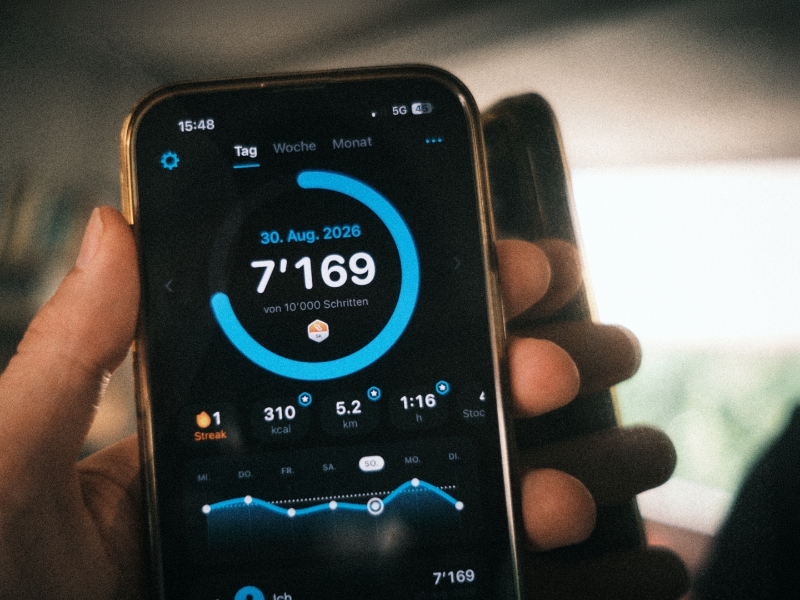
“Human life is fundamentally shaped by technology,” writes philosopher and technology ethicist Anna Puzio at the beginning of her book «Über-Menschen». “Social media and dating apps are part of our interpersonal relationships; diet apps influence our eating habits; wearables measure our pulse and heart rate; fitness trackers count every step we take; and sleep apps accompany us right into sleep – until our smartphones wake us up again the next morning.” So much for our digital daily lives. But does that already make us superhumans?
Cyborg fantasies and brain uploads
So-called transhumanism – which Puzio explores philosophically in her book, delving even into its darker corners – ostensibly aims for something far more ambitious. The ‘trans’ in ‘transhumanism’ is to be understood very literally: The prefix stands for ‘beyond’ or ‘beyond that’ – this new humanism ‘aims to fundamentally transform humanity,’ as Puzio says. It isn’t too picky about the means: Ideas range from life-prolonging chemistry and cyborg fantasies to ‘mind uploading’. The latter is actually an admission that humans, at least as physical beings, will always have certain limits. Therefore, it is better to become like the new AI superintelligences and transfer the mind completely into the cloud right away. There, not only we would have infinitely vast spaces of information, but there would also be no expiration date.
About

Anna Puzio
is a philosopher at the Institute of Forensic Medicine at the University of Bern. Her research areas include, among others, the philosophy of technology, (technological) anthropology, medical ethics, bioethics, and environmental ethics. She studied philosophy, Catholic theology, and German language and literature in Germany and subsequently conducted research in Frankfurt, Vienna, Oxford, Cambridge, and Berkeley. Today, she also works in Vienna and as part of the Netherlands-wide ESDiT Research Program (Ethics of Socially Disruptive Technologies).
Much of this is still a long way off, of course. Puzio calls the entire movement ‘highly speculative,’ but she also notes that it is already very well organized; she doesn’t see science-fiction pipe dreams taking shape here, but rather a concrete ideology. Jennifer Inauen's area of expertise is the current state of fitness and health trackers. As Head of the Department of Health Psychology and Behavioural Medicine at the Institute of Psychology, she specialises in health behaviour change and is interested in the potential of digital apps, among other things. This phenomenon is also known as ‘mHealth’ (short for mobile health), and the market for such health apps on mobile phones is booming: The global market volume for ‘mHealth’ amounted to $62.7 billion in 2023 and is projected to grow to over $150 billion by 2030. The most successful apps are ‘Strava,’ ‘Yazio,’ and ‘StepsApp,’ and they are widely used here as well: In a 2023 survey, over 50 per cent of the population reported using a pedometer.
What counts as healthy?
Unlike transhumanist fantasies, this kind of technological transformation of the body has long since become part of our everyday lives. But what exactly does that mean for us? Are we currently experiencing an ever-increasing ‘datafication’ of health, whereby only that which can be quantified – such as ideal weight, number of steps taken and duration of sleep phases – is considered healthy? When it comes to changes in health behavior, Inauen however believes that the positive aspects of the technology clearly outweigh the negative ones at this time. Health apps have been shown to promote physical activity and lead to better nutrition. “Self-monitoring helps us achieve what we set out to do.” Inauen also emphasizes solidarity: Through apps, people can receive encouragement or even comfort. This, she says, is a true innovation in the digital realm – the ability to share the collected data with others. Otherwise, the monitoring of health data isn’t fundamentally new; people have always kept diaries about their physical condition, recording changes in weight and menstrual cycles, and thus observing them more closely. Digital capabilities have clearly contributed to the widespread adoption of this method.
About

Jennifer Inauen
is a professor of health psychology and behavioral medicine at the Institute of Psychology at the University of Bern. Using everyday methods such as experience sampling, ambulatory assessment, and mobile sensing, her research examines the principles of health behavior change, focusing on diet, physical activity, hygiene behavior, and more. Based on these findings, she develops and tests interventions aimed at changing health behaviors.
Inauen says that, depending on the application, it’s essential that the data be reviewed with a healthcare professional and that decisions be made jointly. This can also help with illness management, for example when it comes to discontinuing unnecessary medications. In this context, it actually sounds more like empowering users than disempowering them. In this context, Inauen also emphasizes that use must be voluntary – “Health tracking must not be coercive.” Puzio, on the other hand, sees definite problems on the horizon. For her, the social pressure is real, something Foucault had already described. For the French philosopher, power and medicine have, in fact, always been closely intertwined. Nutri-Score, BMI – all these metrics are already effectively regulating our bodies, and she definitely sees a ‘normalizing influence’ at work here.
Monitored health behavior?
Inauen advocates for a more nuanced perspective here: “The fact that others can see how many steps I’ve taken is neither purely positive nor purely negative.” Whether health tracking actually triggers social pressure has not yet been determined; the research on this is still inconclusive. But Inauen is, of course, also following developments in China, for example: via the ‘WeChat’ app, for instance, healthy and unhealthy behaviors are already being monitored to a certain extent – she definitely sees signs of ‘social monitoring’ there. Inauen emphasizes: “These are developments I do not want to see in Switzerland,” where corresponding regulations will also be needed. She also points out that health insurance companies in this country, too, have a keen interest in such health data. What she dislikes even more, however, is the fact that, in the worst-case scenario, “responsibility is largely shifted onto the individual,” whereas health policy must always keep sociestructural factors in mind. In the future, health tracking must be “embedded in a broader range of health measures,” such as prevention or assistance for people in precarious situations. The situation is complicated by the fact that usage is not evenly distributed across all social classes, so another divide could emerge. Puzio also recognizes this divide: The Global South, for example, plays hardly any role in transhumanist visions of the future. Ultimately, then, this amounts to a power play by an already privileged class.
“Self-monitoring helps us achieve what we set out to do.”
Jennifer Inauen
More broadly, Puzio takes issue with the fact that transhumanist ideology tends not to be characterized by self-criticism: the bigger picture is given far too little consideration, and “ethics is completely neglected.” In this respect, she can also understand why the movement is often likened to a form of emerging techno-fascism. It involves a great deal of hedonism and, at times, ecstatic promises of happiness. Speaking of which: Just how happy would one have to imagine these ever-improving, ever-optimized humans of the future to be? The superhuman – or immortality – is, after all, an old literary trope – and it’s actually always accompanied by melancholy or, more often, by agonizing ennui. The philosopher identifies another glaring weakness in transhumanist reasoning here: happiness, she argues, is tied to relationships and supportive social structures, not to a perfected body or an eternally long life.
Social media as an ideal of perfection
Inauen, too, sees a problem with today’s technology in this regard: “Am I really pursuing my own goals?” As soon as a standard is set, things can get complicated. It’s always better to choose your own goals – then there’s less risk of chasing after a standard. However, this can backfire. For Puzio, the transhumanist movement is far too “individualistic,” meaning it’s focused solely on one’s own health. Yet such a transhumanist transformation “naturally affects the whole of society.” The fact that this whole phenomenon also takes the form of a monopoly held by a handful of companies with enormous influence – and that this influence extends far into the political sphere – is certainly cause for some unease, especially in light of current developments in the U.S.
“Ethics gets shortchanged in transhumanism.”
Anna Puzio
Puzio concludes her book with a quote from Karl Jaspers: “For the image of humanity that we hold to be true becomes itself a factor in our lives. It determines the ways in which we treat ourselves and our fellow human beings.” Today, this image has taken on very concrete forms – think “Looksmaxxing” or the ubiquitous availability of ideal lifestyles and body images on social media. Puzio calls it an “ideal of perfection.” The fact that the body ideals disseminated on social media are problematic and, in a certain sense, unhealthy has actually been a topic of discussion for quite some time. Inauen, however, would like to see the two areas treated separately: “Our relationship with body images is different from the measurement and comparison of personal health data.” Here, too, she views this societal shift through the lens of a health behavior expert in a rather positive light: “We’re seeing a trend toward a healthier society overall; people are drinking less, and exercise and wellness are playing a bigger role.” She finds it entirely plausible that this shift is “likely facilitated by social media.”
Just take a stroll
So it remains a double-edged sword: Do apps (and digital media) create positive incentives, or are we tracking each other into a hamster wheel? As is so often the case in these confusing times, the truth is probably both. But Puzio believes we should also take a step back and ask ourselves: What devices do we really need? In this regard, she sees an urgent need for more research on digital well-being. We actually feel it ourselves: it’s good for us to take a few steps regularly – and no, it doesn’t have to be the notorious 10,000. So putting away the smartwatch and simply strolling, rather than aiming for a specific number of steps, could very well have a health-promoting effect.
Magazine uniFOKUS

Body images
This article first appeared in uniFOKUS, the University of Bern print magazine. Four times a year, uniFOKUS focuses on one specialist area from different points of view. Current focus topic: Body images