
A winding career path
Climate researcher with a background in craftsmanship
As a climate scientist, Patrick Bigler has developed a mobile measuring tower to enable more precise measurements of Bern's urban climate. And as a trained metalworker, he also constructed the device himself.
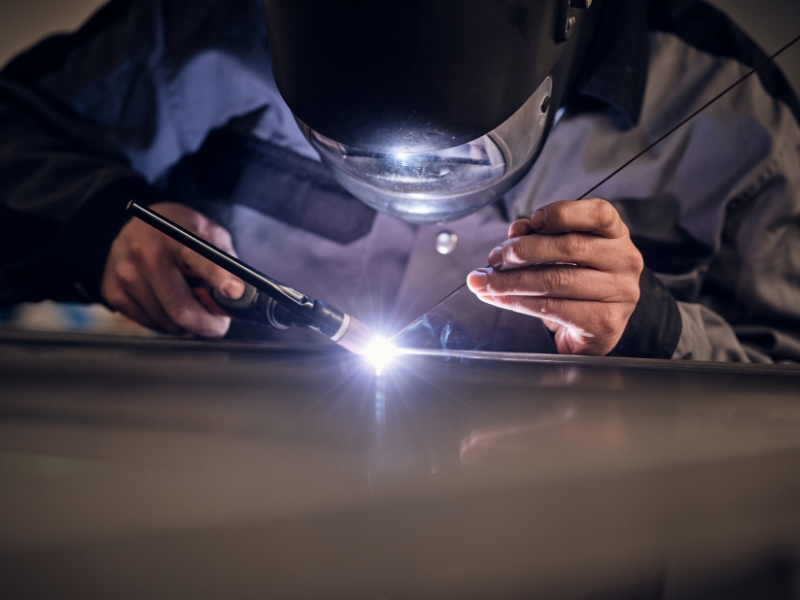
The workshop smells of grease and the exhaust system is hissing. Before Patrick Bigler welds the four steel elements together on his workbench, he checks their alignment. «If something is wrong with the base frame,» he explains, «then everything I build on top of it will be skewed.» The climate researcher, who was a metalworker and metal construction designer in his first career, is working on a self-developed construction for temperature measurements. Once assembled, this modular measuring tower will be five meters high and will be used in "Urban Climate Bern", a large-scale project in which the Climatology Group of the Oeschger Centre for Climate Research (OCCR) at the University of Bern has been researching the city’s climate since 2018.
Until now, the necessary measurement data has been collected using a network of around 80 fixed measuring stations, whose sensors recorded temperatures every ten minutes. Amoung other things, the data serves as the basis for the «Bernometer», a heat app launched in 2024 that Patrick Bigler helped to develop.
A big hit beyond Bern
In addition to the Bernese measuring network, similar measuring networks have been established in Biel and Thun in recent years. Temperature measurement networks based on the Bern model are currently being set up in Naples and Lyon. The advantages of the Bernese system are clear: the self-built devices are light and therefore easy to install, and they are very cost-effective. One drawback, however, is that temperatures are measured at a height of three meters above the ground – mainly to prevent vandalism. This height is not ideal for determining the temperatures people actually experience at street level, especially on hot days.
About
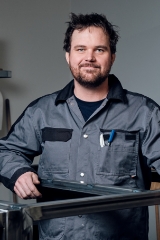
Patrick Bigler
Patrick Bigler has a Master's degree in climate science from the University of Bern and now works as a research assistant at the Institute of Geography and the OCCR.
With the success of these measurement networks, new demands have emerged: «Cities that commission us to take measurements increasingly want to know whether the measures they are taking to combat the summer heat are working,» explains Patrick Bigler. «To answer that, we need more detailed measurements.»
The Bernese urban climatologists came up with the idea of a measuring tower that could record temperatures at several heights, allowing researchers to create a kind of vertical temperature profile. The question remains, which company could produce such a tower without jeopardizing the low-cost approach?
«With a materials budget of a thousand francs, I'll build you a tower like that.»
Patrick Bigler
«I will,» Patrick Bigler calmly explained at a meeting of the research group. «With a materials budget of a thousand francs, I'll build you a tower like this.» Bigler, still a Master's student at the time, didn't mince his words, but simply mentioned his special background: both a climate scientist and metalworker – a pretty rare combination.
An accident led to a new start
In the metal workshop of the Department of Chemistry, Biochemistry and Pharmacy at the University of Bern, where he is working as a guest, Patrick Bigler still wears the grey work clothes from his time as a craftsman. After completing two apprenticeships, he spent four years working in various companies in development, planning and assembly.
Studying geography with a minor in physics at the University of Bern was not originally part of his plan. After a serious accident at work, however, he was forced to reorient himself. «I had been interested in physics for a long time, especially the physical aspect of the climate system,» says Bigler, looking back. «But without the accident, I might not have dared to make a fresh start with a degree course.»
«When you've already had a career and a full salary, it's a big adjustment.»
Patrick Bigler
At over thirty, going to school at a baccalaureate school for adults, then spending another five years as a student until completing a Master's degree in climate science while earning a living on the side was a major challenge. «If you've already had a career and a full salary, it's a big adjustment,» says the current research assistant in the Climatology Group. Although Switzerland’s education system allows for such transitions, careers like Bigler’s are still unusual. He says he has not yet met another university student with a similar technical background.
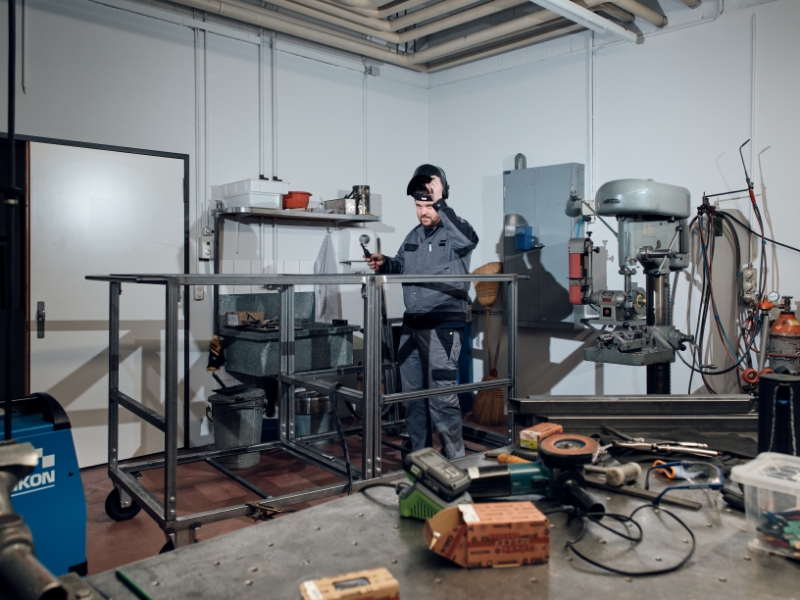
The 38-year-old is not at all bothered by his winding CV, and standing at a workbench again for once is not an annoyance; it is a welcome change. He can use everything he has learned in the development and construction of this measuring tower: «It's a great feeling. My past and my current interests complement each other perfectly in this project.»
Good temperature measurements are challenging
Patrick Bigler is a scientist who wants to understand all aspects of his research work. For him, this includes not only evaluating, modeling and interpreting climate data on the computer, but also collecting data in the field. «In climate science, you work with data day in, day out, but hardly anyone thinks about what it takes to measure that data as accurately as possible.» Taking good quality measurements as cost-effectively as possible is anything but trivial. That is exactly what the new measuring tower aims to do. It should also be as easy as possible to transport and set up. For sustainability reasons, it has been designed in such a way that it could be easily retrofitted should Urban Climate Bern need more than just temperature data in the future.
About the «Urban Climate Bern» project
Since 2018, climate researchers at the University of Bern have been operating a measurement network to monitor the air temperature in and around the city of Bern. One of the aims is to find out how big the heat island effect actually is and where it is making itself felt.
The tower, which measures the temperature at five different heights, will be used for the first time this summer on the WIFAG site in Bern's Wyler district. The area includes both asphalted and green surfaces. This means that meaningful measurements can be taken of the temperatures above sealed and unsealed ground. Measurements are to be taken simultaneously with two towers, which is why the prototype that Patrick Bigler built a year ago is also being used.
Skills in demand
The urban climate researcher looks relaxed, at peace with himself and the world. The impression is not deceptive. He will soon be a father, and his professional future as a research assistant is also secured until 2028. What comes after that? "There are many companies that deal with environmental measurements, that's my thing, and I would like to continue working in this field in the future." The rare combination of the skills of a researcher and craftsman will also be in demand outside the university.
Oeschger Center for Climate Research
The Oeschger Centre for Climate Change Research (OCCR) is one of the strategic centres of the University of Bern. It brings together researchers from 14 institutes and four faculties. The OCCR conducts interdisciplinary research at the cutting edge of climate science. The Oeschger Centre was founded in 2007 and bears the name of Hans Oeschger (1927-1998), a pioneer of modern climate research.
Subscribe to the uniAKTUELL newsletter

Discover stories about the research at the University of Bern and the people behind it.