
Luxury and Monetary Policy
Swiss surpluses: why not let it rain money?
Some Swiss cantons run surpluses year after year – so why can’t this money simply be paid back into taxpayers’ bank accounts? Economist Pierpaolo Benigno explains why disciplined fiscal policy is actually a luxury.

Mr. Benigno, what were your impressions when you first arrived in Switzerland? Did you find it to be the proverbial “land of milk and honey”?
I assume you mean the country as it presents itself to tourists? It’s certainly very beautiful here, but personally, I find the Swiss approach to debt to be the most amazing thing about the country. It’s what I consider to be Switzerland’s true privilege.
What do you mean by that?
Many nations are currently increasing their debt significantly – whether it’s the U.S. or European countries – and in many places, public debt and deficits are becoming an increasingly serious economic problem. Here in Switzerland, however, the principle of sound financial management and disciplined spending still holds true. And that’s a rarity these days.
There are huge differences in the debt burden across different countries – which is sometimes astonishing to us normal people, who have been taught from a young age never to go into debt.
In my view that principle should also apply to national economies, at least in a qualified sense. Italy has a debt-to-GDP ratio of over 130 percent; in the U.S., it is around 125 percent; and in Japan, it is over 200 percent.
What exactly makes Switzerland different in this context – it can’t simply be because we’re a “rich” country?
No, it’s about the fundamental principle of when it is acceptable to take on debt and when it isn’t. According to economic logic, debt can be particularly appropriate for major investments – that is, for projects that will be of benefit for the future, such as the Gotthard Tunnel, for example.
“According to economic logic, debt can make sense, especially for large scale future projects, such as the Gotthard Tunnel.”
Pierpaolo Benigno
In many countries this principle isn’t consistently observed; increasingly, debt is also being used to fund everyday government spending. That’s not really advisable, though. It may be attractive in the short term, but in the long run it can place a burden on the economy.
Conversely, what should be done if tax revenues have been managed “too well” and there’s a surplus at the end of the year? Shouldn’t the excess revenue simply be returned to taxpayers?
It very much depends on whether it is a one-off surplus or a structural surplus. In Switzerland, it is also necessary to distinguish between the Confederation itself, cantons and municipalities, whose fiscal positions can differ considerably. If the branch of government is consistently in the black, it frequently leads to tax cuts. “Refunds” via premium reductions or similar measures are also possible. Or you could simply build reserves.
That sounds a little uncreative. Let’s say I’m the finance minister in Zug, a canton which typically has a structural surplus. As a thank you to taxpayers, couldn’t I do something like handing out free tickets for cultural or sports events instead?
In my opinion, that approach wouldn't be particularly effective. “Gifts” of this kind usually only have a limited long-term effect, even if they’re credited to people’s bank accounts with the goal of stimulating consumption. Of course, they might be attractive from a political standpoint – measures like these can certainly boost popularity. Yet long-term results are more likely to come from a well-considered investment – in schools, for example, or in transport infrastructure.
And can direct payments have a positive effect in countries that have higher poverty rates than Switzerland? That is, if they’re explicitly used as a social policy tool?
A different logic does indeed apply to such countries, where direct payments can be very effective as they alleviate immediate liquidity shortages. However, the underlying problem should always be addressed. If the problem is insufficient income, transfer payments can work very effectively. If the problem lies in inadequate infrastructure or a lack of public services though, additional public investment is required.
It is often said that central banks can create money “out of thin air.” Is there any truth in this statement, and why does it lead people astray?
In modern economies central banks do indeed have the ability to create “central bank money”. They can do this through their monetary policy operations. Central banks have a monetary policy role to play in this respect; they can influence the overall economy in this way. Yet their capacity to do this is not unlimited because excessive money creation can endanger price stability.

There is, of course, that famous thought experiment by Milton Friedman – he called it “helicopter money”: what happens if the government simply “drops” money to the people from a metaphorical helicopter, creating a proverbial shower of cash?
If we imagine the people picking up this shower of cash and spending it straight away, it would boost consumption and be quite positive. Yet the effect would mainly be a short-term one: a baker, for example, would quickly be tempted to raise their prices if they sensed how loose people’s purse strings had become.
What is helicopter money?
“Helicopter money” stems from a thought experiment by Milton Friedman: newly created money is distributed to the population as a one-time payment. Friedman wanted to use this to illustrate how additional money affects the price level. The concept was later discussed as a possible measure against a severe economic downturn when interest rates are very low. This refers to transfers or tax cuts that are permanently financed by central bank money and are not later offset by higher taxes. The study “The Economics of Helicopter Money” by Pierpaolo Benigno and Salvatore Nisticò examines how measures of this kind can stimulate consumption and demand, and what economically equivalent alternatives exist.
Are there any specific examples of where this has been tried? Not literally by helicopter, of course?
Similar measures have been tried from time to time for various political reasons, although not always as helicopter money in the strict sense. For example, during the COVID-19 pandemic, many eligible U.S. individuals and households received direct payments, in some cases of more than a thousand dollars. Yet that wasn’t really helicopter money in the strict sense; it was a fiscal stimulus measure authorised by Congress and implemented by the Treasury Department. If households expect such debt-financed measures ultimately to be financed through future revenues or lower spending, it can affect expectations about future taxes and therefore consumption.
“Central bank money can be created, but it doesn’t automatically lead to more goods, services or productivity.”
Pierpaolo Benigno
But what if the central bank distributes the money?
It is indeed possible to finance such a measure indirectly and on a permanent basis using central bank money. If households don’t anticipate higher future taxes as a result, the impact on current consumption may be greater – especially when the economy is weak and interest rates are very low. However, the measure isn’t free: the crucial limit is price stability. It is also a risky policy, as it can easily become a habit. It’s a bit like having a father who always bails you out from a tight spot. It can create an incentive for policymakers to rely on this assistance time and again.
Do you therefore take the view that helicopter money can’t ever really be good for the economy as a whole?
This kind of a policy can’t create lasting real prosperity – central bank money can be created, but it doesn’t automatically lead to more goods, services or productivity. In a severe downturn, money of this kind can support demand and purchasing power in the short term; if used excessively or permanently, however, it can lead to inflation.
As an economist, you are aware of this, but are politicians aware of it too?
Not always. People sometimes fall prey to this appealing illusion. Without clear limits, it can end in inflation. And that is exactly what is extraordinary about Switzerland – that it maintains an efficient, restrained approach to spending money. Conversely, this gives citizens the sense that they know where their tax money is going – that it isn’t simply “siphoned off” somewhere.
And could that, in fact, be the real luxury in this country?
You could call it a luxury, yes. In any case, it’s certainly a privilege. Here, action is taken when the country is heading toward a budget deficit; in some other countries, deficits are often financed through additional debt. And when investments are made, they’re done in a sensible, non-populist way. After all, what do you think is better when you have surplus funds: to simply make a flat payment of 500 francs to all taxpayers, or to invest in schools and thereby build a better society for the future?
About the person
Prof. Dr. Pierpaolo Benigno
is a professor of monetary macroeconomics at the University of Bern. He grew up near Milan, Italy. After earning a bachelor’s degree in economics from Bocconi University, he completed his studies with a Ph.D. from Princeton University in 2000. He then worked as an assistant professor of economics at New York University until he moved to LUISS University in Rome as a full professor. Benigno has also served as a visiting scholar and consultant for various policy institutions, including the European Central Bank (ECB), the International Monetary Fund (IMF), and the Federal Reserve Bank of New York. He is a research fellow at CEPR (Centre for Economic Policy Research). He is the author of “Monetary Economics and Policy: A Foundation for Modern Currency Systems,” published by Princeton University Press.
SNSF Project (2023–2027): “A New Framework for Monetary Policy Analysis”
Pierpaolo Benigno’s SNSF project, “A New Framework for Monetary Policy Analysis” also focuses on the role of central banks. It includes work on helicopter money and examines how central banks can use their balance sheets as a monetary policy tool in addition to the policy interest rate.
In the model developed, the amount of central bank reserves influences aggregate demand – and thus production and inflation – through the supply of liquidity. In a crisis with very low interest rates, additional reserves can have a stabilising effect; when exiting the crisis, their reduction may, under certain conditions, begin even before the first interest rate hike. The key message is that the balance sheet should be sized and coordinated with interest rate policy in such a way that it best supports the economic situation and monetary policy objectives. As with an emergency stockpile, the following applies: In a crisis, sufficient liquidity must be available; however, more is not automatically better. The appropriate amount depends on the prevailing economic situation. For price stability, central banks therefore need discipline not only in setting interest rates but also in managing their balance sheets: the balance sheet should be large enough to implement monetary policy and safeguard financial stability, but not larger than necessary.
Magazine uniFOKUS
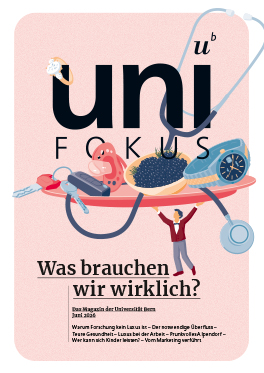
What do we really need?
This article first appeared in uniFOKUS, the University of Bern print magazine. Four times a year, uniFOKUS focuses on one specialist area from different points of view. Current focus topic: Luxury