Planetology
How a collapse could create planets
Oliver Schib has developed a new model for planet formation. His computer simulations show how the gas and dust disks around young stars develop and how instabilities can lead directly to the formation of giant planets.
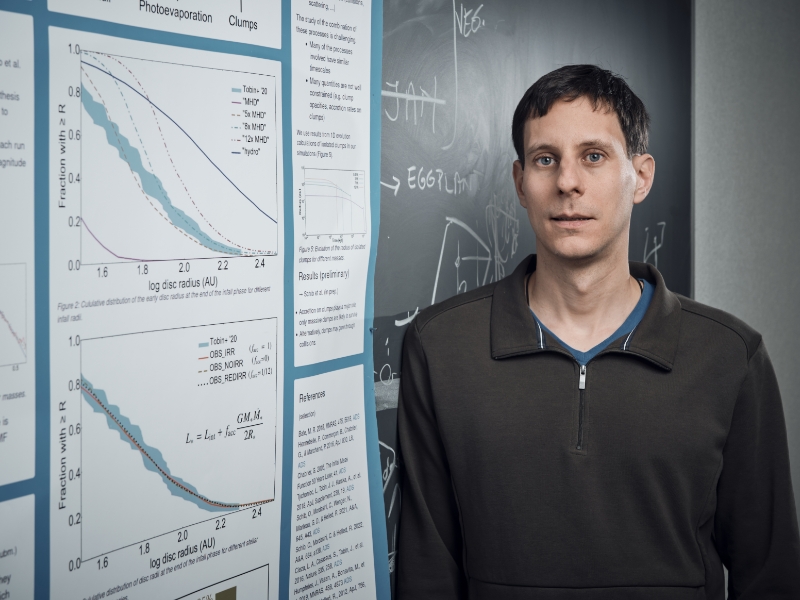
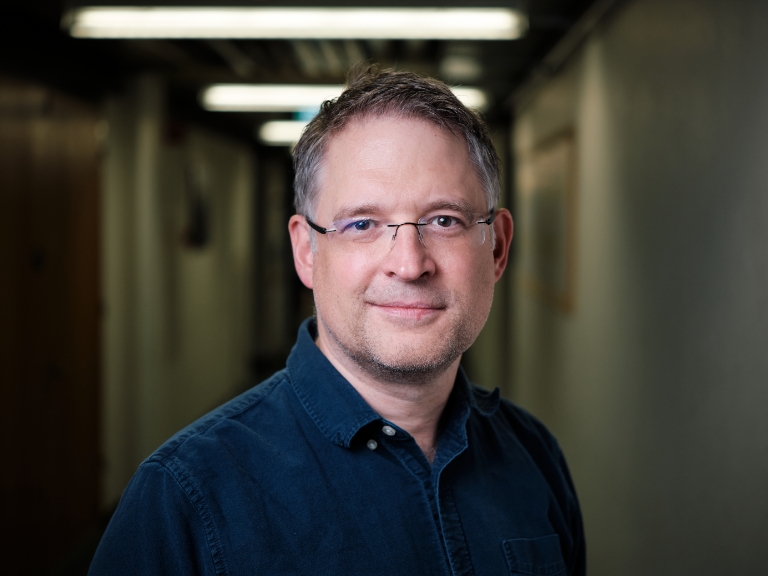
Although Oliver Schib is an astrophysicist, his most important tool is not telescopes, but calculations. "The theory, the abstract fascinates me," he explains: "I find the complexity of the processes in the universe, the many factors that play a role and the fact that these processes can be described with mathematical equations particularly exciting and even more interesting than the direct observation of these phenomena in the sky." He wants to find out how giant planets form.
When disks become unstable
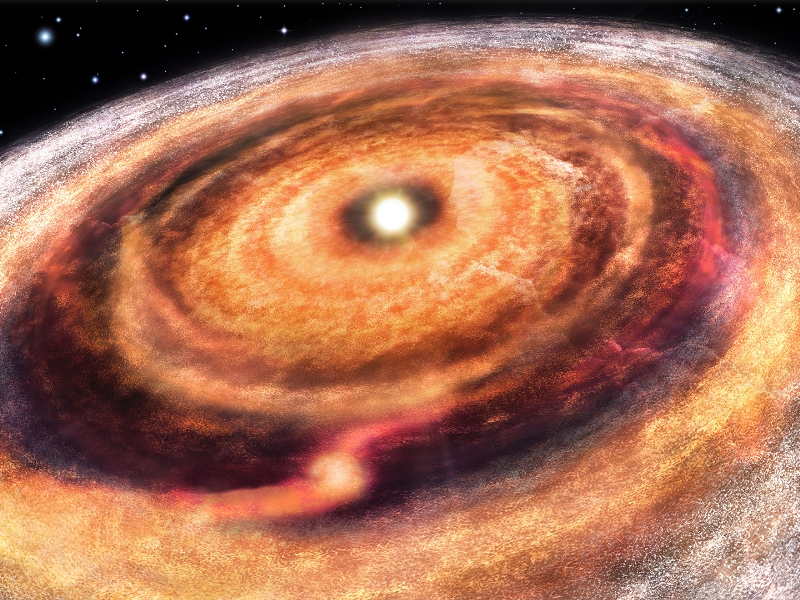
Schib works as a scientist in the Division of Space Research and Planetary Sciences (WP) at the Physics Institute of the University of Bern and is a member of the National Centre of Competence in Research (NCCR) PlanetS. His newly developed computer model deals with disks, which occur frequently in astrophysics. Mass that is distributed over a large scale becomes denser and denser due to gravity. If rotation comes into play, a disk is formed. In very massive disks, individual parts can collapse under their own gravity. "We then speak of disc instability," explains Schib.
“The theory, the abstract fascinates me.”
Oliver Schib
Such disks also exist around young stars. Decades ago, the question therefore arose as to whether disk instability could lead to the formation of planets. "However, testing this hypothesis proved to be extremely challenging because a large number of physical processes had to be taken into account," says Schib. The new model covers these mechanisms for the first time and provides an answer to the previously unanswered question: "We were able to show that planet formation through disk instability actually works in certain situations," summarizes the astrophysicist.
Simulation delivers artificial planetary systems
Using the computer model, he simulated a large number of possible disks and thus generated a wide variety of artificial planetary systems. In technical jargon, this procedure is known as population synthesis. The new model is also called "A new Disc Instability Population SYnthesis", or DISPY for short. "DIPSY represents an important milestone in the theory of planet formation; the model is efficient and physically solid," says Ravit Helled, Professor at the University of Zurich.
Ravit Helled and Christoph Mordasini, Professor of Theoretical Planetology at the University of Bern, jointly launched the project almost ten years ago, which Oliver Schib started as a doctoral student as part of the National Center of Competence in Research (NCCR) PlanetS. The three researchers were subsequently able to establish a collaboration. "Their different areas of expertise complemented each other perfectly," says Christoph Mordasini. "Our work on DIPSY took a lot of perseverance, patience and confidence," says Schib: "We didn't know whether we could actually answer the question of planet formation and had to keep improving our model and will continue to do so."
Aha effect while walking
In his work, the researcher often uses pencil sketches on paper to think about how certain processes could take place using the corresponding physical formulas. Or he uses a simple model on the computer to test what happens and exchanges ideas with other researchers working on similar problems.
However, a brilliant idea often doesn't come to him at work, but in his free time, perhaps on a walk. "Such an 'aha' effect is extremely satisfying when you suddenly have an idea of how to proceed," says the astrophysicist.
“DIPSY represents an important milestone in the theory of planet formation.”
Ravit Helled
He was already fascinated by space as a child: "Back then, I wanted to be an astronaut. Later, I didn't always know exactly which direction I wanted to take." But during his studies, some very exciting lectures sparked his interest in astrophysics. After his Master's thesis in cosmology, however, he decided to leave university and look for a job in industry.
From industry back to research
The qualified physicist opted for the electricity sector. As a project manager, he spent four years preparing risk studies. "I gained very valuable experience there and learned a lot," he says: "But in industry, it's very important to keep things running and not necessarily to find out new things." That's why, over time, he missed the challenge and decided to return to research. "That took a lot of courage," he recalls. Because he didn't know anyone else who had dared to start again at the university after such a long absence.
“As a child, I wanted to be an astronaut.”
Oliver Schib
With DIPSY, he tackled a subject that was a niche topic at the time. Following the discovery of the first exoplanets orbiting distant stars, a standard model was developed at the University of Bern in 2001 that describes the formation of planets using other physical processes. According to this model, small dust particles clump together in the disk to form rocks and planetary cores. This is called accretion. Many of the observed planets, especially the Earth-like ones, can be explained using this model. But certain giant planets should not even exist according to this model.
Explanation for mysterious giant planets
This is where DIPSY can step in: The simulations show that instability occurs in around ten percent of the disks. The result is a huge ball of gas with a very low density. In half of the cases, this clump survives. The most common result is a brown dwarf, i.e. an object that is heavier than a planet but lighter than a star. In another ten percent of cases, a planet is formed that has at least the mass of Jupiter. In particular, the existence of previously mysterious giant planets far away from their star or close to a very small star could be explained in this way. "If you compare the systems artificially created with DIPSY with the actual, real existing systems, you can see surprisingly good similarities in certain areas," explains Schib. Helled adds: "However, the results of the models are also very important for guiding and interpreting future observations. Our models provide concrete predictions about where and in what form certain objects can be observed."
As complex as Schib's work is, he makes every effort to explain the basic principles to laypeople. "If someone is interested, there is usually a positive exchange," he says: "But of course there are also people who think my work is a bit weird, which is probably true to a certain extent."
“Climbing is a wonderful balance to my top-heavy work.”
Oliver Schib
To clear his head a little in between, he indulges in his hobby of climbing, "always with the right safety measures, but with a certain thrill". He can feel his vital energy flowing and his thoughts focusing. "When you're in a difficult passage, all your attention is on the rock," he says: "It's a wonderful counterbalance to the very top-heavy work I usually do."
About the person
Oliver Schib, born in 1985 in the canton of Aargau, is an astrophysicist in the Division of Space Research and Planetary Sciences (WP) of the Physics Institute of the University of Bern and an associated researcher at the NCCR PlanetS. He studied at ETH Zurich and completed his doctorate at the University of Bern.
About the person

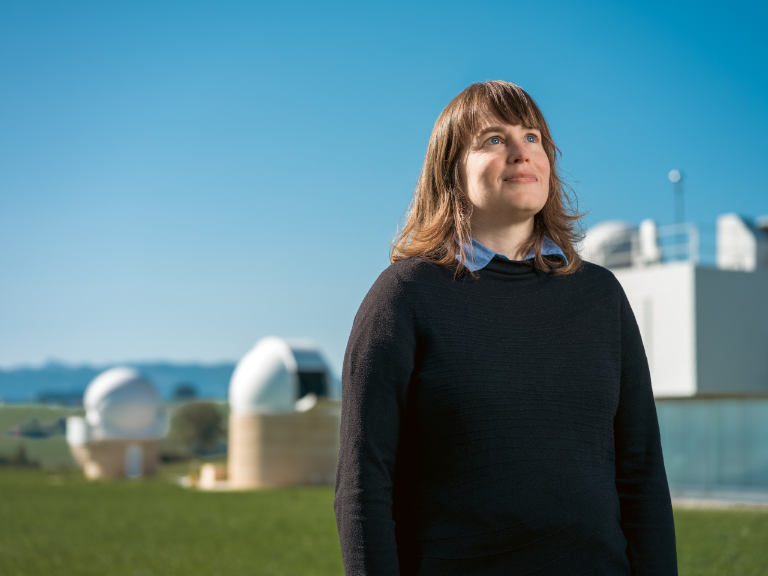
Ravit Helled is Director of the Department of Astrophysics and Professor of Theoretical Astrophysics at the University of Zurich as well as project leader at the NCCR PlanetS, which is run jointly by the University of Bern and the University of Geneva. Her research focuses on planet formation, planetary interiors, planetary evolution, solar system physics and exoplanets.
About the person
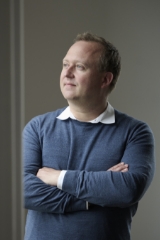
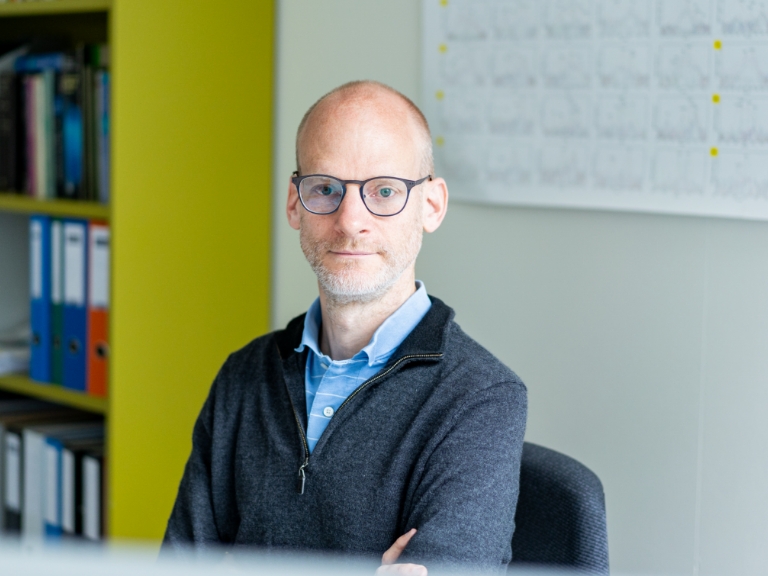
Christoph Mordasini heads the Division of Space Research & Planetary Sciences (WP) at the Physics Institute. He works primarily in planet formation theory with a focus on large numerical models such as the "Bern Model", one of the largest models, and is involved in ground- and space-based missions.
Details of publications
Schib, O., Mordasini, C., Emsenhuber, A., Helled, R.: DIPSY: A new Disc Instability Population SYnthesis, I, Astronomy & Astrophysics, December 2025
https://doi.org/10.1051/0004-6361/202556262
Schib, O., Mordasini, C., Emsenhuber, A., Helled, R.: DIPSY: A new Disc Instability Population SYnthesis, II, Astronomy & Astrophysics, 2025
DOI:10.1051/0004-6361/202556261
Subscribe to the uniAKTUELL newsletter

Discover stories about the research at the University of Bern and the people behind it.