
Astronomy
Even sharper images from the Zimmerwald Observatory
Air turbulence impairs observations of the universe from Earth. The Swiss Confederation has granted CHF 3 million to the Zimmerwald Observatory to support the development of an optical system that will correct the disruptive effects in real time.

The air turbulence in the Earth's atmosphere makes the stars twinkle. This has a romantic effect in everyday life. For astronomy, however, it is a problem: the Sun, planets, stars, or satellites appear blurred when viewed through a telescope due to air turbulence. Images of the International Space Station (ISS), taken by the Zimmerwald Observatory, also suffer from this effect and only show details such as docked spacecraft after post-processing. "With adaptive optics, we want to make the original image much sharper," says Lucia Kleint, Director of the observatory and professor at the University of Bern. Adaptive optics compensates for distortions by actively adjusting the telescope mirror system in real time.
"With adaptive optics, we want to make the original image much sharper."
Lucia Kleint
Three million francs from the federal government
The development of the new optics system for Zimmerwald is one of only two projects selected for funding by the federal government as part of its MARVIS program. MARVIS stands for "Multidisciplinary Applied Research Ventures in Space" and aims to strengthen Switzerland's position in space research. The optics project will receive a federal contribution of three million francs between 2025 and 2029.

"We knew that we had submitted a convincing and timely proposal," says Jonas Kühn, an assistant professor at the University of Bern and co-applicant of the project: "Our project objectives are in line with the goals listed in the roadmap for Swiss space policy." Further co-applicants are Dr. Mathieu Salzmann of the EPF Lausanne and the company "s2a systems Sàrl". The project is called TESSA, short for "Technologies to Enhance Space Situational Awareness".
"Zimmerwald is the largest professional observatory in Switzerland."
Lucia Kleint
TESSA will use adaptive optics to provide high-resolution images of satellites orbiting the Earth. This will show how a satellite is moving, whether it is stable or wobbling, and whether the solar panels are damaged, for example - important information for satellite operators such as the European Space Agency (ESA). Astronomical observations are also planned. "We may also be able to build the optical system in such a way that it can be commercialized," says Kleint.

Although adaptive optics is a standard feature of the large telescopes in Chile, Hawaii and La Palma, there is currently no telescope with such a system in Switzerland. "Zimmerwald is the largest professional observatory in our country," says Kleint. Although the telescope for which TESSA is being developed is comparatively small with a mirror diameter of 80 centimetres, it is so good optically that the upgrade will definitely be worthwhile. Kleint: "The current limit for observations is our air turbulence, not the telescope."
Mirror deforms in real time
At the heart of the adaptive optics system is an additional, thin mirror that can change shape very quickly. A sensor measures how the light is currently distorted by the air. A computer calculates how the mirror must deform to compensate for this distortion and sends the corresponding commands. "The deformable mirror has to do exactly the opposite of what happens in the atmosphere," explains Kleint: "It has to adjust its shape several hundred times a second, in real time." To achieve this, the mirror has so-called actuators underneath its surface: small elements that can locally pull or push the mirror upwards at the appropriate points and deform it at lightning speed.
"We knew that we had submitted a convincing and timely proposal."
Jonas Kühn
In developing TESSA, the team draws on the experience gained from building an adaptive optics system for a Swiss 1.2-meter telescope in La Silla, Chile. The difficulty: the system was originally developed for observing distant stars. "We have to adapt the design so that it can image fast-flying objects in low orbit with a high cadence," explains Kühn: "All this on a smaller 0.8-meter telescope, where the additional instrument must not be too large or too heavy. What's more, Switzerland is not as ideal as an observation site as Chile because of the weather and a larger air turbulence. “But our measurements have shown that Zimmerwald is a very good site in Switzerland”, says Kleint.
In addition to satellite observations, Lucia Kleint also wants to observe eruptions on stars in Zimmerwald. Among other things, this research should help to better understand the eruptions on our Sun and predict space weather: solar storms can lead to increased radiation levels on Earth, power outages and interference with navigation and communication signals and can even cause satellites to deorbit.

Kleint received one of the highly coveted ERC Consolidator Grants from the European Union in 2022 for her research into stellar flares. With the help of the grant, her team is currently also developing a new, unique instrument for the Zimmerwald Observatory in her optics laboratory at the University of Bern. Once everything is ready, the instrument will be connected to TESSA for observing stellar flares. "It may be hard to believe that these two projects - observations of satellites and stellar flares - can be combined," says Kleint: "But this way it is possible and it has mutual benefits."
Testing prototypes
Meanwhile, Jonas Kühn and his team want to use TESSA as an "on-sky" laboratory for testing components for future astronomical instruments that are being developed in Bern or elsewhere in Switzerland. These will one day be used in the large telescopes in the Chilean Andes, i.e. the Very Large Telescope VLT with its 8-meter mirrors and the Extremely Large Telescope (ELT) with its 39-meter mirror, which is currently under construction.
"TESSA will be an ideal platform to show our students and researchers how to make astronomical observations with adaptive optics."
Jonas Kühn
"The fact that the Zimmerwald site is only a twenty-minute drive from Bern makes this very attractive," he says: "And TESSA will certainly also prove to be an ideal platform to show our students and researchers how to carry out astronomical observations with adaptive optics."
About
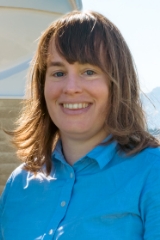
Lucia Kleint
Lucia Kleint is a professor at the Astronomical Institute of the University of Bern (AIUB). She heads the Zimmerwald Observatory and the Space Weather Research Group at the University of Bern and is co-director of the Astronomical Institute.
About

Jonas Kühn
Jonas Kühn is an assistant professor in the Department of Space Research and Planetology at the University of Bern's Institute of Physics (WP). He develops new concepts for astronomical instrumentation.
Subscribe to the uniAKTUELL newsletter

Discover stories about the research at the University of Bern and the people behind it.