ICFG
25 Years of Gender Studies: What Still Matters—and What's Next?
Since 2001, the Interdisciplinary Centre for Gender Studies (ICFG) has been exploring the role of gender in academia and society. Co-directors Michèle Amacker and Patricia Purtschert explain why many of the same questions remain relevant—and why critical research matters now more than ever.
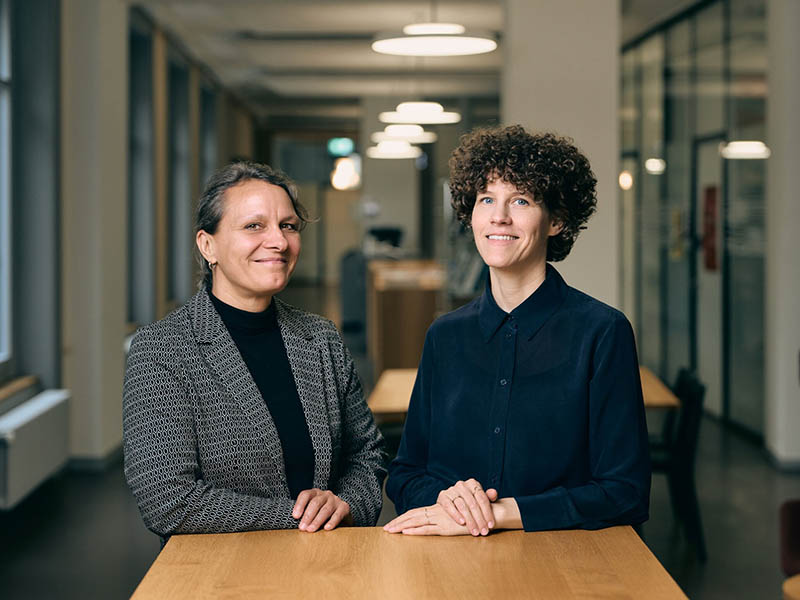
What began in 2001 as an initiative by a group of dedicated women professors has become an established part of the University of Bern. From modest beginnings, the ICFG has grown into an interdisciplinary research center spanning several faculties and employing more than 40 people. In this anniversary interview, the two co-directors look back on the center's development, discuss how their research makes an impact beyond the university, and share the questions that will shape their work in the years ahead.
Michèle Amacker, Patricia Purtschert, what was the vision behind the founding of the ICFG in 2001?
Michèle Amacker: The time was right. Switzerland, and the University of Bern in particular, had been relatively slow to embrace gender studies compared with other parts of Europe and the United States. Workplace gender equality measures were already in place, but women's and gender studies needed an academic home of their own. Women professors from various disciplines at the University of Bern came together to make that happen. The broader vision was to investigate the role of gender in academia and society—and, through that research, contribute to a more just society.
The ICFG was established as a network, with the aim of bringing gender studies perspectives into every faculty, for example through courses and collaborative research projects. The center's scientific advisory board and affiliated professorships remain important today. At the same time, gender studies has become more firmly established as an academic field: There are now two professorships based in different faculties.
“Critical thinking doesn't mean simply rejecting everything. It means taking a closer look and asking: Whose perspective is missing?”
Patricia Purtschert
What does research gain when different disciplines work together?
Patricia Purtschert: Many research questions naturally call for multiple perspectives. Gender issues have legal, social, economic, and epistemological dimensions, and these are often impossible to separate. Our team brings together people from different disciplines, allowing us to approach a question collaboratively from the very beginning. This often provides a better starting point for new insights than working within a single discipline.
Michèle Amacker: We often investigate questions that involve historical, sociological, and legal dimensions at the same time. This makes our findings broader in scope, but also more nuanced and precise. For example, in a current research project funded by the Swiss National Science Foundation (SNSF), we're exploring alternative ways of organizing low-wage workplaces. We're approaching the issue from the perspective of the sociology of work and bringing in a legal research team. After all, to understand workplace participation, you also need to understand the legal framework.

Patricia Purtschert: I see something similar in my research on postcolonial Switzerland. Studying colonial patterns of thought from a historical perspective also changes the philosophical questions I ask about knowledge and power. Historical research helps us arrive at different, more precise answers to philosophical questions—and vice versa.
How does the ICFG bring its findings into public debate?
Michèle Amacker: We don't just publish academic articles and books. Our research also leads to exhibitions, websites, apps, podcasts, guidelines, and recommendations. We organize public lecture series and provide consulting services. When we conduct commissioned research for the federal government, cantons, or other organizations, part of the task is often to identify practical recommendations based on the findings.
At the same time, it's important to us to incorporate knowledge produced outside the university. Whenever possible, we therefore choose transdisciplinary and participatory research approaches.
“As a university, we have a responsibility to critically examine these issues and ensure that knowledge is shared and accessible.”
Michèle Amacker
Patricia Purtschert: For gender studies, this also raises a fundamental question: What counts as knowledge in the first place? Engaging with marginalized perspectives broadens our understanding. One example is the history of lesbian women in Switzerland, whose stories went largely untold for decades and are now being documented through oral history interviews. Research like this reveals just how much is missing from our conventional accounts of history.
Which of your research projects have received the most public attention?
Michèle Amacker: A study on women's health that we conducted on behalf of the Swiss Federal Office of Public Health attracted considerable attention. The report established an important foundation for understanding where Switzerland stands on women's health and gender-related health issues more broadly—and where action is needed.
The study was widely discussed. Researchers and people across society drew on it because it brought together important findings in one place. This made it possible to formulate key demands and highlight the substantial need for action.
But public attention is unevenly distributed. Menstrual health in the workplace, for instance, is getting a lot of attention right now, and our research report on the subject received extensive media coverage. It's much harder to draw attention to low-wage work, such as cleaning, childcare, or caregiving in private households. Yet these are precisely the areas where people whose perspectives are often overlooked are affected.
The University of Bern is addressing digital inequality through its Digital In/Justice Initiative. What is the idea behind it?
Michèle Amacker: The Digital In/Justice Hub is an open space for research, teaching, and knowledge exchange focused on inequalities in the digital world. It examines, for example, how the growing use of AI technologies in everyday life shapes social inequalities. The starting point is the recognition that digital technologies and data are not neutral—they reproduce existing power structures. The initiative is run by an interdisciplinary team and funded through the university's digitalization strategy.
One of our goals is to connect researchers across the University of Bern who work on digitalization. Teaching and knowledge transfer are also central to the initiative: We want to develop innovative approaches to teaching and make new research findings accessible to students. Technology is changing rapidly. By working together, we can pool our knowledge and discuss ways to respond, rather than feeling at the mercy of these developments. We also want to involve people from outside the university, including artists and others with expertise in this field.

How can research help us better understand these developments and make decisions that will stand the test of time?
Michèle Amacker: Knowledge is essential. When I understand something in all its complexity, I can respond to it differently. Digitalization, in particular, is transforming how students learn and acquire knowledge. They experience these changes every day and bring a great deal of knowledge of their own. That's why dialogue is so important. As a university, we have a responsibility to critically examine these issues and ensure that knowledge is shared and accessible.
Beyond subject-specific knowledge, what can students learn at the ICFG?
Patricia Purtschert: In gender studies, we explore fundamental questions: How is knowledge produced? Which forms of knowledge gain acceptance, and which don't? And what does all of this have to do with power?
Students learn to critically examine what is presented to them as knowledge. That's an important skill both at university and beyond. Knowledge is always produced under particular social conditions and from a particular perspective. When I say something as a professor, it carries a different weight than when someone whose voice is rarely heard in society speaks. We can learn to recognize these differences and deal with them responsibly.
“Trust your instincts.”
Patricia Purtschert
I often tell students: "Trust your instincts." If something presented as knowledge makes you uncomfortable, take that feeling seriously. Explore it. We give students the tools to turn that feeling into a question they can investigate scientifically.
Critical thinking doesn't mean simply rejecting everything. It means taking a closer look and asking: Whose perspective is missing? Why is a particular statement taken for granted? And how could we expand what we know?
What issues will shape gender studies over the next 25 years?
Michèle Amacker: Unfortunately, many of the questions we've been working on for the past 25 years remain unresolved. Social inequalities and power structures are persistent. Poverty and gender were already important topics when the ICFG was founded, and they remain so today.
We want to place greater emphasis on gender-based violence in the near future. Gender and health, as well as digitalization from an intersectional perspective, will also continue to be important areas of research.
Patricia Purtschert: Right now, I'm exploring ecofeminism in my teaching: How are environmental problems, gender relations, racism, and capitalism interconnected? It's not a new question, but it's an extremely urgent one.
It's equally important to continue bringing untold histories to light—for example, the histories of trans people or Black women in Switzerland. The aim isn't always to find something entirely new. Some questions need to be pursued over time and asked again as circumstances change.
“Many of the questions we've been working on for the past 25 years remain unresolved.”
Michèle Amacker
As the ICFG celebrates its 25th anniversary, is there anything else you'd like to emphasize?
Patricia Purtschert: Our team culture. For us, care isn't just a research topic. We also want to foster a culture of care within the university, where the people who work here feel comfortable and supported.
Power imbalances within a university can't simply be eliminated. But we can ask ourselves how we want to deal with them. That's what we strive to do at the ICFG.
ICFG 25th Anniversary Celebrations in 2026
The ICFG is celebrating its 25th anniversary with a diverse program of public events. All members of the university community, project partners, former staff members, founders, and anyone else interested are warmly invited to attend. All events are free of charge.
History of the ICFG
What began in 2001 with extremely limited resources, but with great determination and foresight, has grown into a vibrant institution at the University of Bern with an extensive international network. Since its founding, the Interdisciplinary Centre for Gender Studies (ICFG) has become a place where gender is not only recognized as an important category of analysis but also understood, researched, and critically examined as a matter of major social relevance. The ICFG reflects the establishment of gender studies as an important transdisciplinary field of academic inquiry over the past few decades, including at the University of Bern.