Prepared for the next pandemic
«You hope you'll never need the insurance»
After 18 intensive months, enrollment for the 'Bern, get ready' (BEready) study has been completed. This globally unique collection of data on infectious diseases in humans and pets is intended to help mitigate the effects of the next pandemic.
The "BEready" flyer states that the study should help us to effectively combat future pandemics. How can you fight something that isn't there yet?
Eva Maria Hodel: By definition, a pandemic is a global issue. Here in Bern, we can't prevent one from breaking out somewhere. However, we can prepare for it, and with solid, reliable local data, we can ensure that next time, we are not flying blind through the crisis as we were at the beginning of the pandemic. If we have more knowledge, for example about how quickly a virus spreads within households, policymakers can take targeted measures and hopefully mitigate the impact of a pandemic. The aim of our study is twofold: Firstly, we want to improve our general knowledge of infectious diseases. Secondly, we want to be able to react more quickly to future pandemics.
What do you mean by "react more quickly"?
Since April 2024, we have been looking for households in the canton of Bern willing to participate in our observational study. This work is now complete. If a new pandemic starts, we can rely on the network that we have now established. We know who is willing to share their health data with us. Currently, we are simply storing the participants' blood samples because we don't yet know what to look for. However, the samples are available to us as a kind of pre-pandemic comparison sample if required.
Who is taking part in the study?
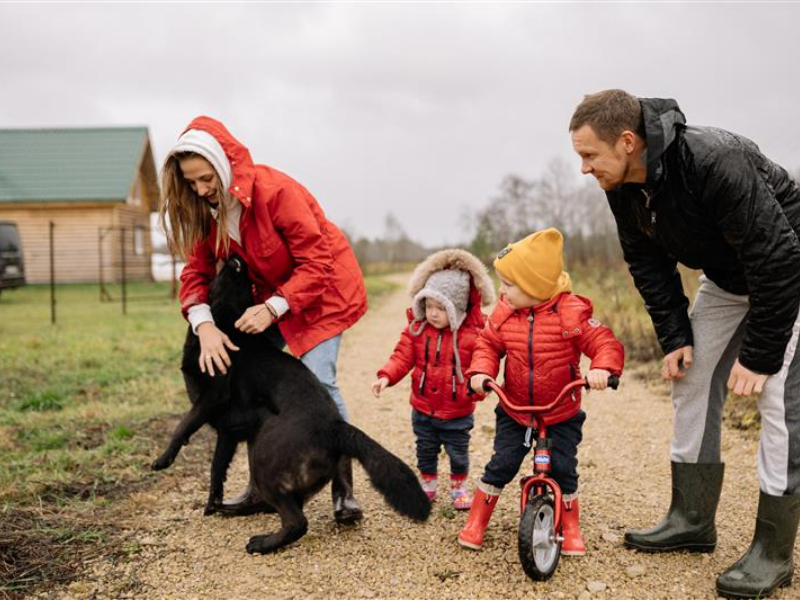
There are around 450,000 households in the canton of Bern. Of these, 135,000 were randomly selected. Thanks to our considerable efforts, we have now exceeded our target of 1,500 households. In total, more than 2,000 people and over 200 pets, mainly cats and dogs, are taking part in 'BEready'. The households are spread all over the canton. As expected, slightly more women than men, and more people of retirement age than young adults, agreed to take part in the study. However, our study includes people of all ages, from newborns to over 90-year-olds.
Invitation in the letterbox
Cornelia Wagner, you are taking part in "BEready". How did you find out about the study?
The invitation to take part in the study arrived in my letterbox one morning.
Why did you decide to take part?
I think it makes sense for society to prepare for the next pandemic. I'm an epidemiologist at the University of Fribourg, and although my job involves long-term studies, it is not in the field of infectious diseases. Due to my profession, I am aware of the importance of such data. It's interesting for me to see the other side. I analyse data on a daily basis, and I am now gaining an insight into what it feels like to contribute data to a study. Moreover, the effort involved is minimal. I thought to myself, 'Why not go to the Inselspital for an afternoon and fill out a few online questionnaires?' Once you've done that, the effort required as a participant is minimal: last week, for example, my partner and I had a cold. It only took five minutes to report it.
There are no tests yet for the pathogens of a future pandemic. What exactly did the participants agree to?
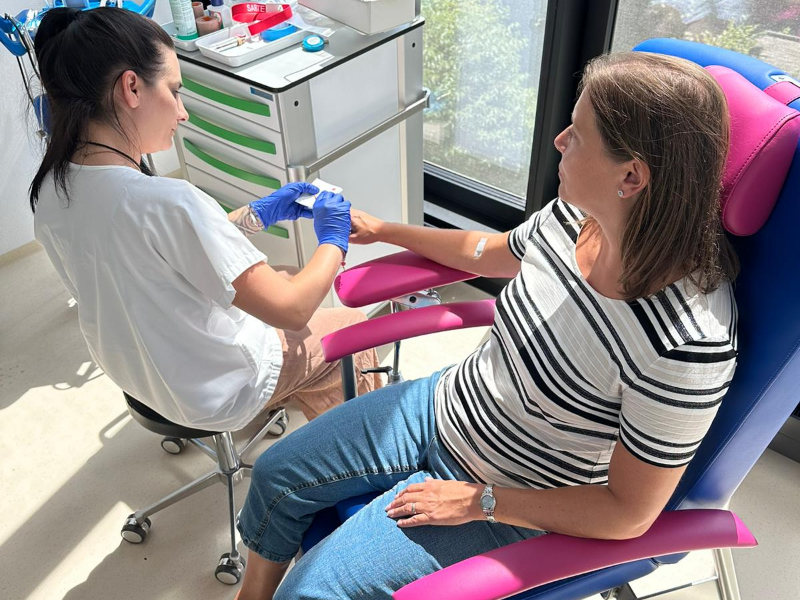
'BEready' is an observational study in which we collect data in the form of annual questionnaires. These cover topics such as people's eating habits and health status, including whether they suffer from allergies or chronic illnesses. We also collect annual blood samples.
Our study has no set end date. We have informed the participants that the study is designed for the long term. The ethics committee has initially approved the study for five years, after which we can apply for an extension. We don't currently know whether nasal swabs, urine samples or saliva samples will be required in the future – but we know exactly who we can count on, as we know that the participants in the BEready study like our idea and are generally willing to provide such samples if required.
Ideally, you don't need the data.
Yes! (laughs) If everything goes perfectly, the event you're trying to prevent won't happen. It's like taking out insurance. You hope you'll never need it. But if a damage does occur, you're glad you're well prepared.
Moreover, our approach of monitoring infectious diseases throughout the entire household, including children and pets, is unique worldwide. We therefore believe that it is well suited to filling existing knowledge gaps.
“We can't prevent a pandemic from breaking out somewhere, but we can prepare for it.”
- Eva Maria Hodel
The study relates to the canton of Bern. Is the data also relevant beyond the canton's borders?
For logistical and financial reasons, we have limited the study geographically. In principle, 'LUready' or 'SOready' would also be suitable. However, our study was made possible thanks to a generous donation from the Vinetum Foundation. The foundation made it clear from the outset that the money should benefit the canton of Bern.
During the pandemic, Switzerland has used data from Belgium and several other European countries to model aspects of the spreading of the disease, such as the duration and number of social contacts. In times of need, you simply use whatever data is available and make assumptions about what might be similar and what might be different. If Grisons can access data from Bern in future, for example, this will probably be advantageous. Even if there are differences in cantonal regulations, the healthcare system in Switzerland remains comparable overall.
Social divisions have emerged during the pandemic, for example between those in favour of and those against vaccination. How does BEready deal with that?
Yes, the pandemic has divided the population. Many unvaccinated people were marginalised by society and had negative experiences. For some of these people, such feelings resurface when we announce a new study on pandemic preparedness. We have therefore received several unpleasant emails and phone calls, but fortunately no threats.
In the invitation letter, we inform people that they have been randomly selected. It is not our place to tell people what to do. We simply observe and aim to make comparisons, for instance between vaccinated and unvaccinated individuals. This is why we have also encouraged sceptical individuals to participate in 'BEready'.
That sounds very conciliatory. It's as if you want to get everyone back on board.
Our aim is to conduct a study for as many people as possible in the canton of Bern. Our study is open to everyone: young and old, healthy and unwell, critical and enthusiastic. We are interested in covering the entire spectrum. This also makes sense from an epidemiological perspective because comprehensive data enables us to assess the impact of measures such as school closures on the population as a whole more effectively.
“Can a virus spread if the cat brings home a dead bird?”
- Eva Maria Hodel
Why is "BEready" also interested in pets?
There are various reasons for this. Firstly, we want to be able to trace the transmission routes of viruses and other pathogens. Currently, we only take blood samples from dogs and cats. However, this may change if bird flu becomes widespread in the future, for example, and we therefore want to collect more data on birds. We also want to know whether pathogens spread to pets, and vice versa. For example, can a virus be spread if a cat brings a dead bird home?
And the second reason?
It is well-known that pets can have a positive effect on mental health. This, in turn, could strengthen the immune system and hinder the spread of pathogens. In order to investigate this, we would take a closer look not only at dogs and cats, but also at rabbits and hamsters.
During the enrollment process, we also found that people were more motivated to take part if their pets were involved too. For many people, pets are family members. They are pleased that our study includes all the people and animals in the household. The ‘One Health’ approach that we are pursuing actually goes even further in principle: it also considers the environment and the consequences of climate change, for example. Diseases transmitted by mosquitoes and ticks, for example, are on the rise. We want to expand our expertise in this area.
About the person

Eva Maria Hodel
is the project manager of the "BEready" cohort study. She is a trained pharmacist and epidemiologist - and knows that after some practice, you can fold 150 letters and put them in an envelope in an hour.
Subscribe to the uniAKTUELL newsletter

Discover stories about the research at the University of Bern and the people behind it.