
Work-Life-Balance
With children, time is the greatest luxury
Expensive daycare, lagging gender equality, and delayed parenthood: many factors are contributing to the declining birth rate in Switzerland. What would need to change to reverse this trend?

The role of children in society has changed. Today, it is far more socially acceptable not to have children than it was 100 years ago. Ben Jann, professor of social structure analysis at the University of Bern, attributes this to the “cost-benefit structures” associated with children. “In our modern industrialized society, children primarily serve a consumerist purpose,” he says. In family sociology, this means that children today fulfill more intangible, personal, and emotional needs than they did in the past.
Before social insurance became the state’s responsibility, many people viewd children as a necessary “investment”. Offspring were expected to contribute to the household income, care for relatives, and look after siblings. “Today, the child has value in and of itself. People have children because they enjoy having children,” says Jann.
Since the late 1960s, the birth rate in Switzerland has fallen steadily. At an average of 1.3 children per woman, it is now at a historic low. This is not merely because people are becoming parents later and later, leading to a decline in fertility. While the desire to have children in Switzerland remained stable for a long time, it has declined in recent years. In a survey conducted by the Federal Statistical Office three years ago, 17 percent of 20- to 29-year-olds stated that they did not want children – more than twice as many as in 2013. Among 30- to 39-year-olds, one in three currently chooses not to have children.
Magazine uniFOKUS
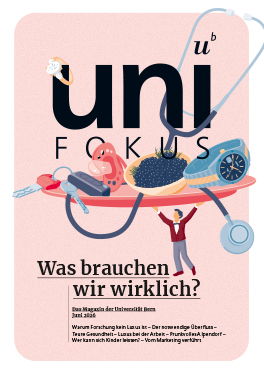
What do we really need?
This article first appeared in uniFOKUS, the University of Bern print magazine. Four times a year, uniFOKUS focuses on one specialist area from different points of view. Current focus topic: Luxury
Switzerland: Bringing up the rear on work-life balance
Aside from changing social norms, cost is a common explanation. Given the political, economic, and social conditions in Switzerland, can many people truly no longer afford to have children? Are children, so to speak, a luxury?
Isabelle Stadelmann, professor of comparative politics at the University of Bern, says: “I would rather speak of a conflict of goals that has intensified, especially for women.” Many women still feel that it is impossible to have both – a successful career and children. “In this situation, women are increasingly opting for economic security and independence over having children.”
A research project by the Institute of Political Science (IPW) shows that Switzerland ranks last in Europe when it comes to work-life balance, gender equality, and family policy. “Even recent reforms, such as the national initiative for supplementary childcare, do nothing to change this,” says Stadelmann. “While there are better childcare options available, they remain very expensive.”
Switzerland lags behind particularly when it comes to parental leave. The EU requires at least four months of parental leave per parent following a birth or adoption, of which at least two months must be taken by the father – a policy also known as the “daddy quota.” In Switzerland, mothers receive only the mandatory 14 weeks of maternity leave, while fathers have been entitled to two weeks of paternity leave since 2021.
About the person

Isabelle Stadelmann-Steffen
is a professor of comparative politics at the Institute of Political Science at the University of Bern. Her research interests lie in the areas of public policy, direct democracy, and political behavior and attitude research.
What is a luxury for you?
“When I can choose between options, whether in research topics or leisure activities.”
Traditional role division prevails
One consequence of this is that after the birth, an “return to traditional roles” often occurs due to unequal division of labor, contrary to previous plans, as stated in a research report by the Federal Commission for Family Affairs.
In Switzerland, the “breadwinner model” is still the most common, in which the man works full-time and the woman takes on more care work. Unlike in Sweden or Germany, for example, egalitarian parental leave models – in which parents divide paid and unpaid work more evenly—are spreading more slowly in Switzerland. Yet it is precisely these models that effectively promote work-life balance and equality, as research at the IPW has shown. “It would be a luxury if we could truly ensure that everyone, regardless of gender, had the opportunity to combine a good job with time for childcare,” says Stadelmann.
Could AI free up time for children?
The concept of luxury also revolves around money. According to estimates by the Canton of Zurich, raising a child between the ages of one and four costs an average of 1140 Swiss francs per month. Added to this are childcare costs, which vary depending on where you live and your income and are among the highest in Europe. At the same time, government subsidies are low. For instance, sending two preschool-aged children to daycare two days a week in Köniz accounts for six percent of a couple’s annual income.
Children pose a particular risk of poverty for single parents and families with at least three children. Nevertheless, sociologist Ben Jann does not describe having children as a luxury from a socioeconomic perspective, because higher income does not automatically mean more children It has been proven that the more educated a person is, the fewer children they have. The longer the educational path, the later the age at which one marries or starts a family. 'As long as one’s professional situation hasn’t stabilised, the desire to have children is postponed,' says Jann.
Above a certain level of education and income, the opportunity costs are also higher – that is, the income a person “misses out on” due to parenthood, for example because they reduce their workload. This, too, can deter couples from having (another) child.
If parents work more, they in turn lack time for family, leisure, and household chores. Jann notes: “The luxury when it comes to children isn’t money, but the quality time one spends with them.” Artificial intelligence offers an opportunity here: “Machines can work for us – and we can spend more time caring for our children.” Provided that the benefits of technological development are distributed fairly.
About the person

Ben Jann
is a professor of social structure analysis and leads the research for the nationwide longitudinal TREE study (Transitions from Initial Education to Working Life). He has published on topics including labor market inequalities and gender equality.
What is luxury for you?
“Having enough time to think.”
Actual paternity leave is out among young men
However, both Stadelmann and Jann ask: Are men unable or unwilling to spend more time with their families? Studies, including an IPW study on time conflicts among egalitarian couples, show that men experience stress and a loss of freedom more frequently when they are expected to take on more childcare responsibilities. Women see more of the advantages and opportunities. "Parental leave with a 'daddy quota' is particularly effective here because it involves fathers in childcare from the outset," says Stadelmann.
The political scientist explains that conservative values in Switzerland are slowing down political change, which is already hindered by direct democracy and federalism. While family models and realities are becoming more diverse, divisions are also widening. Surveys of young Swiss people born between the late 1990s and early 2000s reveal that men of Generation Z are more likely than young women to hold right-wing and conservative views on family models. Young women increasingly favour egalitarian family models.
'When attitudes towards fundamental issues such as the division of roles do not align, partnerships fail and consequently there are fewer children,' says Stadelmann.
About the person

Michael von Wolff
is Chief Physician of Gynecological Endocrinology and Reproductive Medicine at the University Clinic for Gynecology at Inselspital Bern.
Challenges in family planning
'Finding the right partner to start a family with is definitely a luxury these days,' confirms Michael von Wolff, chief physician for gynaecological endocrinology and reproductive medicine at Inselspital, University Hospital Bern. More than half of the women who freeze their eggs at the hospital in order to have children do not yet have a partner for family planning at the time they do so.
Fertility declines rapidly after the age of 35. Treating an unfulfilled desire to have children can cost several thousand francs, from hormone therapies to artificial insemination. Around three percent of live births in Switzerland result from in vitro fertilisation. Until now, patients have had to pay for everything themselves. According to von Wolff, only someone with enough money, time, and flexibility from their employer can afford the treatment. "That is a luxury – or rather, socially unfair," believes the physician.
However, reproductive medicine is not a simple solution. The older the mother, the higher the risk of complications, miscarriages and birth defects. 'For the body, it's actually more of a luxury to have children at 25 or 30,' says von Wolff. 'Parents who are no longer quite so young' are under pressure. On the other hand, they have more time for education and personal development. So are children a luxury? What is certain is that they demand a lot of resources from parents, especially in Switzerland, resources that not everyone has.
Subscribe to the uniAKTUELL newsletter

Discover stories about the research at the University of Bern and the people behind it.