Bern’s Largest Housing Development Project
The Viererfeld Becomes a Living Laboratory
Within the next twenty years, 3,000 people are expected to move into Bern’s Viererfeld district. Researchers at the University of Bern’s Institute of Geography have launched a wide range of projects to study the transformation of this area of land in the north of the city into a new urban neighbourhood.
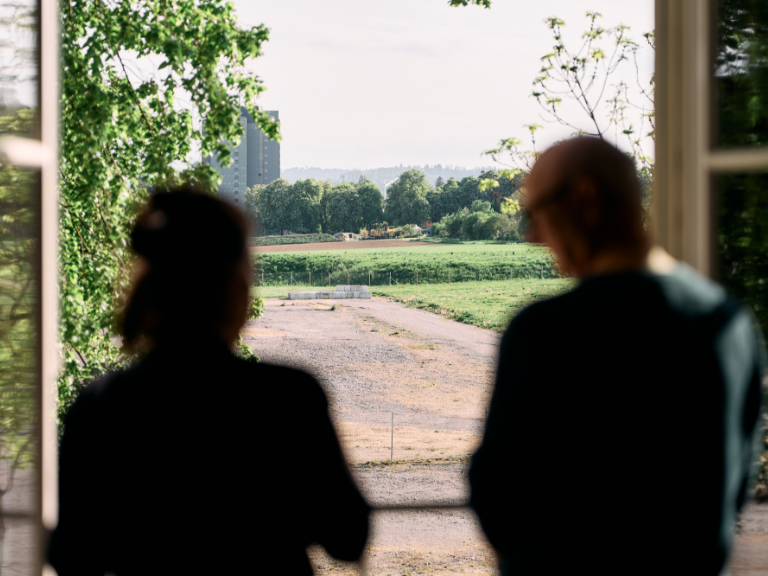
Spanning more than 19 hectares, the Viererfeld stretches out before Enge primary school in Bern. Over the coming years, the site is to be gradually developed to provide housing for 3,000 residents and more than 500 jobs. After decades of political wrangling and several closely contested public votes, the Swiss capital’s largest housing project is finally going ahead.
“There is little room left for major adjustments. At this point, it is fascinating to study how this construction project will change people’s living conditions and the environment,” says Stefan Brönnimann. The head of the Climatology Unit at the University of Bern’s Institute of Geography and his colleagues identified the Viererfeld — located within walking distance of the institute — as an ideal research site. While Eawag, the Swiss Federal Institute of Aquatic Science and Technology, had already spent several years measuring precipitation and temperatures there, the University of Bern is now continuing these observations. Yet the “UrbanLab” research project (see box) is going much further.
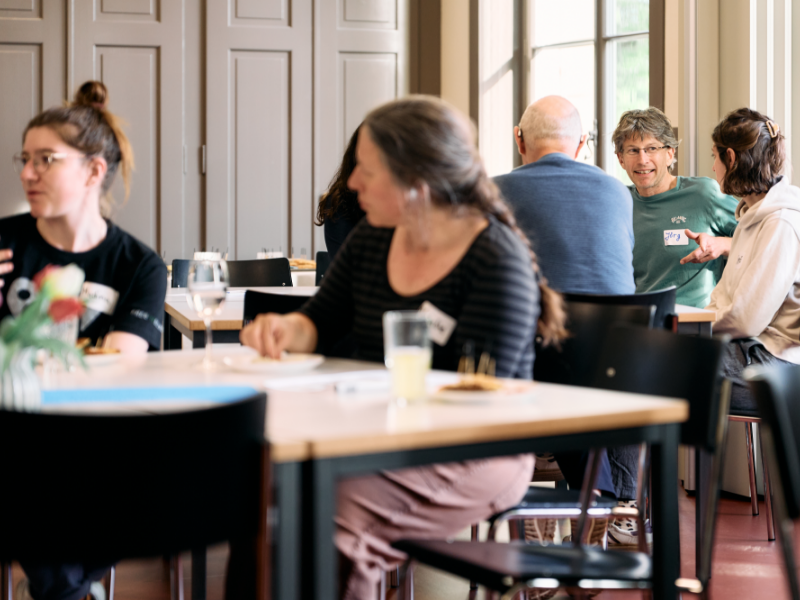
To demonstrate this, at the end of April the Institute of Geography invited local residents to a “KooPéro” at the Enge school building— an event designed to foster the exchange of information and dialogue. Neighbours of the future district were invited to participate. “We wanted to know: What are their priorities? What concerns them? And how do they feel about living next to a major construction site for two decades?” explains Moritz Gubler, a research associate at the Institute of Geography and lecturer at Bern University of Teacher Education.
Preserving the Area’s Cooler Character
The Viererfeld isn’t just a plot of urban land that has so far been used for agriculture. With its partially dense tree cover along the edges, it is also the coolest part of the city temperature-wise. “In the city centre, we are trying to combat heat islands through greening, rainwater infiltration and shading measures. Here, by contrast, we are studying how a sustainable construction project can preserve the existing conditions as far as possible,” explains Gubler. The Viererfeld offers students and researchers a rare opportunity to investigate real-world urban development processes in collaboration with other disciplines and institutions — processes that would otherwise remain theoretical. Its size is also remarkable: 19 hectares, where many urban projects concern little more than a handful of parking spaces.
“We are investigating which types of outdoor spaces are attractive to schoolchildren.”
Sophie Meyer, project manager at the Institute of Social and Preventive Medicine
UrbanLab Viererfeld
An UrbanLab is a shared space for learning and research. It brings together researchers, public authorities and residents to address questions of sustainable urban development.
The University of Bern’s current UrbanLab is exploring how the ecological and social sustainability goals of the City of Bern can be achieved during and after the construction of the new Viererfeld neighbourhood from a variety of transdisciplinary perspectives. To this end, practice-oriented data is collected from physical geography, biology, economics and the social sciences. The project also aims to simulate the interactions between the new residential structures and environmental factors.
The findings intend to provide planners with valuable ideas and approaches for further developing their projects.
The UrbanLab encompasses numerous individual projects, including the work of student Anja Netzle. Netzle has distributed hundreds of questionnaires to households surrounding the Viererfeld to find out where residents feel particularly comfortable and which places they tend to avoid. The results are being translated into “mental maps” that identify especially valued locations within the area.
A clear favourite has emerged: the old tree-lined avenue, with its panoramic views of the Alps on clear days. By contrast, many respondents described the forest edge on the opposite side — where dog owners frequently let their pets run free — as less pleasant. “One possibility would be to repeat the survey as construction progresses, ensuring that the quality of the surroundings does not deteriorate,” explains Netzle.
Many respondents also shared personal memories connected to the Viererfeld. “As children, we would secretly dig up potatoes there in the evenings and take them home with us,” one resident wrote. Another recalled stories from their parents about the Swiss Exhibition for Women’s Work (Saffa), held on the site in 1928.
Contributing to Quality of Life
In her bachelor’s dissertation, student Aline Huber is focusing on water management at the site. “I’m studying how the blue-green infrastructure — the water and green spaces within the development — can be strengthened,” she explains. Huber is calculating the current precipitation levels on the site’s open fields and comparing them with future projections.
Up to half of the site is intended to remain open and publicly accessible as a park. “Ideally, I will be able to provide recommendations that allow for even more infiltration and greening,” Huber says. Although the construction project has already been approved and can now only be modified in minor details, façade greening could still be incorporated and help improve the local microclimate.
The project’s interdisciplinary nature is also evident in the work of Sophie Meyer, project manager at the Institute of Social and Preventive Medicine. Meyer co-supervises a doctoral project examining how schoolchildren use public space. School classes from the nearby Enge school have been asked to photograph places where they enjoy spending time during summer. The photos will provide insights into how outdoor spaces in the new neighbourhood should ideally be designed so that children and teenagers can continue to use them despite increasingly hot summers — thereby supporting their health.
Residents Hope for Improvements
What impact will housing for 3,000 people and several hundred jobs have on the neighbourhood and its residents?
“I hope the new development will mean that some new local shops open, similar to those in the Länggasse district,” says one resident, who has lived in the area since childhood. His companion would also be happy to welcome the development’s future residents. Having moved to Bern from Biel herself, she remembers experiencing the shyness of the local people first hand. “Someone once told me that unless you went to school in Bern, you’re not a real Bernese person.”
“I hope some attractive housing for older people will be built — then I would be able to stay in the neighbourhood.”
Viererfeld resident
The resident says she values social diversity, but is concerned about the expected site traffic, noise and dust during the construction phase. At the same time, she acknowledges that the ageing neighbourhood north of the main station could benefit from renewal. Approaching retirement herself, she feels comfortable in the area. “But whether I’ll still be able to climb the stairs to the first floor in ten or fifteen years, I don’t know.” She hopes suitable housing for older residents will be included in the development so she can remain in the neighbourhood.
A representative of “Pluto,” an emergency housing shelter for young people aged 14 to 23, also attended the event. The shelter’s current location nearby is ideal, he said: “Not too peripheral, not too close to the city centre.” Yet once housing for young families is built nearby, conflicts could arise with shelter users. This illustrates how competing uses within urban neighbourhoods don’t simply coexist but need to actively be negotiated.
Jeannine Wintzer, a social geographer involved in the project, stresses that new forms of coexistence need to be developed so that marginalized groups, including young people, aren’t pushed further to the city’s edges but instead considered part of the neighbourhood.
It will only become clear in two decades’ time as to whether the Viererfeld development fulfilled expectations or whether the scepticism was justified — and whether new local shops or even a weekly market emerge to connect the new neighbourhood with the surrounding streets.
By then, today’s students will long since have moved on, and “Pluto” will probably have found a new home as well. Project leader Stefan Brönnimann acknowledges that direct before-and-after comparisons will only be possible with difficulty. “But as a research and learning laboratory, the Viererfeld is extraordinarily diverse — and in twenty years others might revisit the topic and compare its outcome with today’s observations.”
Engaged UniBE: Building Bridges Between University and Society
Our society faces major challenges, including climate change and adaptation, biodiversity loss, demographic change and the impacts of digitalisation. Addressing these challenges requires broad public dialogue. Engaged UniBE is an initiative of the University of Bern that aims to actively strengthen the dialogue between academia and society and to anchor the university more strongly within society.
Subscribe to the uniAKTUELL newsletter

Discover stories about the research at the University of Bern and the people behind it.