
Climate Change
Putting Switzerland’s 2026 Drought into Perspective
The effects of the 2026 drought are still visible everywhere. Researchers at the University of Bern have compared droughts in the 21st century with those of the past 600 years. Their findings show that the risk of drought is increasing sharply as climate change progresses.
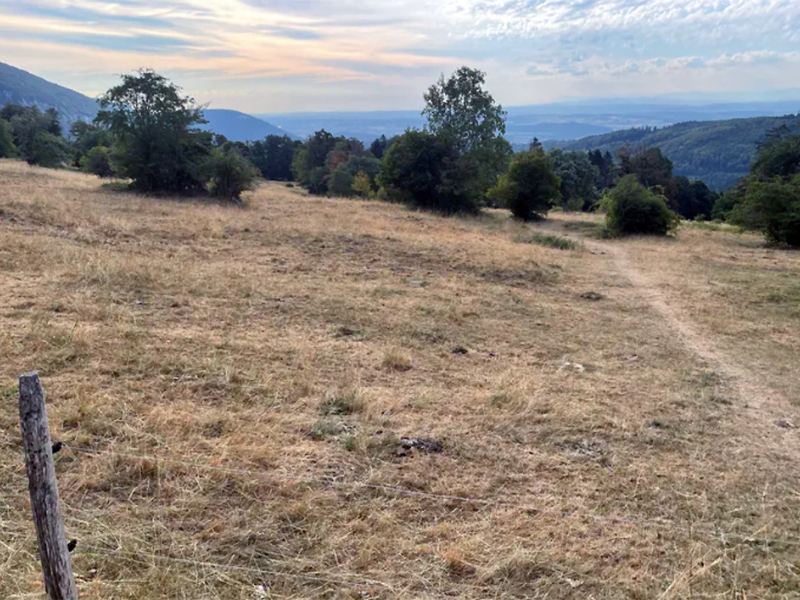
Withered meadows, crop losses, widespread forest damage, and low river levels: Hot summers like those of 2003, 2018, or now 2026 are perceived as exceptional. But how exceptional are these droughts really when compared to the natural climate variability of past centuries?
Alumna Patricia Helpap systematically investigated this question in her master’s thesis at the University of Bern, not only for Switzerland but on a global scale. To this end, Helpap—who is now pursuing her PhD at ETH Zurich—collaborated with researchers at the Oeschger Center for Climate Research (OCCR). The results were recently published in the journal AGU Advances.
Modern droughts are not unprecedented everywhere yet
In her work, Helpap examined the last 600 years through 2024. She combined observational data with simulations from a global climate model. This allowed her to take a uniquely broad look back into the past.
“Some regions, such as the western United States, the Amazon, and Central Africa, have experienced droughts in the 21st century that were unprecedented in the last 600 years,” she explains. In Europe, on the other hand, individual years of drought fell, statistically speaking, within the range of historical fluctuations.
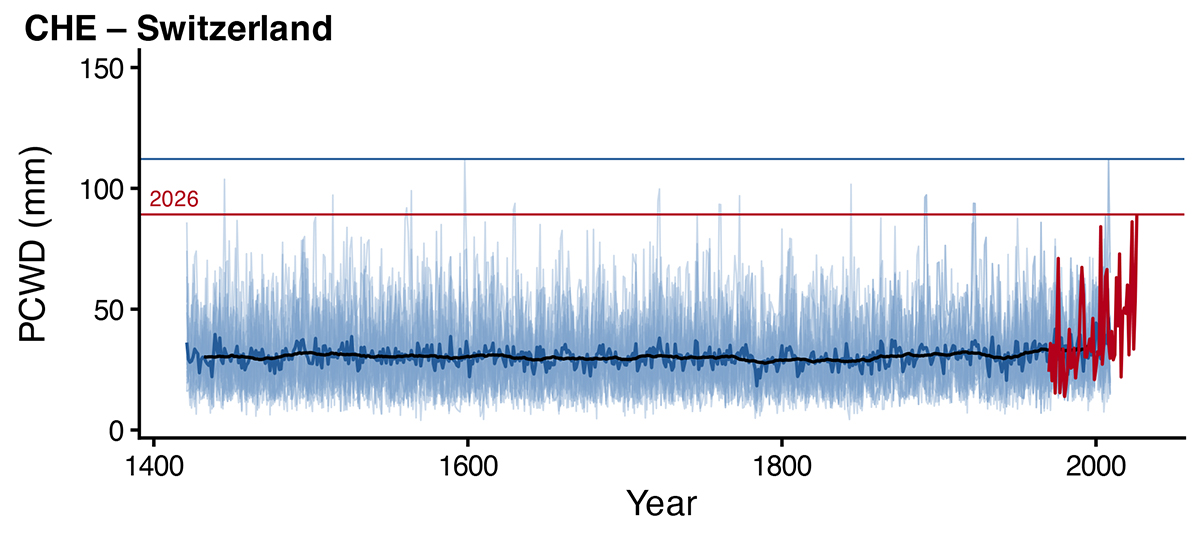
However, according to Patricia Helpap climate change is increasing the risk of extreme droughts everywhere. It is now more likely than ever before during the last 600 years that they will occur.
Climate change makes droughts such as the one in 2026 more likely
The data included in the AGU Advances study only extends through 2024. It therefore does not cover the 2026 drought. However, Benjamin Stocker, head of the Geocomputation and Earth Observation research group at the OCCR and co-author of the study, and his team have since published an expanded analysis. This shows that the 2026 drought was the most severe drought in Switzerland since systematic climate records began.
About the Person
Patricia Helpap was a Master student at the Oeschger Center for Climate Research at the University of Bern until August 2025. She is now a doctoral candidate at the Institute for Atmospheric and Climate Science at ETH Zurich.
About the Person

Benjamin Stocker heads the Geocomputation and Earth Observation research group at the Oeschger Center for Climate Research.
Nevertheless, simulations covering the past 600 years show that even more severe droughts occurred on rare occasions. “Statistically speaking, the 2026 drought was not unprecedented, but it was nonetheless an extreme event,” explains Stocker. “Put simply, under pre-21st-century climate conditions, a comparable drought would have been expected about once every 500 years.” However, the probability of such extreme events has shifted to such an extent that droughts of comparable or even greater magnitude must be expected soon if climate change continues to progress.
Publication details
Helpap, P., Brönnimann, S., Hand, R., Franke, J., Raible, C. C., & Stocker, B. D. (2026). Are modern droughts unprecedented? AGU Advances, 7, e2026AV002536. https://doi.org/10.1029/2026AV002536