
Places at the University of Bern
Medieval prints on digital platforms
The Center Historical Collections at the University of Bern catalogs and preserves centuries-old materials and makes them digitally accessible. A look behind the scenes reveals how the past and the future are coming together.
The Center Historical Collections of the University of Bern is located in the heart of Bern’s historic old town, in the Münstergasse Library. The Center is home to centuries-old printed works and maps from all over Europe. In the vaults of Münstergasse 61, the Head of the Center, Valentina Sebastiani, makes her way into the secure area of the building. She is about to take uniAKTUELL on a short journey back in time to the 15th century.
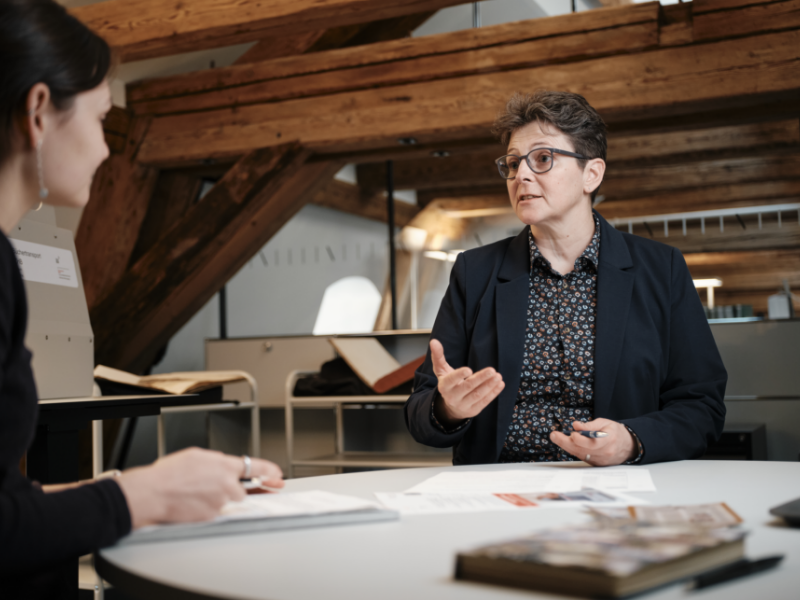
The Center Historical Collections is dedicated to the cataloging, conservation, retro-digitization, and accessibility of historical collections. “The mission of the Center is to preserve these collections as cultural heritage and as a source of identity for future generations,” explains Sebastiani.
Center Historical Collections
Center Historical Collections
The correction workshop is a free, public participatory offer from the Center Historical Collections together with the Münstergasse Library of the University Library of Bern (UB Bern). Participants go through digitized newspaper articles together and correct OCR errors in order to sustainably improve the quality and searchability of the e-newspaperarchive portal. The offer takes place within the framework of Citizen Science at Bern University Library and is open to the general public.
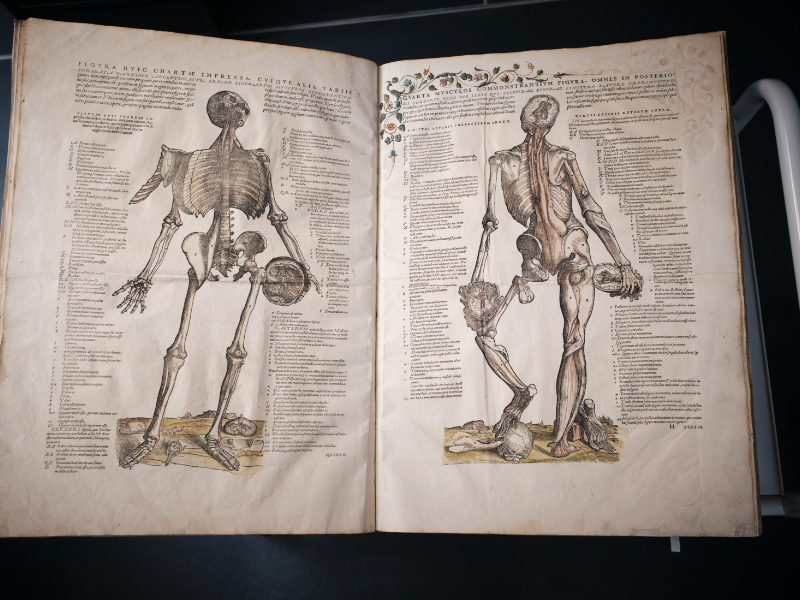
The scope of these collections is impressive: “We hold over half a million early prints and around 22,000 historical maps here,” Sebastiani continues, pointing to one of the most famous medical treatises of the 16th century: a copy of De humani corporis fabrica libri septem, written by the anatomist and surgeon Andreas Vesalius in 1543, which lies on a table in her office.
Yet even though Valentina Sebastiani and her team handle such rarities on a daily basis, this is by no means something they take for granted: “It is a privilege to be able to work with these prints,” she emphasizes, adding: “Only thanks to the collectors of the past do we now have the opportunity to analyze how knowledge was created, disseminated, and used.” This once again ties in with the Center’s mission. The originals are to be preserved for at least another 500 years so that future generations will also have the opportunity to study these works.
«It is a privilege to be able to work with these prints.»
- Valentina Sebastiani
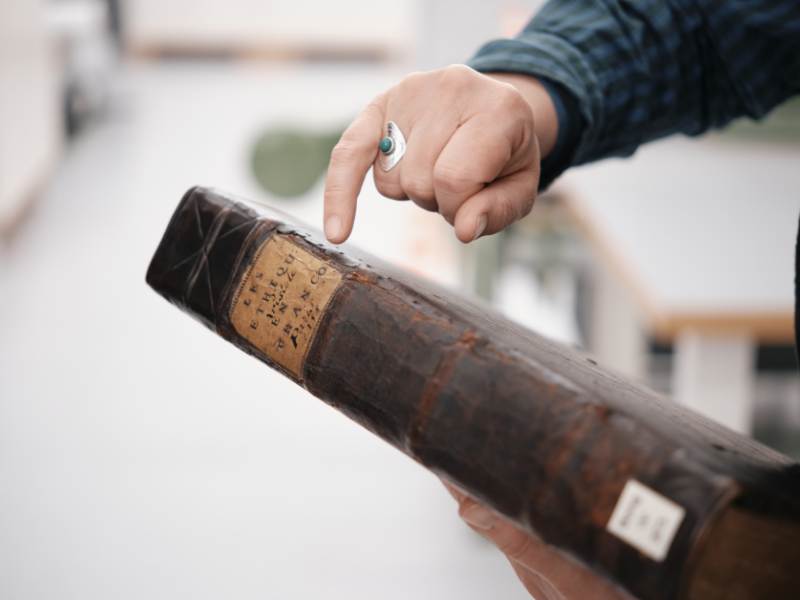
Valentina Sebastiani moves on to the next book, which is waiting in a special transport container and will accompany her through the various areas of the Center. It is an incunable – one of the earliest printed works produced after the invention of book printing in the 15th century.
Over 500 years into the past
Valentina Sebastiani carefully carries the incunable to the first station on this journey, where she meets staff member Fabian Fricke. He is responsible for cataloging and making the old collections accessible. As he removes the valuable book from its protective cover, he explains that this station is particularly interested in the history of the book.
His trained analytical eye examines this unique item to obtain key information for the catalog entry. “When cataloging early prints, we not only record general information about the work and its edition, but also special features such as the binding and previous owners,” explains Fricke. Each year, they produce around 2,100 catalog records.
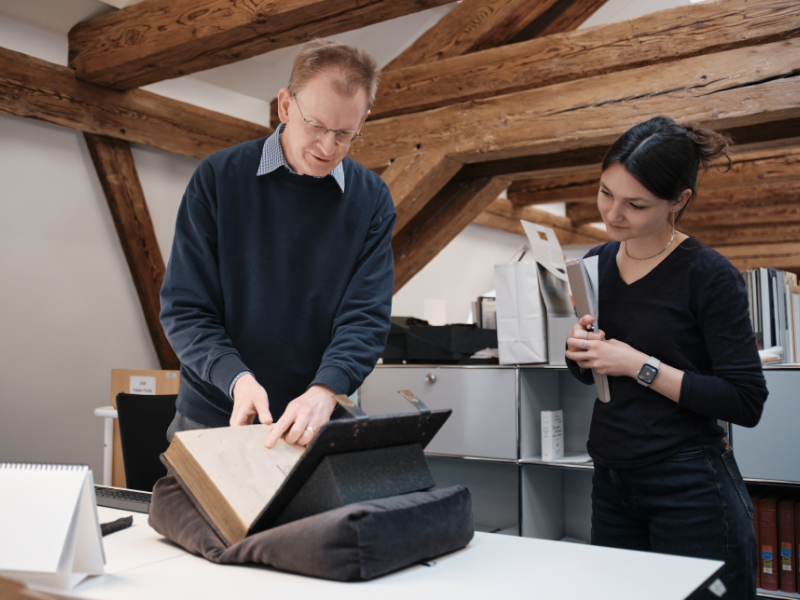
“There's always a bit of research involved,” continues Fabian Fricke as he records the metadata. “The book Les éthiques en francoys was printed in Paris in September 1488.” Using the date and address entered, the printer or publisher of the book can also be found, for example.
Enabling sustainable access
With the knowledge gained, the book moves on to the Conservation unit, a bright studio equipped with microscopes and various measuring instruments. Here the book is handed over to Petra Hanschke, Head of the Conservation unit and Deputy Head of the Center.
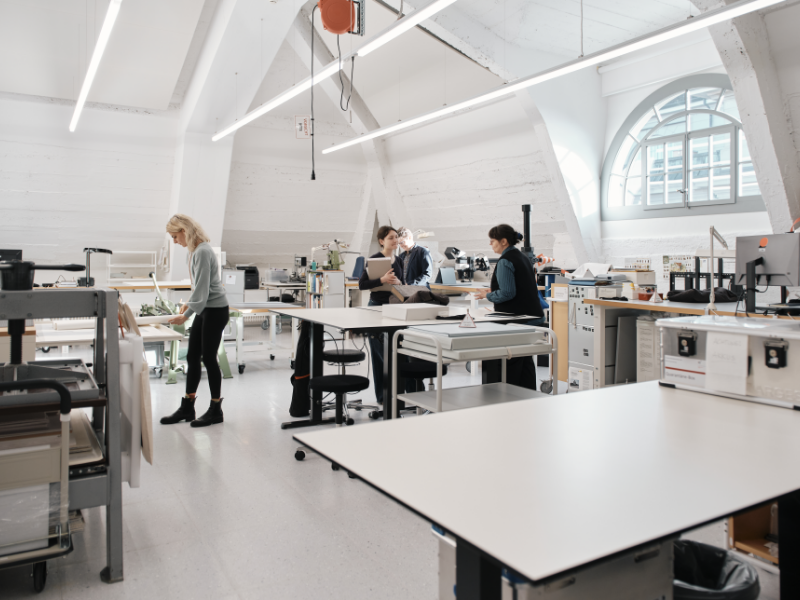
The Conservation unit defines the proper procedures for handling these unique items. “When an item comes to us, we first carry out an assessment of its condition,” explains Hanschke. This begins with a risk analysis in order to determine appropriate preventive measures and keep the risk of damage to the book as low as possible. “The aim of conservation is not to impose an endpoint with an invasive treatment, but to leave room for future generations to decide for themselves what they want to do with the books,” Hanschke explains.
Petra Hanschke takes a close look at the book. She checks the condition of the leather binding, identifies traces of moisture damage on the pages, and examines the ink and pigments used.
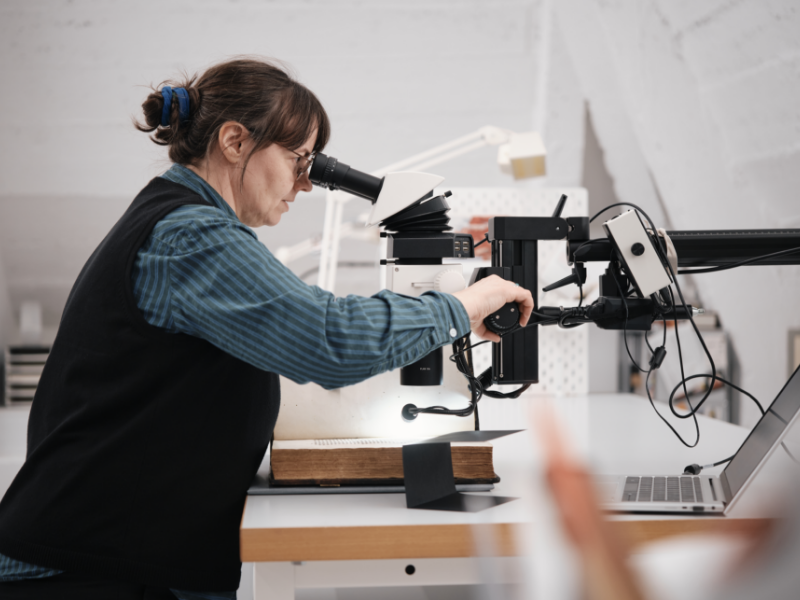
Good cooperation between the various specialists in the different areas is therefore extremely important to Petra Hanschke. “Our main task is to ensure that the apparent dichotomy posed by use and preservation becomes a tandem,” she explains.
«Our main task is to ensure that the apparent dichotomy posed by use and conservation becomes a tandem.»
- Petra Hanschke
This interplay of different expertise becomes even clearer at the next stage: “Retro-digitization is about making the books digitally available on platforms such as swisscollections, e-rara or E-Periodica while carefully observing all conservation requirements,” says Valentina Sebastiani.
Back to the future
Arriving in the studio of the Retro Digitization Service brings one abruptly back into the present. The ultra-modern equipment and numerous screens form a striking contrast to the incunable that has just been brought in. “Very old and very modern – that is what makes our work so exciting,” says Sebastiani, as she hands the incunable over to photographer Remo Stoller.
Which device is used for digitization depends, among other things, on how gently the print needs to be handled. “It is also essential that the color reproduction is true to the original,” says Remo Stoller.
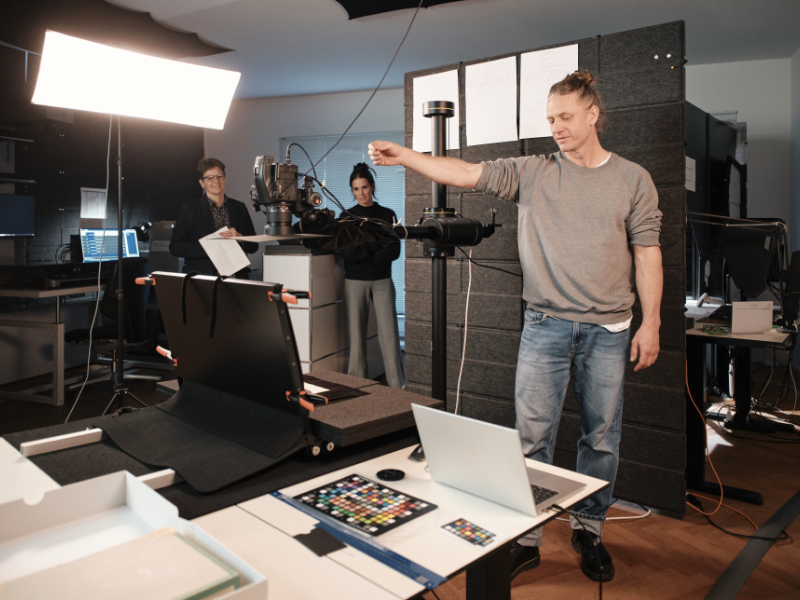
The book is positioned for digitization, and the image settings are configured according to the specifications of the respective platform. A bright flash illuminates the room, and the first page appears on the screen. This process is repeated for every single page.
«We connect analog printed works from the Middle Ages with the digital world of online platforms.»
- Beat Vonlanthen
“We then upload the work to a transfer server. From there, it is collected nightly by the ETH Library and uploaded into a platform,” explains Beat Vonlanthen, Head of the unit. “It is then structured in the Visual Library Manager. This is how we connect analog printed works from the Middle Ages with the digital world of online platforms,” he adds.
From unique specimen to digital copy
The journey then takes us back to Fabian Fricke in the Cataloging and Accessibility unit. He now has access to the digitized book via the Visual Library Manager. “By structuring the content, we make it easier for users to navigate the digitized book and find the information they are looking for.” Fricke checks that all pages have been scanned, divides the book into chapters, and creates tables of contents.
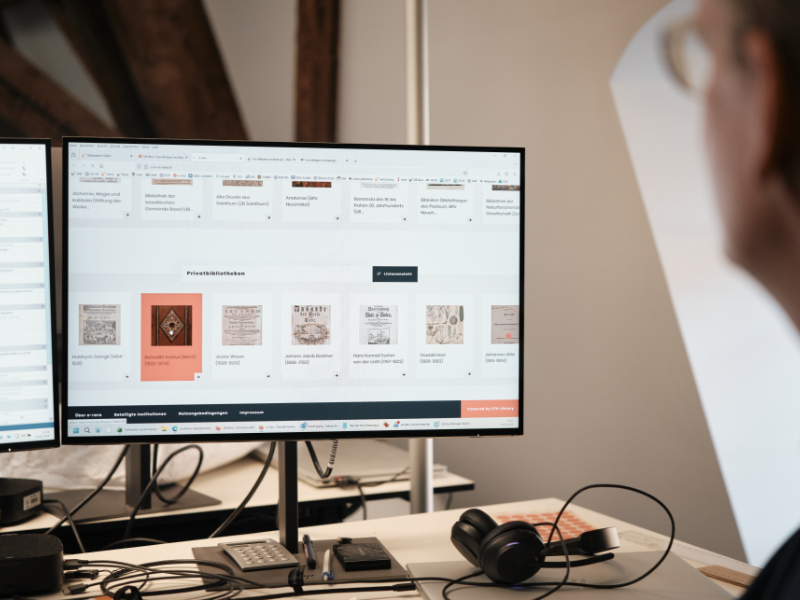
Another part of the process involves the use of artificial intelligence. Although unique historical works and automated digital copies may seem contradictory at first glance, the team has a clear stance on AI: “We follow developments in artificial intelligence with great interest,” emphasizes Center Head Valentina Sebastiani. “AI opens up new possibilities for making texts available while protecting the original.” Optical character recognition (OCR), for example, is already part of their everyday work.
«By structuring the content, we make it easier for users to navigate the digitized book.»
- Fabian Fricke
However, this technology is not yet without its faults. Errors in text recognition can, for example, be corrected in the “correction workshop.” Offered as part of a citizen science initiative, it is open to the public. The works are then presented to a broad audience on platforms such as e-rara. It is also possible to consult the originals in the special reading room.
Correction workshop
The correction workshop is a free, public participatory offer from the Center Historical Collections together with the Münstergasse Library of the University Library of Bern (UB Bern). Participants go through digitized newspaper articles together and correct OCR errors in order to sustainably improve the quality and searchability of the e-newspaperarchive portal. The offer takes place within the framework of Citizen Science at Bern University Library and is open to the general public.
“We want to preserve the cultural heritage of Bern and beyond,” explains Valentina Sebastiani. “Through conservation, accessibility, and outreach, we create sustainable access to our historical collections and help to make them better known.” In this way, the Center Historical Collections is building a bridge between the past and the future.
About the person:

Dr. Valentina Sebastiani
Dr. Valentina Sebastiani is Head of the Center Historical Collections at the University Library Bern (UB Bern) and is responsible for its strategic development. Her tasks include coordinating retro-digitization, securing third-party funding, and managing projects and processes in the areas of preservation, administration, and accessibility of historical collections and Bernensia. She also represents the interests of the historical collections within UB Bern, as well as in professional bodies and on digital platforms in Switzerland and internationally.
Subscribe to the uniAKTUELL newsletter

Discover stories about the research at the University of Bern and the people behind it.