
Rubbish or resource?
Let’s talk rubbish
Talking about waste is usually a necessary evil. But the way we refer to it and talk about unwanted waste also determines how we deal with it. A project at the Department of English at the University of Bern is looking for new ways to approach the grubby pariah linguistically.
Hong Kong is a forest of skyscrapers, an Asian financial centre whose cityscape is characterised by glittering shopping malls. What hardly anyone notices are the columns of men and women who discreetly clean the restaurants, scrub the toilets and remove the detritus of consumerism. While cleaning service workers are indispensable for keeping the consumer carousel running, they are socially stigmatised and usually ignored – even by the academic research. Charmaine Kong wants to change this.
Magazine uniFOKUS
Language
This article first appeared in uniFOKUS, the University of Bern print magazine. Four times a year, uniFOKUS focuses on one specialist area from different points of view. Current focus topic: Language.
To this end, the doctoral student at the Department of English at the University of Bern joined the cleaning teams in the Asian megacity. “I'm investigating how people talk about waste and dirt at the heart of the system – or how the unpopular topic is simply left out of the collective consciousness,” says Kong. Emblematic of this is the fact that cleaning service workers are rarely provided with adequate checkrooms and break rooms. This contrasts with how these people themselves talk about their work: contrary to what might be assumed, they are not at odds with their fate, but are in fact proud to have established themselves professionally and to be able to support their children with their earnings.
Questioning the everyday
Crispin Thurlow, Full Professor of Language and Communication at the Department of English at the University of Bern, has been investigating the connection between rubbish and language for some time. “Language is central to how we think about waste in everyday life. In official public messaging, for example, we are constantly encouraged to focus primarily on paper and plastic bottles – while many other things are overlooked or ignored,” says Thurlow. Unlike many other research projects, “Articulating Rubbish” (see box) listens to the people behind the scenes.
While Charmaine Kong interviews humble cleaning staff in Hong Kong, PhD student Laura Wohlgemuth goes down into the cellars of private individuals where unused, but not necessarily worthless, items are stored. Children's clothes, dog baskets and Bülach preserving jars remain in storage for months, years or even decades until the material is either needed again, disposed of or put to the next stage of use, be it being placed at the roadside with a “free for the taking” sign or the thrift shop. Finally, Alessandro Pellanda, the third doctoral student, visited numerous municipal administrations and tried to find out why they attach so much importance to the design of the municipal infrastructure – right down to the design of the municipal fee-based rubbish bag.
The solution to the “waste crisis” starts small
The “temporary storage facility in the cellar” and the fee-based bin bag are so banal that they are hardly discussed in everyday life. That should change. Because what is needed is awareness and then action on a small scale, in the private and personal sphere, to make change possible on a large scale. According to the United Nations Environment Programme (UNEP), 1.3 billion tons of municipal waste are produced worldwide every year, putting a strain on the environment and human health. “There is a disconnect between the promise made by the administration responsible for waste management and the responsibility we have as individuals for the creation and disposal of waste,” explains Thurlow.
«There is no such thing as zero waste.»
- Crispin Thurlow
Waste is not simply rubbish that is bad and should be minimised. “By not simply seeing excrement as something disgusting, for example, but understanding that excrement is completely natural and can even be useful as fertiliser, the way we think about the nature of waste can shift,” Thurlow gives an example. And there is no such thing as zero waste anyway: waste can also be the starting material for upcycling and thus make something new possible. After all, what we throw away or keep also says something about us ourselves. Such a more conscious approach to language and waste could lead to us becoming more cautious about what goods we allow into our homes. After all, we are responsible for them until they become waste again or raw material for something new.
Zur Person
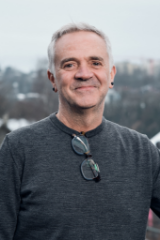
Prof. Dr. Crispin Thurlow
ist seit 2014 Ordentlicher Professor für Language and Communication am Institut für Englische Sprachen und Literaturen der Universität Bern. Zuvor arbeitete er mehr als ein Jahrzehnt an der University of Washington in den USA, wo er 2007 den Distinguished Teaching Award für hervorragende Lehre erhalten hat.
“Switzerland is building on its waste myth.”
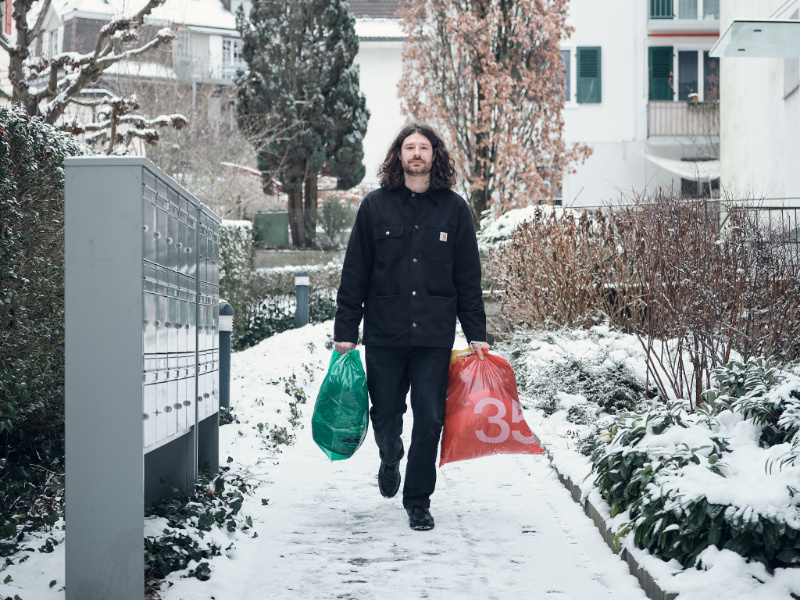
“Blue lakes, green meadows, sparkling-clean old towns: Switzerland likes to present itself as a role model when it comes to cleanliness. We are also supposedly the world leader in waste recycling. While Switzerland’s official authorities are working on this myth, it is blissfully ignored that hardly any other country produces as much waste per capita as we do. In fact, the 29 waste incineration plants would grind to a halt if we suddenly switched to zero waste.
My dissertation puts the spotlight on exactly this contradiction between what is said and what is not said. I also show how cities and municipalities spend a lot of energy and money on the design of an individual fee-based rubbish bag. My home canton of Ticino alone has several dozen variations. Although the plastic bag is only on the roadside for a few hours, the authorities use it to promote themselves as competent waste managers. Who knows, maybe I can later establish myself as a communications consultant in the field of waste for municipalities.”
“Our cellar is a stopover.”
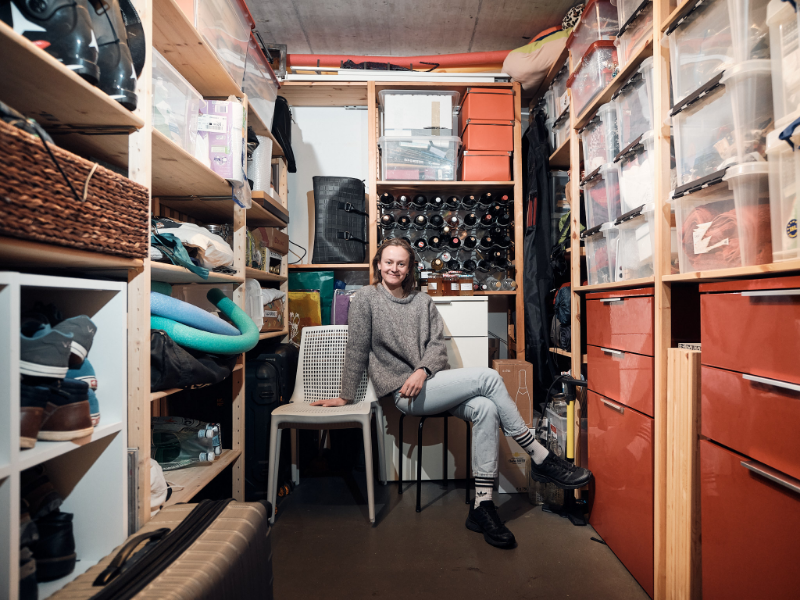
“It may be cool, damp and often a bit creepy, but the cellar is always practical. It's where we pile up everything we don't want to throw away and soothe our guilty conscience about having bought too much. For my dissertation, I asked people to show me their cellar and tell me something about the items stored there. The things there are in a sort of limbo state that is not normally described in words, but tacitly accepted. Some things are discussed beforehand at the kitchen table, such as whether you really want to keep the children's clothes or whether it would be better to put them in the used clothes collection or give them to the thrift shop. Choosing the cellar as temporary storage gives the item a certain emotional value.
The conversations with participants have also shown how important it is for us to behave correctly. At the same time, we all tend to hoard. Incidentally, cellar compartments in Swiss apartment buildings also lend themselves to an unspoken competition: whoever keeps things perfectly tidy is the winner.”
About the project
Waste is also affected by language
Crispin Thurlow is leading the “Articulating Rubbish” project funded by the Swiss National Science Foundation (SNSF), which is investigating the how rubbish is understood and manifested linguistically. This could lead to a new way of talking about waste – and dealing with it. The idea for the project was partly developed in the “Language and Waste” seminar, which was co-funded by the Sustainable Development through Education (FNE) programme. The FNE programme also sponsored a special seminar that brought students from all over Europe to Bern in 2025 as part of the European University Alliance ENLIGHT.
Subscribe to the uniAKTUELL newsletter

Discover stories about the research at the University of Bern and the people behind it.