
Elite sports and academic studies
“It was hard to accept that nature is stronger”
Romano Mombelli swam against the current in the Kaʻiwi Channel for 13 hours before he had to abandon the attempt. The extreme swimmer has already crossed the English Channel and the Strait of Gibraltar – and works at the Institute of German Studies at the University of Bern.
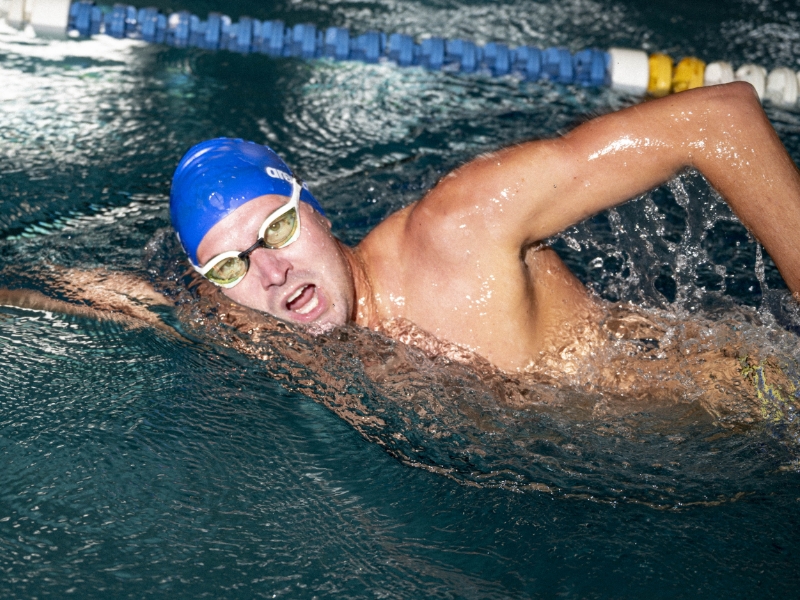
Romano Mombelli is used to pushing himself to the limit. The extreme swimmer and PhD student at the Jeremias Gotthelf Research Centre at the University of Bern takes on challenging open-water crossings, sometimes covering more than 40 kilometres, and trains up to twelve times a week during the peak season. But not everything can be planned – as his latest challenge in Hawaiʻi showed.
Bittersweet Hawaiʻi
Mombelli has a special history with Hawaiʻi. During his first attempt to cross the Kaʻiwi Channel between the islands of Molokaʻi and Oʻahu, he was forced to abandon the attempt due to burns and paralysis caused by jellyfish stings. Eleven years later, he returns – with considerably more experience in open-water swimming. Mombelli approaches his second attempt with more confidence and composure.
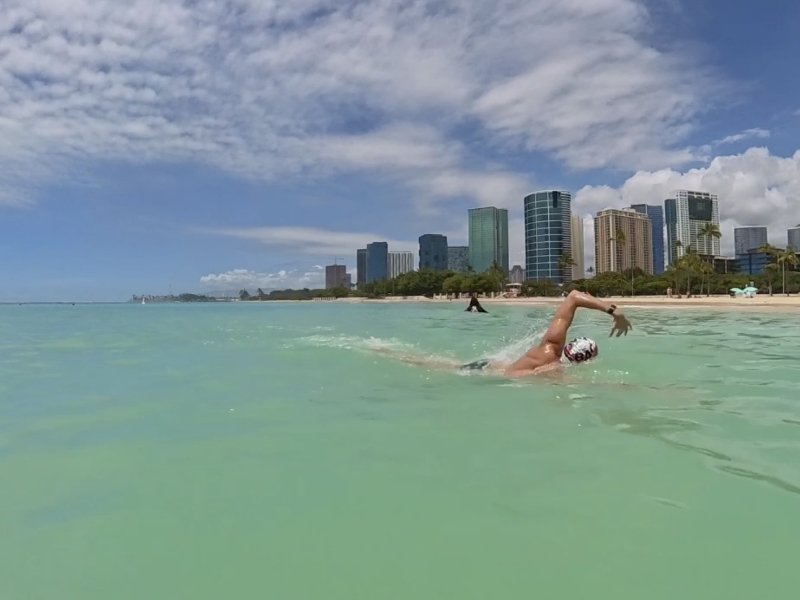
This time, his preparations, nutrition and collaboration with the support team are all on point. He has also become accustomed to the stings from jellyfish. However, the El Niño climate phenomenon and Hurricane ‘Lowell’, which had passed through shortly before, altered the conditions around the Hawaiian Islands. The north-easterly and easterly currents, which are absolutely essential for success, are failing to materialise. For 13 hours, Mombelli swims against the current.
“It’s like mountaineering. If the conditions don’t allow it, you sometimes have to abandon a project.”
Romano Mombelli
Even if he’d carried on swimming for another 30 or 32 hours, he reckoned he wouldn’t have reached the other shore. “It was hard to accept that nature is stronger. But I’ve made my peace with Hawaiʻi,” says Mombelli. Aborting the attempt felt different to his first attempt: “It’s like mountaineering. If conditions don’t allow it, you sometimes have to abandon a project.”
From the pool to open-water swimming
It wasn’t a foregone conclusion that Mombelli would seek out such challenges today. His sporting career began, quite traditionally, in the swimming pool. He competed in pool events right up until the end of secondary school. In his last two seasons as a pool swimmer, he reached the final of the 200-metre butterfly at the ‘Open de France’ on both occasions. Back home, he watched the race again on Eurosport and realised just how far he still was from the very best in the world, despite the already high level of training he was putting in. “You’re still 15 metres behind. How am I going to make up that gap?” he asked himself at the time. The next step would have meant training abroad and two to three sessions a day. At the same time, his university studies were drawing nearer. “Do I want to sacrifice that much?” he asked himself.
He’d had enough of ‘counting tiles’ – as Mombelli calls swimming in the pool – and was thinking of hanging up his swimming trunks for good. But there was one dream he still wanted to fulfil: to swim from Europe to Africa.
“When I arrived in Morocco, I said I’d never do anything like that again.”
Romano Mombelli
After a short training camp in Spain and with little experience of open water, he crossed the Strait of Gibraltar from Tarifa in Spain to Point Cires in Morocco. “When I arrived in Morocco, I said I’d never do anything like that again,” he recalls.
That resolution didn’t last long: open water had gripped him. As the Strait of Gibraltar is one of the ‘Ocean’s Seven’, a new goal presented itself at the same time. His retirement from competitive pool swimming led to his entry into extreme swimming.
Yet it is not just the distance and the thrill of pushing his limits that fascinate him about open water. During night-time crossings, bioluminescence sometimes makes the water glow. “It feels as if you’re floating through a starry sky. It really is magical,” says Mombelli. That’s why he often experiences his greatest moments of happiness in the water. However, it’s often only days after a crossing that he fully realises what he has achieved.
The contrast to studying
At first glance, extreme swimming and German studies could hardly be more different. For Mombelli, however, they are closely linked – and the sport also influences his academic work. In the water, he can switch off, let his thoughts wander and reflect on questions from his academic work: “A problem I can’t solve at my desk, I solve in the water”, adds Mombelli.
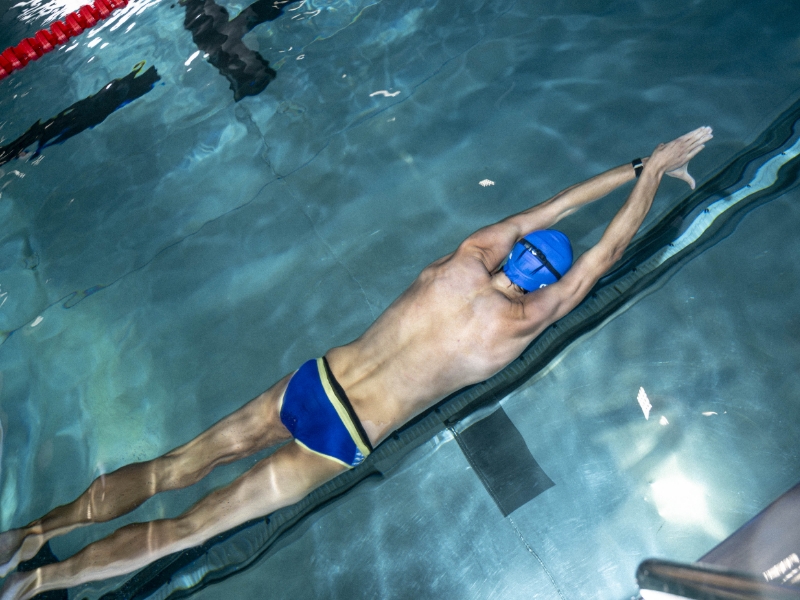
Ideas and possible solutions often come to him whilst training or during crossings. He takes these back to his desk with him – for his PhD thesis, for example, or for his work at the Jeremias Gotthelf Research Centre.
“A problem I can’t solve at my desk, I solve in the water.”
Romano Mombelli
To ensure there’s room for both, his daily routine follows a fixed structure. During the week, he often starts the day with a training session, then works at the university and trains again in the evening. He also plans his academic work for the long term: for his doctoral thesis, he has a fixed chapter structure and a timetable running until 2028.
Without flexibility, it wouldn’t work
“Without the flexibility that the University of Bern affords me, I wouldn’t be able to manage this level of training at all.” Mombelli’s training camps, competitions and crossings frequently take place abroad and cannot be fully accommodated within regular working hours. He can plan his holidays flexibly, and even in his day-to-day life there is scope for training in the mornings and evenings.
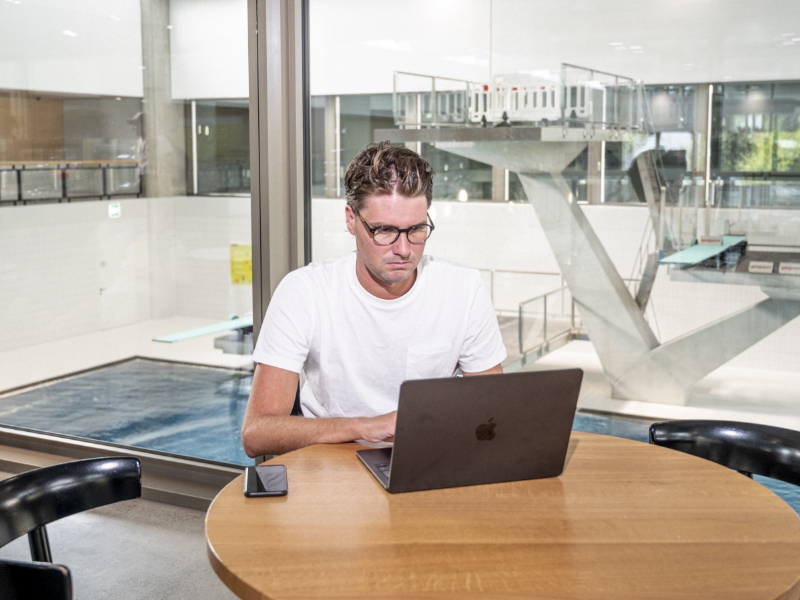
“That’s not something to be taken for granted,” says Mombelli. For him, this flexibility is based on mutual trust. In return, he must ensure that his work is completed, even if this means returning to his desk after the evening training session. He has never failed to meet agreed targets so far.
Mombelli does not decide alone how his sporting career will progress. However, it is already certain that the next goal is on the horizon. He is planning new projects and expeditions together with his support team. They assist him with organisation, nutrition, communication and preparation.
In terms of his research, the next major goal has already been set: Mombelli aims to complete his PhD thesis by early 2028.
Elite Sports and Academic Studies
The University of Bern supports elite athletes so they can balance their studies and sports as effectively as possible. Individual adjustments to the study plan can be arranged with the respective faculties.
Subscribe to the uniAKTUELL newsletter

Discover stories about the research at the University of Bern and the people behind it.

