Focus on Water Reserves
Copernicus Climate Dataset Benefits from Bern-Based Calculations
For the first time, the European climate service of Copernicus is providing a dataset that regularly tracks changes in the Earth’s water storage worldwide. Researchers at the University of Bern are providing crucial calculations for this effort.
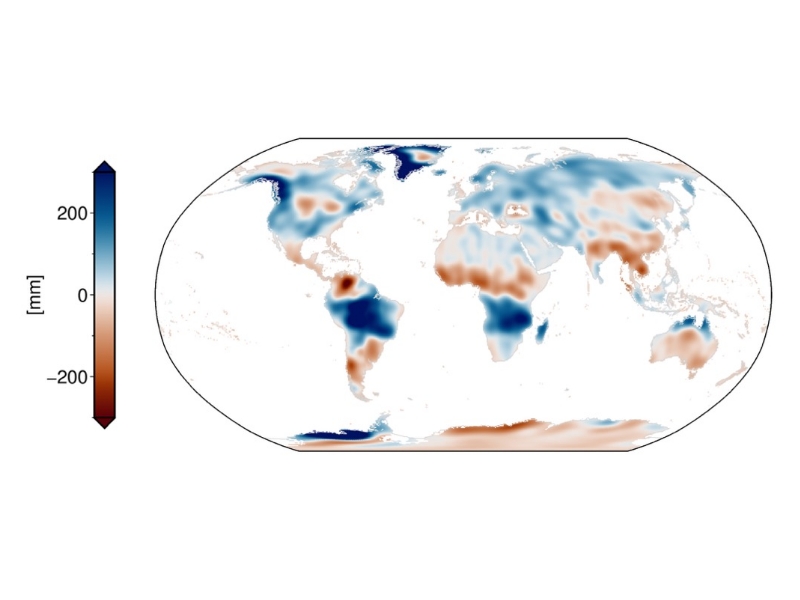
The climate service of the European Earth observation program Copernicus now offers a comprehensive dataset that documents changes in water storage worldwide. The data show how much the current volume of water in a region—in soils, groundwater, lakes, rivers, snow, and ice—deviates from the long-term average.
The University of Bern plays a central role in this effort: Researchers at the Astronomical Institute (AIUB) are providing key calculations for the dataset, which is now continuously updated and freely accessible via the Climate Data Store of the Copernicus Climate Change Service (C3S) (see info box).
Adrian Jäggi, co-director of the AIUB, explains: “The dataset is of great importance to anyone who needs to know where water is disappearing or increasing over the long term on a large scale across the Earth—for example, for weather and climate services, for decision-makers in politics and administration, for insurance companies and NGOs, as well as for climate research and hydrology.”
Satellites Measure Water Shifts
The Earth has an uneven gravitational field, meaning the force of gravity varies from place to place. This gravitational field changes when large volumes of water shift. Special satellite missions such as GRACE and GRACE-FO can measure these minute changes in gravity.

Jäggi says: “At the University of Bern, these measurements are used to create global gravity field models that show where water is decreasing or increasing on a large scale. To ensure these models are as robust and accurate as possible, the Astronomical Institute operates a combination center that integrates the models—based on slightly different approaches—from all international research groups in this field into a final model. This makes it possible to create maps that depict changes in water storage even more accurately compared to a long-term average.”
Significance for Climate Monitoring and Society
Water is essential for life, and climate change is significantly affecting the global water cycle: Droughts are becoming more frequent or more intense, glaciers are melting , and heavy precipitation and flooding are on the rise. To understand these changes and adapt to them, reliable and long-term comparable data are needed.
Jäggi says: “The new dataset helps identify regions that are losing water and supports policymakers and the private sector in planning irrigation and infrastructure. The data is therefore also of great importance for global climate monitoring.”
With the new Copernicus dataset, the University of Bern’s research findings are being integrated into a permanent European climate service. This improves the accessibility and reliability of the data for users worldwide. “The University of Bern is thus contributing directly to the Copernicus Earth observation program. It is doing so free of charge, as the work of Bern researchers on Copernicus will no longer be funded starting in 2023 because Switzerland is not participating in Copernicus,” says Jäggi.
The University of Bern is also involved in developing the data processing system for the next ESA gravity mission, scheduled to launch in 2032. Similar to GRACE/GRACE-FO, it will measure minute changes in Earth’s gravitational field, thereby providing an even more precise picture of how water and ice are changing on Earth. This will make it easier to detect changes in individual river basins, mountainous regions, or groundwater reservoirs and to determine long-term climate trends with greater certainty. “The goal is to establish a continuous, decades-long data series on changes in water and ice masses—as a solid foundation for climate research and climate policy,” says Jäggi. “In this way, the University of Bern is actively shaping the future of climate research and contributing to the monitoring of global water storage,” Jäggi concludes.
The Climate Change Service of the European Earth Observation Program Copernicus
The Climate Change Service (C3S) is part of the European Earth Observation Program Copernicus. It collects, aggregates, and analyzes data on the Earth’s climate—from satellite measurements, ground-based monitoring stations, ocean buoys, and climate models. The goal is to provide reliable information on how the climate and environment are changing worldwide. The data can be freely accessed via the Climate Data Store and is available to researchers, government agencies, the private sector, and the general public. C3S is operated by the European Centre for Medium-Range Weather Forecasts (ECMWF) on behalf of the European Union. The service is a central component of the European climate infrastructure and supports countries and organizations in monitoring climate change, better understanding risks, and planning measures for adaptation and protection.
More information: https://climate.copernicus.eu/
The Astronomical Institute of the University of Bern (AIUB)
The AIUB plays a leading role on the international stage in the fields of fundamental astronomy, satellite geodesy, and space weather. For example, the Bernese GNSS Software is developed in Bern—a scientific software package for the high-precision analysis of data from global navigation satellite systems (GNSS) such as GPS or Galileo. Today, this software is installed at over 800 institutions. In addition, the Center for Orbit Determination in Europe (CODE) and the Combination Service for Time-variable Gravity Fields (COST-G) are based in Bern; as operational analysis centers, they process data from all GNSS and gravity field missions, thereby providing the foundation for the new Copernicus C3S product.
More information: https://www.aiub.unibe.ch/index_ger.html
About the person

About the person
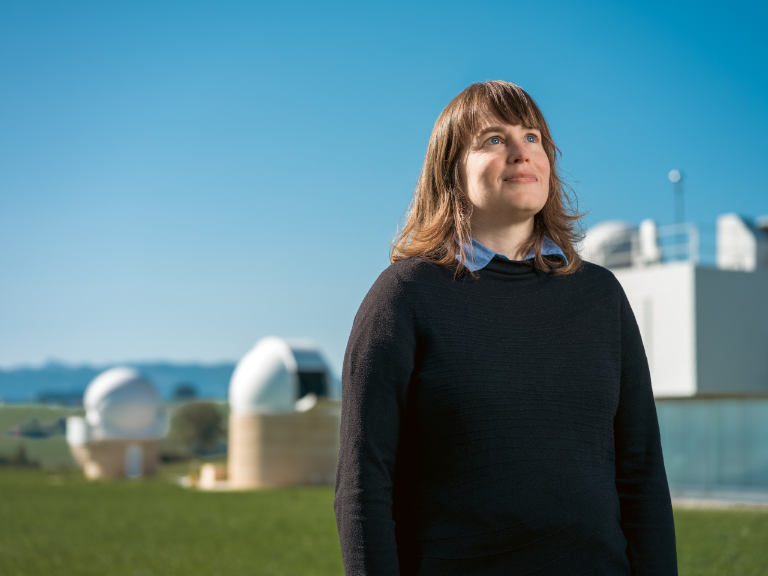
Adrian Jäggi is co-director of the Astronomical Institute at the University of Bern. After studying astronomy at the University of Bern, he served as a Carl von Linde Fellow at the Institute for Advanced Study at the Technical University of Munich. He has been back at the University of Bern since 2009, first as scientific director of the Satellite Laser Ranging activities in Zimmerwald and, since 2012, as director of the Institute of Astronomy. His research focuses on the precise determination of the orbits of artificial satellites and the associated determination of geophysically relevant parameters, such as the Earth’s gravitational field.
Contact
Prof. Dr. Adrian Jäggi Institute of Astronomy at the University of Bern (AIUB)
Direct phone: +41 31 684 85 96
Email: adrian.jaeggi@unibe.ch
Subscribe to the uniAKTUELL newsletter

Discover stories about the research at the University of Bern and the people behind it.