Biomedical Engineering
ARTORG Center: From Idea to Product
The Faculty of Medicine at the University of Bern is home to one of the University's strategic centers: the ARTORG Center for Biomedical Engineering Research. For 18 years, clinical practice, research and technology have been converging here to improve patient care.

Not far from the western train tracks lies the sprawling Bern University Hospital campus, a collection of buildings in a variety of architectural styles. This mix of historic clinics, new buildings and interim solutions, is home to almost never ceasing activities—clinicians, researchers, patients, students, visitors, university and hospital staff, and passers-by all mingle as they go about their business at the Insel Campus Bern. Well-represented and firmly rooted in this mixed environment is the ARTORG Center for Biomedical Engineering Research of the University of Bern.
A mastication simulator for testing dental implants
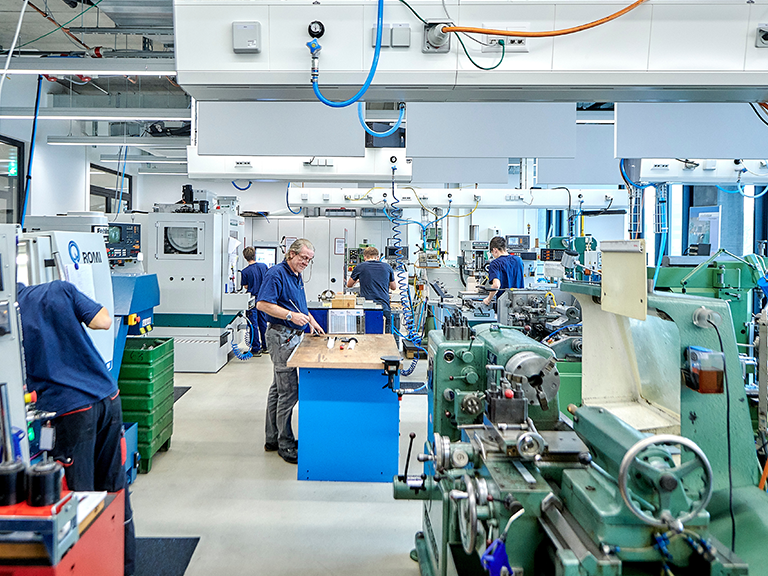
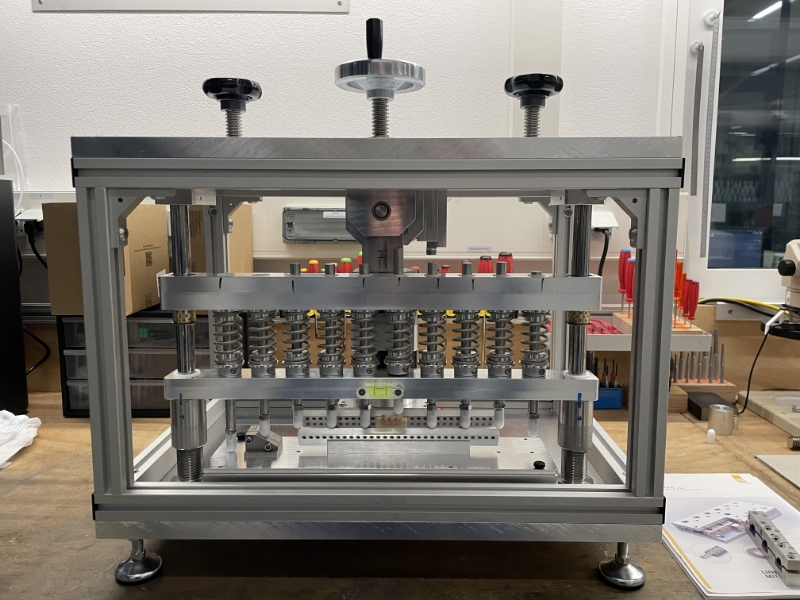
The ARTORG workshop is at the heart of what makes the center unique —and a key reason it can fulfill its role at the intersection of research and development. “In the ARTORG workshop, we turn scientific ideas into initial prototypes of medical devices,” explains workshop manager Ralf Kreienbühl. “For the Laboratory of Dental Digital Technology, for example, we developed a new mastication simulator for their studies. The entire design, the manufacturing of all components, and the assembly of the subassemblies were carried out in our workshop. The electronics were integrated with significant support from our Neuro Robotics’ E-Lab.” Thanks to the new mastication simulator, the laboratory at the University of Bern’s Dental Clinics can now test up to ten dental implants simultaneously for load-bearing capacity and stability.
Mechanical production is not where the role of the workshop ends. A key hallmark of the ARTORG Center is the training of apprentices in the profession of polymechanic EFZ at the workshop: “Our apprentices work here directly on complex medical research and development projects, thereby receiving training that goes beyond the traditional manufacturing skills of a polymechanic. This includes working with high-precision computer-controlled lathes and milling machines as well as modern CAD/CAM systems but also developing an understanding of the processing of biocompatible materials such as titanium, stainless steel, or engineering plastics used in medical products,” says Kreienbühl. “This combination of vocational training and applied medical technology produces highly qualified specialists—a valuable resource for Bern as an innovation hub.” In addition to ARTORG’s own research groups, the workshop’s clients include Inselspital, Bern University Hospital, medical technology spin-offs, and the Swiss Institute for Translational Medicine and Entrepreneurship (sitem-insel) with its numerous partners.
Building bridges between research and development
The ARTORG Center holds a unique position in the University of Bern’s Faculty of Medicine. Founded in 2008 as a strategic research center of the University of Bern and the Inselspital, the center was conceptualized as an Engineering Department within a Medical Faculty. Its mission: to shorten the path from the idea in the lab to the application at the patient's bed.
“ARTORG was founded to address a structural gap between medicine, engineering and clinical application,” explains Prof. Raphael Sznitman, Head of the Artificial Intelligence in Medical Imaging laboratory and Director of ARTORG. “From the beginning, the center was conceived not simply as a biomedical engineering research institute, but as a translational center dedicated to moving biomedical innovations into clinical practice and ultimately into real-world healthcare applications and the market.”
To accomplish this, ARTORG very early on invested into the necessary structures: the center employs dedicated people for regulatory and quality affairs, offers mentorship in business development and technology transfer, and has its own integrated mechanical production workshop as mentioned above.
Heart, the urinary tract, and AI
The research questions tackled at ARTORG directly arise from the limitations and challenges that clinicians face in daily patient care. These include, for example, effective and user-friendly monitoring and management of dietary needs and rehabilitation progress, non-invasive and patient-specific diagnostic tools, and efficient, precise surgical technology.
Originally, the research groups were structured according to research focuses related to organs—hence the name ARTORG, derived from “Artificial Organ.” For example, the Cardiovascular Engineering group primarily focuses on solutions for cardiovascular diseases, while the Urogenital Engineering group develops new technologies related to the urinary tract. This structure remains largely in place today, but the center’s interdisciplinary nature has led to the research of its now thirteen research groups increasingly adopting a cross-organ approach and expanding into areas such as artificial intelligence, robotics, computer-aided medicine, and digital health.
Prof. Dominik Obrist, Head of the Cardiovascular Engineering Group, sees this as a clear strength: “We’ve found that technologies for catheters, sensors, and implants that we’ve developed for one organ can also be applied to other parts of the body. This is extremely fruitful because it allows us to transfer a technology to new clinical fields.” In doing so, the research groups combine modern methods from sensor technology, imaging, simulation, robotics, data analysis, and materials science—always with the aim of addressing specific clinical questions and needs.
Where disciplines converge
Projects at ARTORG are designed from the outset for close collaboration: engineers, clinicians, biologists, as well as computer scientists, materials scientists, and life scientists develop solutions together. “Clinicians and engineers do not work in isolation from one another,” emphasizes Raphael Sznitman, “but are in constant dialogue about specific clinical problems, with clinical requirements directly influencing research questions, technology development, validation strategies, and pathways to clinical implementation from the very start.”
One such project is “DextEgg”—a new, interactive, sensor-based rehabilitation system for training fine motor skills in the clinic and at home. Because personnel resources are scarce in many clinics, training is increasingly shifting to everyday life at home—where, however, it is often perceived as monotonous and consequently quickly neglected or carried out only half-heartedly. DextEgg combines fine motor skills training with entertaining, motivating game exercises and software that allows therapists to remotely monitor and individually tailor their patients’ training plans. With support from a UniBE Innovation Grant and a UniBE Venture Fellowship, DextEgg is being developed by PhD student Nic Krummenacher and Venture Fellow Samuel Knobel in the Gerontechnology and Rehabilitation research group at ARTORG.

This collaborative aspect is also reflected geographically in the positioning throughout the Insel area, which also includes sitem-insel. This fosters a lively exchange between the center’s members and the Insel Campus community—ranging from spontaneous encounters in the cafeteria to joint research initiatives. Sznitman sees great value in the exceptionally close collaboration between ARTORG and Inselspital: “This proximity enables researchers to understand surgical and clinical workflows, while clinicians are actively involved throughout the entire innovation process. The result is a form of ‘lived interdisciplinarity,’ in which collaboration is embedded in everyday life rather than added on afterward.”
For Obrist, too, this proximity to Inselspital is central to successful research: “We have less difficulty than other universities in identifying the relevant problems and achieving results that go beyond scientific publications. This helps us make our work more results-oriented, meaningful, and ultimately more effective.” The Inselspital—and its patients—are always at the center of all these interactions.
How researchers become CEOs
The success of this collaboration depends largely on the people involved: “The projects implemented at ARTORG require a certain openness and willingness to understand the problems faced by clinicians and patients, rather than simply pursuing one’s own research interests. Genuine listening and responsiveness are key here,” emphasizes Dominik Obrist. The prospect of translating research into a product, a startup, or a clinically applicable technology fundamentally shapes how research projects are conceived and developed from the outset. Researchers must think beyond proof-of-concept science and consider early on how technologies can ultimately function within clinical workflows, regulatory frameworks, and real-world healthcare systems.
The integration of ARTORG into the Inselareal and sitem-insel complex has made the center a strong economic player: In the nearly 20 years since its founding, ARTORG has spawned 18 spin-off companies. These ensure that developed technologies and instruments actually find their way into clinical applications. These include, among others, CASCINATION AG and TightValve, which are developing, on the one hand, applications and instruments for imaging and robotic surgery for precision medicine, and on the other hand, a surgical instrument for measuring the tightness of heart valves during heart surgery.
Technologies that lead to such spin-offs usually begin as a doctoral student’s project or as part of a master’s thesis. To bring these technologies into practice, young researchers must think outside the box and position themselves in leadership roles. For this, they are exactly in the right place in Bern. “Together with the broader Bern Biomedical Engineering Network, this close integration between the University of Bern, Inselspital, and the engineering research infrastructure has established Bern as one of the leading centers for biomedical engineering and translational medical technology in Europe,” concludes Raphael Sznitman.
ARTORG Day 2026 – Celebrate with us!
On May 27, 2026, the ARTORG Center celebrates the successes of the past years, the remarkable breadth of research at the center, and the incredible people who have made this journey possible. The event highlights outstanding projects and pays tribute to the vision behind ARTORG as a strategic center of the University of Bern. Above all, ARTORG Day celebrates the young researchers whose passion and hard work continue to drive new technologies for better treatments and improved patient care.
About the person

Raphael Sznitman
is Professor of Artificial Intelligence in Medical Imaging and Director of the ARTORG Center for Biomedical Engineering Research at the University of Bern. His research interests lie primarily in the areas of computational vision, probabilistic methods, and statistical learning as they relate to applications in medical imaging.
About the person

Dominik Obrist
is Professor of Cardiovascular Fluid Mechanics and Head of the Cardiovascular Engineering Group at the ARTORG Center for Biomedical Engineering Research at the University of Bern. In his research, he combines physical modeling, numerical simulation, and experimental methods to better understand blood flow in the heart and blood vessels and to develop new medical technology solutions.
About the person

Ralf Kreienbühl
heads the mechanical workshop at the ARTORG Center for Biomedical Engineering Research. He is a trained polymechanic and has many years of experience in precision manufacturing for research and medical technology. Together with his team, he builds prototypes for research groups and clinical partners and trains apprentices in the polymechanic profession (EFZ).
Subscribe to the uniAKTUELL newsletter

Discover stories about the research at the University of Bern and the people behind it.