Is laughing allowed?
What a story about religious humor reveals
Throughout history, Jews, Christians and Muslims have laughed more at each other than with each other. A legend about three travel companions provides an insight into the background.
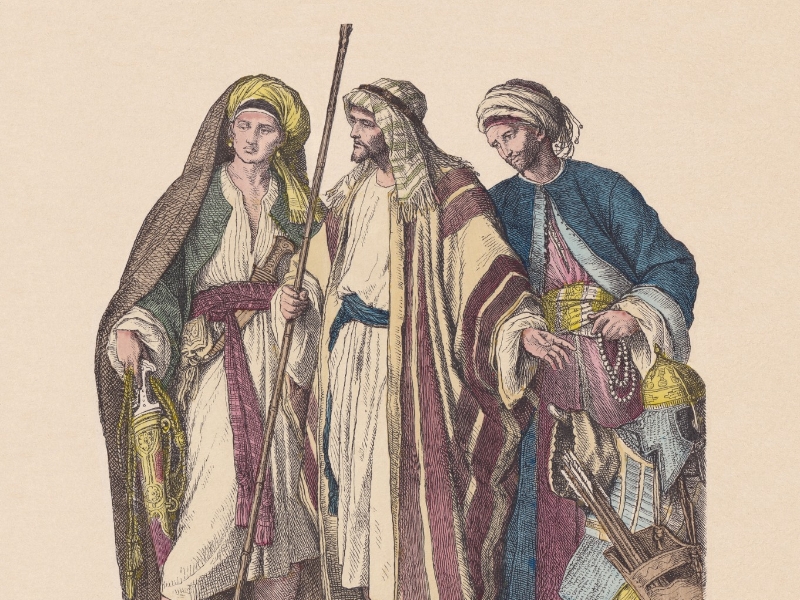
A Muslim, a Christian and a Jew are on the road together, find a coin and use it to buy a cake. The Jew suggests that the person who has the best dream at night should get the cake. In the morning, the Muslim recounts how Muhammad led him through paradise. The Christian tells the story of how Jesus showed him hell. The Jew says: “Moses took me by the hand and said: “Your Muslim travel companion is in paradise, your Christian travel companion is in hell. So you don’t need to worry – just eat the cake.’ And that’s what I did.”
Unclear origin and stereotypes
We do not know whether this story is a Jewish, Muslim or Christian invention. The version reproduced here can be found in a 19th-century Arabic collective manuscript, which is now kept in the Bibliothéque Nationale in Paris. Is it an example of the famous “Jewish humor”? Or a sarcastic polemic penned by Muslims or Arab Christians, which uses the polemic motif of the cunning Jew taking advantage of the religious sincerity of others?
This question confronts us not only with gaps in transmission and the limits of historical knowledge, but also with stereotypes about the three religions and their relationship to humor. The witty Jew who cunningly steals his way through life. The devout Christian whose fear of divine punishment prevents her laughter. The humorless Muslim who sacrifices his joie de vivre in the hope of a pleasurable paradise. It is also widely believed that Muslims and Christians suspect blasphemy behind every joke, while Jews are the masters of satirical sayings about their own God. Like all stereotypes, these are neither entirely accurate nor entirely coincidental.
A product of social conflict
The spectrum of humor is broad in all three religions. It ranges from liberating laughter about the inadequacies of life and self-deprecating distance from religious precepts through satirical distortions of one’s own and others’ notions of God and holiness to subversive sarcasm with regard to religious hopes and scornful mockery of others’ rules of life and notions of God. Christianity knows holy fools and Easter laughter in the church. Islam is rich in humorous narrative traditions. One of them claims that the wisdom teeth of Prophet Muhammad were visible when he laughed. And Jewish humor is probably also a survival strategy in the long history of oppression and persecution.
“ The laughing third party is not only a religious figure of fun, but also a product of social conflict.”
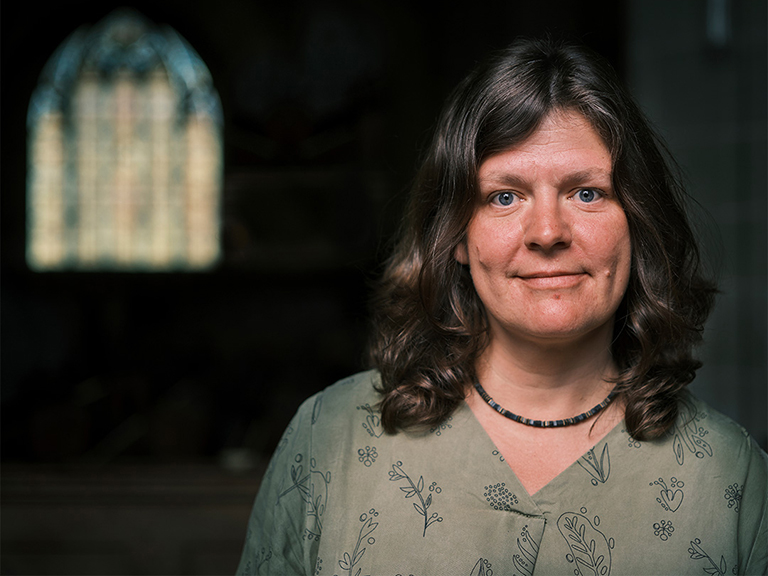
Katharina Heyden
A look at different versions of the story of the three hungry companions and their religious dreams sheds light on the ambivalent function and effect of humor in the entangled history of the three religions. Because the narrative plot is much older than the Arabic manuscript in Paris. The story has circulated in all three communities since antiquity and has been constantly adapted to suit respective humorous needs. This makes it one of many examples of how Jews, Christians and Muslims negotiate their rivalries in narrative traditions that they produce together. The laughing third party is not only a religious figure of fun, but also a product of social conflicts, as the sociologist Georg Simmel described in his works on the society-forming function of conflict.
Mockery as resistance to power
In a collection of Jewish parodies about Jesus, the “Toledot Yeshu”, dating back to the early Middle Ages, the three companions compete not for a cake, but for a roast. Jesus and his two disciples Judas and Peter are served a goose by their hostess. But Jesus says it is too small for three hungry eaters. So whoever has the best dream at night should get the roast for themselves. In the morning, Peter recounts his dream of him sitting next to the throne of the Son of God. Jesus replies: “I am the Son of God, and I dreamed that you would sit next to me. So I’m better in my dream than you are in yours, and the goose is mine.” But Judas simply says: “In my dream, I ate the goose.” And Jesus then discovers that this dream indeed came true overnight.
Magazine uniFOKUS

"Funny, isn't it?"
This article first appeared in uniFOKUS, the University of Bern print magazine. Four times a year, uniFOKUS focuses on one specialist area from different points of view. Current focus topic: humor.
Jesus appears here as a selfish and victorious type of ruler who stakes his claim not only to the roast, but also to infinite power, but in the end stands as a loser. This could be a subversive way in which Jews humorously responded to oppression under Christian rule.
However, this version of the story can only be found in a Latin source dating back to 1705. In his foreword, the Christian editor says that by publishing the satirical legends, he wants to make the “uselessness of the Jews” known to the public. So what may have functioned as subversive amusement about Christian rulers in the protected space of a Jewish community for many generations is eventually presented to the Christian public as dangerous blasphemy with an anti-Jewish twist. We know from both distant and recent history how quickly such accusations can turn into violence.
Superior modesty
Other Christians have turned the same narrative plot into an uplifting and exhilarating educational story. In a late medieval collection of exemplary stories of moral edification, the “Gesta Romanorum”, the story serves not only to reinforce claims to Christian superiority, but also to teach Christian modesty. This time the story focuses on a piece of bread. The first companion represents Saracens and Jews reveling in their religious dreams of paradise. The second companion is the rich Christian, who has to expect punishment in hell. Only the humble Christian emerges victorious from the religious battle for food. However: He cannot actually be all that modest as he was the one who invented the rules of the game.
Subscribe to the uniAKTUELL newsletter

Discover stories about the research at the University of Bern and the people behind it.
The most detailed and artistic version of the story is presented by the Persian poet Jalal al-Din Rumi (1207–1273) in his “Masnavi”. The object of desire is now a candy, Halva. This time, it’s the Muslim who proposes the dream contest. He has been fasting all day, while the Christian and the Jew have been eating. Therefore, the hungry Muslim suggests they share the cake. But the Christian and the Jew are so full and yet so insatiable that they refuse. They agree on the dream decision. In the morning, the Jew recounts how Moses led him to Mount Sinai, surrounded by a cloud of light. The Christian counters with the account of his being taken up with Jesus into the fourth heaven. The Muslim then justifies his nocturnal consumption of Halva by saying that Muhammad told him in a dream: “Oh, you who have been left behind by the other two and have experienced injustice, so you may as well get up and strengthen yourself with sweetness.”
Rumi writes for a Muslim readership in predominantly Muslim societies. In this context, the story of the laughing third party reads like a legitimization of the prevailing power relations. While Jews and Christians indulge in the most beautiful hopes of the afterlife, the Muslim should at least benefit in this life.
A reflection of social recognition
Judaism, Christianity and Islam have developed their ambivalent humorous potential in a long shared history with each other and against each other. Religious reference to a divine counterpart can promote humorous distance from oneself and the world, condemn any joke about God and his worship as blasphemy, or rise mockingly above those of other faiths. The potential of humor to unfold depends not only on individual levels of humor, but also on the social status and recognition of religious communities in a society.
About the person

Katharina Heyden
has been Professor of Ancient History of Christianity and Interreligious Encounters at the Faculty of Theology at the University of Bern since 2014. Together with historian David Nirenberg (IAS, Princeton), she launched the international research initiative “Interactive Histories, Coproduced Communities: Judaism, Christianity and Islam” and received an SNSF Consolidator Grant in 2023 for her research on religious co-production.
What makes you laugh?
“Situational comedy, self-irony and the memory of my sister not being able to tell me a joke on the phone because she was doubled-over laughing.”