
Forum for University and Society
"Our events are also social spaces"
The university is more than just teaching and research. In order to document its contribution to society, the Forum for University and Society (Forum für Universität und Gesellschaft, FUG) has been inviting participants to events for more than 20 years and successfully cultivating an exchange with the political leadership.
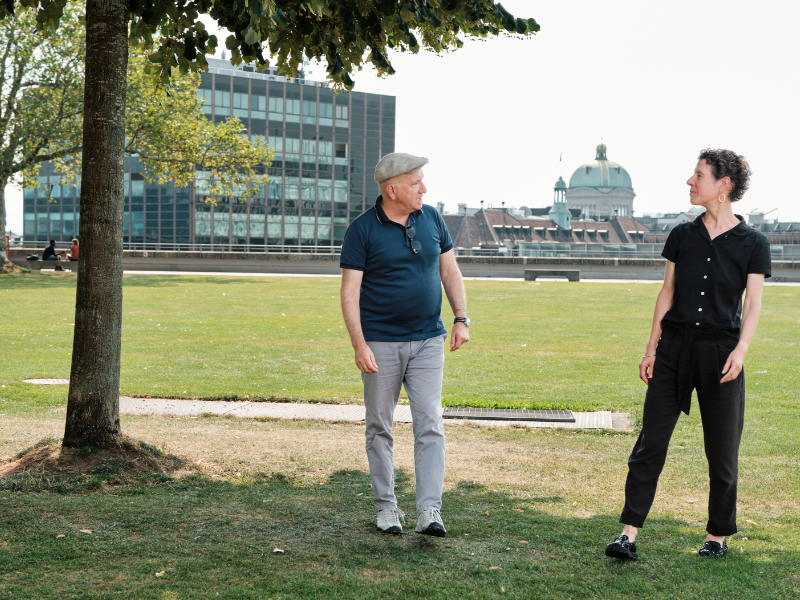
"Academic Commission," was the name given to an illustrious group that met regularly starting from 1987 at Villa Kocher in Bern to discuss the issues of the time. The group was limited to 40 to 60 people. With the establishment of the Academic Commission, the University of Bern fulfilled a request by the Executive Council of Bern to become more open to the outside world. After feasting their mind on a smorgasbord of intellectual conversation, a hearty dinner was served. And as was appropriate for such high-profile events, an academic book on the subject was published after each meeting – albeit after a two-year wait.
While the Academic Commission did fulfil the mandate given to it to the letter, after 15 years it was decided to modernize and open the type of event.
Current topics, close to the audience
The change took place in 2002: Already the name of the successor organization "Forum for University and Society" (Forum für Universität und Gesellschaft, FUG) promises an interest for new things and openness to the outside world. One aspect that has remained the same is the funding for the current three-person team at the office, which is divided into the equivalent of two full-time positions: Part of the annual budget comes from the income from the assets of the Stiftung für Universität und Gesellschaft (University and Society Foundation), which was founded on the occasion of the 150th anniversary of the University of Bern in 1984. The University of Bern provides the rest as part of a performance mandate.
“We offer the opportunity to talk to interesting people or to ask questions or raise issues to local politicians.”
Sarah Beyeler
Also unchanged is the equal representation different walks of life in the composition of the Forum: 15 people each come from business, politics and society, or from the university, who will be coming up with the topics for the next events. The focus topics are as diverse as our society: "Democracy and the Internet", "Culture as a challenge", and "The changing world of work" are just three examples from recent years.
This year's "Bern Forum Discussions" on the topic of "Mental Health" will run until mid-September. It takes a year and a half to two years before the focus topic is ready to be spread over three public evening events, which attract up to 200 people each.
Thinking Bern beyond the city
Ten years ago, on the proposal of the Forum, the University decided to seek dialog with society also outside the city limits of Bern and negotiated a corresponding performance mandate with the FUG. Since then, the team has complemented the topic discussed in the Bern Forum dialog with two "regional dialogs".
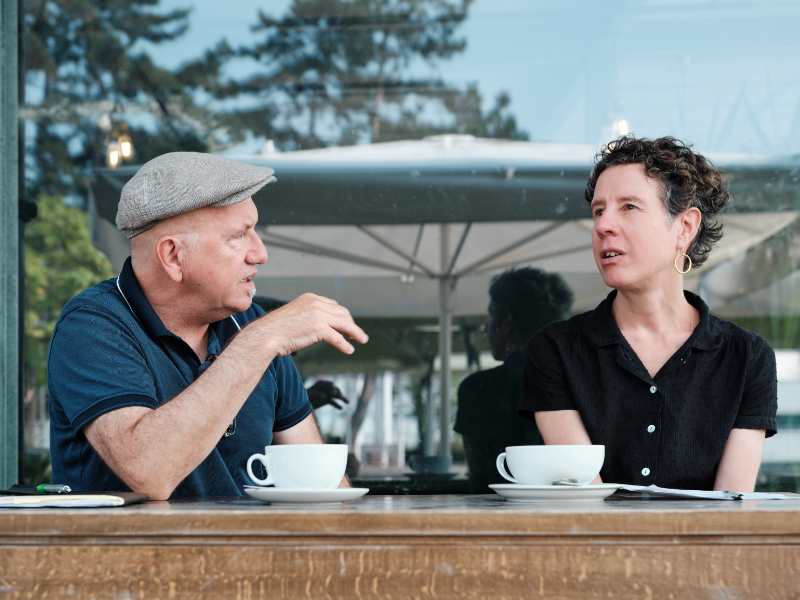
In these, a representative of the university and two or three experts from the respective Bernese region take to the podium. "This allows the regional aspect to be put on the agenda, but it is also quite simply an opportunity to talk to interesting people or to ask questions or raise issues to local politicians," is the experience of FUG employee Sarah Beyeler, who organizes these regional dialogs.
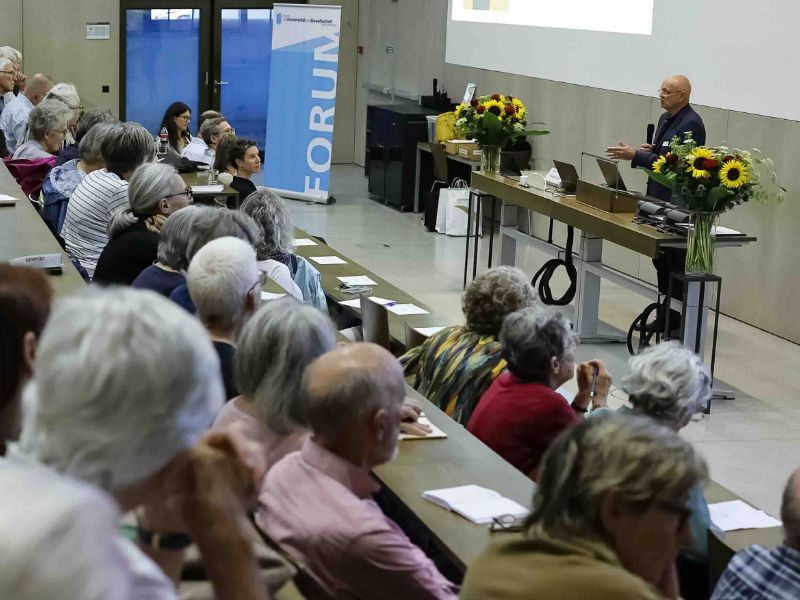
Going to Burgdorf or Thun also helps to reach new people who then sign up for the newsletter and thus ensure that interest in the events remains high. After all, keeping the visibility of and awareness for the event high is an important part of her work, Beyeler emphasizes: Some of those who supported the relaunch of the Forum a good 20 years ago are now over 80 years old. Accordingly, it is important to draw the attention of the baby boomers, who are now reaching retirement age, to the offer.
The variety of topics is an opportunity in this regard: New focal topics also mean new people and institutions to which advertising can be directed.
Care for a mealworm appetizer?
While the Forum events – whether in Bern or somewhere else in the region – always take place in the evening, the Forum projects, also organized by the FUG, are spread over three to five Saturday mornings. This time window allows more space to elucidate and discuss complex topics from different perspectives.
This year's series, titled "Crises, Conflicts, Wars – The World Order in turmoil", could not be more topical, even though it was set up in the spring of 2024. "We are aware that the timing of the event is not ideal for everyone," admits FUG Executive Director Marcus Moser. "Young people have other things on their minds on Saturday morning than listening to lectures and discussing challenging topics."
People with small children are busy with keeping the household running, students, for their part, stock up on sleep before heading out for the weekend. Therefore, the majority of attendants to the Forum projects on Saturday are seniors, but with 200 to over 300 participants the events are well attended. After the intellectual main event, an aperitif awaits the guests, which has long since become a social occasion with regular guests.
"Where possible, we don't limit ourselves to just lectures, but also try to include other dimensions," adds Sarah Beyeler. This was particularly successful in the Forum project on food trends: The audience was treated not only to the usual appetizers, but also sample roasted mealworms and meat substitutes. "We would very much like to do even more in this direction and supplement the program with the help of external partners or with visits on site," says Marcus Moser. "Unfortunately, the strict regulations from the Foundation restrict us in this respect."
A Bridge to the Grand Council
The FUG also wants to be a fixture on Bern's cantonal political landscape and therefore invites the cantonal councilors once per session to a "Dialog at Noon." The meeting from 12 o'clock to 1.15 p.m. is closely timed and includes a lunchtime lecture on current projects at the university.
The informal discussions that follow are at least as important as these insights into the goings-on at the university. "Of course, the parliamentarians need to return to parliament quickly. But there is always enough time to make a short inquiry or to make a contact," says Marcus Moser.
The response to the event, at any rate, is very positive: Up to 35 representatives of the people take part in the dialog. "And time and again I hear that people also come to the event for their own personal education," says Moser with delight.
“The digital documentation of our events is by no means a compulsory exercise for the archive.”
Marcus Moser
Whether the "Dialog at Noon," "Forum Project," or "Forum Discussions" all formats served to bring the university closer to society, business and politics and to put it in a good light.
It is still published today
The work for the FUG office is still not over even after the event has finished: The videos of the lectures are edited and posted online after a few days on the Forum's own YouTube channel. In addition, the team summarizes the lectures of the Forum projects in writing and later publishes a digital brochure in which the individual videos are embedded. "The digital documentation is by no means a compulsory exercise for the archive," Moser emphasizes. Some of the carefully designed documents were accessed up to 15,000 times.
What started out a bit sluggishly and rather academic over 40 years ago is now state-of-the-art and open to the whole of society.
The Forum for University and Society
The Forum for University and Society is a network of representatives from science and business/political practice. Its members, from various departments of the university as well as from politics, business and culture reflect the bridging function between the university and society. The forum makes expert knowledge available to the public by gathering, clarifying and evaluating the current knowledge on selected topics in series of events. The events of the Forum are open to the public, admission is free.
Subscribe to the uniAKTUELL newsletter

Discover stories about the research at the University of Bern and the people behind it.