
Innovative Teaching
The Treasure Chest Brings Statistics to Life
The IMPULS: LEHRE programme supports innovative teaching projects at the University of Bern. One of them is the “Treasure Chest”. It contains teaching formats designed to help students engage with the notoriously unpopular subjects of statistics and mathematics through real-world scenarios.
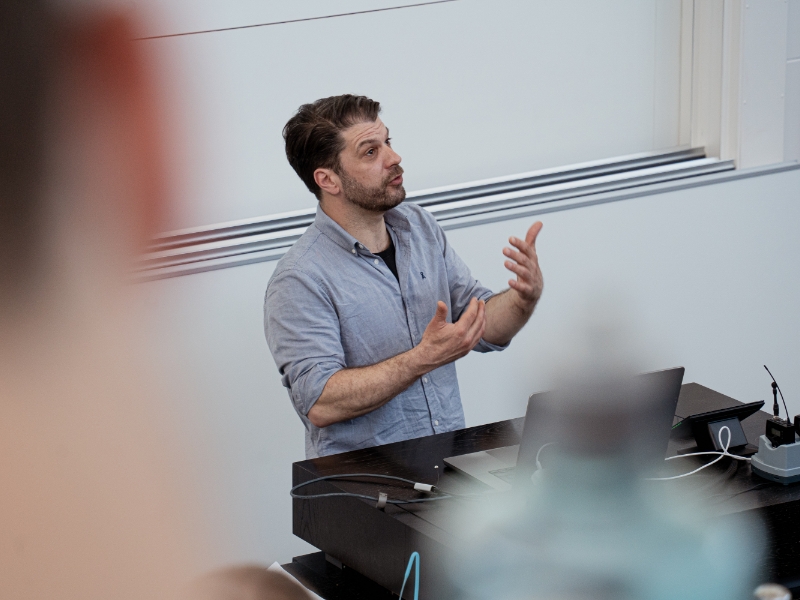
Every Tuesday from 1:15 to 3:00 PM, a statistics class takes place in the Haller Auditorium at the University of Bern. Within a quarter of an hour at most, the bachelor’s students in biology will have gathered here for a lecture by Stephan Peischl. “We statistics lecturers are well aware that our subject is not particularly popular with many students,” he observes. “That’s why today I’m placing statistics in an applied, biological context — using what we call a treasure from the Treasure Chest.”
The “Treasure Chest” was initiated by Professor of Statistical Data Science David Ginsbourger, together with mathematics lecturer PD Kevin Wildrick and Professor of Theoretical Physics Urs Wenger, with the aim of developing new, engaging teaching formats for statistics and mathematics. The “Treasure Chest” received support from the Vice-Rectorate Teaching through the IMPULS: LEHRE teaching promotion programme (formerly “FLE”), which enables the development of innovative teaching projects. The “Treasure Chest” is sustained by the diverse contributions of numerous participants, whose ideas, commitment, and expertise have been decisive in shaping it.
«Students should recognise early in their studies how important statistics is — and not just coast through it. Statistics is the central working method and shapes the way of thinking in their later professional fields.»
Stephan Peischl
“Many students still don’t understand what they need statistics for,” says Peischl. In some programmes within the natural, social, and economic sciences, statistics is a compulsory subject. Today’s lecture topic is base pairs: humans have 3.2 billion of them on the chromosomes in our cells. Crossover — the genetic recombination that occurs during the formation of sperm and egg cells — is a vital evolutionary process that generates genetic diversity.
In rare cases, however, it can lead to hereditary diseases. The class focuses on identifying so-called crossover hotspots: regions in the genome where crossovers occur more frequently than elsewhere. These hotspots help divide the genome into blocks and pinpoint exactly where on the chromosomes the genes responsible for a rare hereditary disease are located — and to calculate the probability of a person being affected by such a disease. Peischl develops his lecture around a topic from epidemiology: the study of how rare diseases occur within populations.
IMPULS : LEHRE
Implementing Innovative Teaching Projects — with Support from the Vice-Rectorate Teaching
Through the IMPULS: LEHRE promotion programme, the Vice-Rectorate Teaching (VRT) supports the implementation of innovative teaching projects aimed at achieving excellence in teaching. The programme is open to lecturers and others with responsibility for teaching. Projects that bring about concrete and lasting improvements in studies, introduce new teaching formats, or further develop existing teaching provision in terms of concept and pedagogy are eligible for support. The aim is to enable students to learn in ways that are effective, motivating, and future-oriented.
The students are already familiar with the subject matter from a content perspective. Today it is placed in a statistical context. The level is demanding, but Peischl explains things so clearly that the students pay attention, participate actively, and ask follow-up questions, which the lecturer welcomes. “You can tell how important it is to Mr Peischl that we understand the topics being discussed,” says biology student Tom Fässler during the break. “He explains things multiple times and in different ways, and even takes time during breaks to clear up any confusion,” says the 23-year-old, who is studying biology in his fourth bachelor semester.
Anyone working in a scientific profession will spend a great deal of time after graduating in front of a computer, working with datasets. This is another reason why Stephan Peischl is convinced of the value of this teaching format. “Students should recognise early in their studies how important statistics is — and not just coast through it. Statistics is the central working method and shapes the way of thinking in their later professional fields,” says Peischl. “This awareness might also lead a student to realise that they are in the wrong programme.”
Stephan Peischl, who holds a doctorate in mathematics, was brought on board by biology professor Claudia Bank for the “Treasure Chest”. Peischl is the ideal person to develop an innovative teaching format, says Bank. “He understands the difficulties involved in grasping statistics, but above all he brings memorable explanations — perhaps because he taught himself statistics.” Peischl has also, as a mathematician, worked extensively in areas of biology. For several years he was a lecturer in the Master’s programme in Bioinformatics.
Climate science students benefit too
Other lecturers are devising “treasures” for further disciplines: Senior Scientist and Lecturer Anja Mühlemann, for example, holds a doctorate in statistics and is based at the Institute of Mathematical Statistics and Actuarial Science (IMSV). She is currently using in her teaching a “treasure” developed by Bernese climatologist Lorenz Hilfiker on ice melt in the Baltic region. In the autumn semester 2026/27, she will be teaching statistics to climate science students. “It is not so easy to get hold of suitable datasets from climate research. Unlike the research findings themselves, the raw data often remain unpublished. Or they are simply too complex to use for illustrating more straightforward statistical methods,” says Mühlemann. There is often too little time to prepare those datasets in a way that makes them usable by others. “I am looking for different ways to bring statistics closer to students within their own field.”
Practical examples and applications from a student’s own field of study are valuable for breaking down the resistance that many students have to statistics, says Mühlemann. “That is why the Treasure Chest, developed by David Ginsbourger, is hugely welcome to me and, I think, to students as well.” One goal of the project is to prepare the individual treasures in a way that allows them to be used by other lecturers too. Ideally, datasets should also be found that are suited to illustrating a range of statistical methods and can run like a thread through a whole lecture course.
After the lecture, student Tom Fässler says he appreciates the new teaching format: “Mathematics is often too abstract for me, so that I sometimes lose track of what each variable stands for. Mr Peischl explained probability theory today using chromosome crossovers in a very concrete way. The applied teaching style definitely helps my understanding more than working with abstract variables.”
Subscribe to the uniAKTUELL newsletter

Discover stories about the research at the University of Bern and the people behind it.